Vietnam Report unveils top 50 prestigious, effective public companies for 2026

HDBank, VietinBank, LPBank, FPT Corporation, MBBank, Vinhomes JSC, VPBank, Vietcombank, Vietjet Air, and SHB topped the 2026 VIX50 ranking of the nation’s most prestigious and effective public companies.

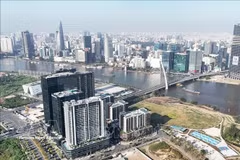
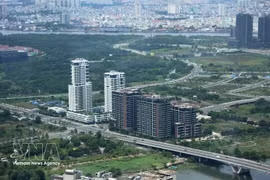
Illustrative image (Photo: VNA)

Hanoi (VNA) – The Vietnam Report JSC on June 2 unveiled the 2026 VIX50 ranking of the nation’s most prestigious and effective public companies, with the awards ceremony set for August in Hanoi.

Topping the list are HDBank, VietinBank, LPBank, FPT Corporation, MBBank, Vinhomes JSC, VPBank, Vietcombank, Vietjet Air, and SHB.

CEO of Vietnam Report Vu Dang Vinh said the ranking and a concurrent survey show that 70.2% of enterprises expect higher capital demand in 2026, as the economy enters a faster-growth phase. Ambitious targets, infrastructure expansion, industrial development, high-tech, digital transformation, energy, and domestic consumption are all fueling medium- and long-term funding needs.

Yet, the capital allocation structure remains imbalanced. The banking system, suited mainly for short- and medium-term financing, is overburdened, while strategic sectors demand stable, long-term, risk-tolerant capital. Vietnam’s credit-to-GDP ratio hit 145% in 2025. As of mid-May 2026, total outstanding credit approached 19.4 quadrillion VND (746 million USD), up 18.3% year-on-year.

A notable signal is the recovery of initial public offerings after years of subdued performance following the 2017–2018 boom. Based on announced plans, the IPO pipeline for 2026–2028 is estimated at roughly 47.5 billion USD, pointing to a new wave.

This cycle is driven by multiple tailwinds, including an impending market status upgrade, better trading infrastructure, and remarkable regulatory reforms to ease corporate fundraising. The Politburo’s Resolution 79-NQ/TW on State sector development and Decree 57/2026 on state capital divestment are expected to speed up state-onwed enterprises (SOE) restructuring and boost the supply of quality equity. Meanwhile, the Government’s Decree 245/2025/ND-CP slashes the post-IPO listing timeline from 90 days to just 30 days - a landmark reform.

At the same time, a growing number of companies are migrating from the Unlisted Public Companies Maarket (UPCoM) or the Hanoi Stock Exchange (HNX) to the Ho Chi Minh Stock Exchange (HoSE), seeking deeper liquidity, stronger valuations, and a broader investor base.

Vinh pointed to four factors poised to perform most positively, including public investment disbursement, performance of public companies, the operation of the KRX system (the Korea Exchange’s modern trading platform for Vietnam), new trading mechanisms, and continued legal improvements. The biggest downside risks are external uncertainties and cost pressures.

Public investment is the strongest growth driver, with 72.2% of surveyed firms expecting positive developments, far outpacing other factors. Faster disbursement directly benefits construction, materials, logistics, and industrial parks, while generating economy-wide spillovers that indirectly reinforce market sentiment.

First-quarter earnings already bolstered that confidence. Aggregate after-tax profits across the market jumped 39% year-on-year, anchoring investor sentiment. Profit growth remains led by banking and real estate, but positive signals are spreading. Consumer sectors, notably retail and tech, are improving thanks to market share gains and replacement demand. Cyclical industries like construction materials, oil & gas, and power generation retain positive momentum.

Beyond stronger earnings, the market looks to structural reforms. The KRX launch, new trading mechanisms, shorter settlement cycles, and a more transparent, business-friendly regulatory framework will boost liquidity and enhance the overall efficiency of Vietnam’s capital market./.
VNA

See more

Sellers learn about products at the event (Photo: VNA)

Amazon moves from sales channel to brand builder for Vietnamese exporters

With its strong manufacturing base, abundant raw materials, and rapidly growing digital commerce ecosystem, Vietnam can become a leading e-commerce export hub in Southeast Asia. Through platforms such as Amazon, Vietnamese products can not only increase export turnover but also gradually build globally competitive brands capable of conquering global markets.

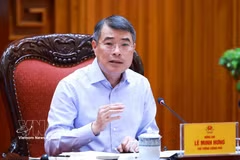
Prime Minister Le Minh Hung speaks at the meeting on the Vietnam International Financial Centre. (Photo: VNA)

PM orders breakthrough mechanisms for VIFC in June

VIFC development still faces challenges amid a complex global environment, with financial centres worldwide competing intensely for capital. As a late entrant, Vietnam must adopt sufficiently strong mechanisms and policies to attract investors while maintaining effective oversight, controlling risks, safeguarding macroeconomic stability and ensuring sustainable growth.

The Vietnam Chamber of Commerce and Industry (VCCI) releases the 2025 Business Law Flow Report on June 2, 2026. (Photo: VNA)

VCCI report points to unprecedented pace of business law reforms

A defining feature of the year was the Politburo's issuance of four major resolutions covering science, technology and innovation, international integration, law-making and law enforcement reform, and private sector development. VCCI said the resolutions signalled a broader shift in governance, with policymaking increasingly focused on enabling growth, fostering innovation and unlocking development resources.

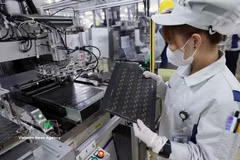
Production of printed circuit boards (PCBs) for electronic devices at the factory of Mektec Manufacturing Vietnam Co., Ltd, a Japanese-owned enterprise, in the Thang Long II Industrial Park, My Hao ward, Hung Yen province. (Photo: VNA)

Stronger local linkages key to unlocking greater value from FDI

Experts said Vietnam should introduce targeted incentives to attract investment in high-tech industries, renewable energy, green growth and the circular economy, while tightening screening of projects that are resource-intensive, environmentally damaging or generate limited added value.

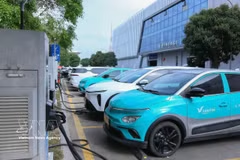
Electric vehicle charging stations and battery-swapping kiosks are becoming increasingly common across streets, parking areas and residential neighbourhoods in Hanoi. (Photo: VNA)

North – South Expressway expands EV charging infrastructure

ccording to the Department for Roads of Vietnam, the Vietnam National Petroleum Group (Petrolimex) is investing in nine rest stops. At the Mai Son–National Highway 45 rest area, 10 charging points have been installed on each side of the expressway. Each point has two charging ports, providing 20 EV charging spaces on each side.

Vietnamese durian is set to enter India’s 1.4-billion-consumer market. (Photo: VNA)

Vietnamese durian gains access to new markets

Le Anh Trung, Chairman of the Dak Lak Durian Association, said durian remains a relatively new product for Indian consumers. While the market is highly segmented, India has a large and growing middle- and upper-income population with the purchasing power to support premium fruit imports.

Children experience virtual reality technology at Nha Trang Centre shopping mall in Khanh Hoa province. (Photo: VNA)

Vietnam’s digital economy surpasses 72 billion USD in 2025: press briefing

The ministry reported that hi-tech exports accounted for 50.76% of the country’s total merchandise exports in the first quarter of 2026. Notably, Vietnam rose to 50th place in the 2026 Global Startup Ecosystem Index published by StartupBlink, climbing five positions from the previous year and achieving its highest ranking to date.