Deputy PM requests faster disbursement of ODA-funded projects

As of June 15, the disbursement rate for public investment funded by external sources had reached only 9.99% of the assigned plan. Although the figure was higher than in the same period last year, it remained well below the national average. Notably, one out of eight ministries and central agencies and 13 localities had yet to disburse any allocated capital.

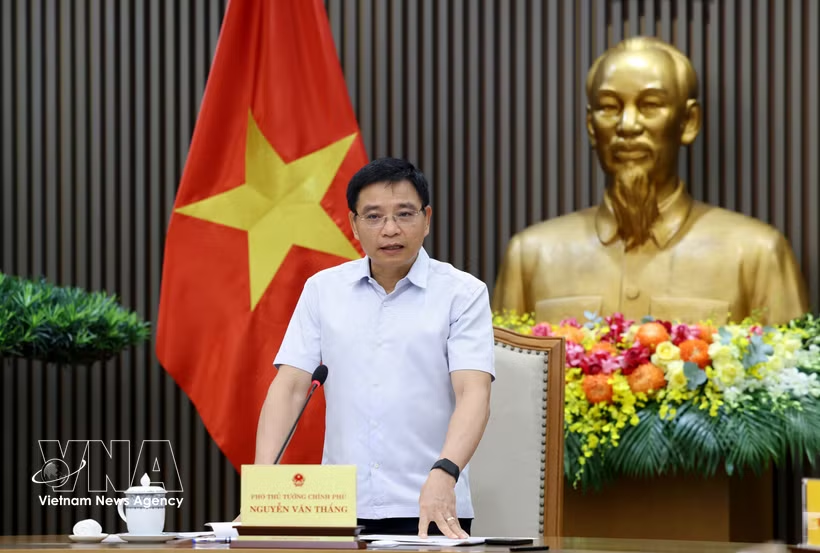
Deputy Prime Minister Nguyen Van Thang speaks at the meeting with ministries and sectors in Hanoi on June 17 to review public investment disbursement and address bottlenecks affecting ODA projects. (Photo: VNA)

Hanoi (VNA) – As official development assistance (ODA) is no longer concessional financing but increasingly structured as loans at commercial interest rates based on negotiations and agreements, Deputy Prime Minister Nguyen Van Thang stressed the need for a change in approach towards this source of capital and called for special attention to speeding up disbursement of ODA-funded projects.

Thang made the request while chairing a meeting with ministries and sectors in Hanoi on June 17 to review public investment disbursement and address bottlenecks affecting ODA projects.

According to the Ministry of Finance, in the first six months of the year, proposals for new ODA loans worth nearly 1.7 billion USD were approved, while procedures were completed for the signing of three foreign loan agreements valued at nearly 586 million USD.

However, as of June 15, the disbursement rate for public investment funded by external sources had reached only 9.99% of the assigned plan. Although the figure was higher than in the same period last year, it remained well below the national average. Notably, one out of eight ministries and central agencies and 13 localities had yet to disburse any allocated capital.

Opinions presented by the ministry and other agencies attributed the slow progress mainly to unresolved site clearance, delays in tendering and contract signing, prolonged project preparation and implementation, inconsistencies between domestic procedures and donor requirements, and investment plans in some localities that did not reflect actual implementation conditions.

Concluding the meeting, Thang underlined that achieving ambitious growth targets would require stronger performance from traditional growth drivers, namely investment, exports and consumption. Within investment, ODA and concessional foreign loans remain an important source of financing.

For projects already under implementation, he instructed governing bodies and project owners to prioritise completing land clearance to enable construction works to proceed, adding that heads of agencies would bear full responsibility before the Government and the Prime Minister for implementation progress.

For new projects, he proposed that land clearance should either be carried out in parallel with or ahead of loan negotiations and agreement signing, so that construction could commence immediately once the loan became effective. He also suggested considering separating land clearance components from projects financed by foreign loans where appropriate.
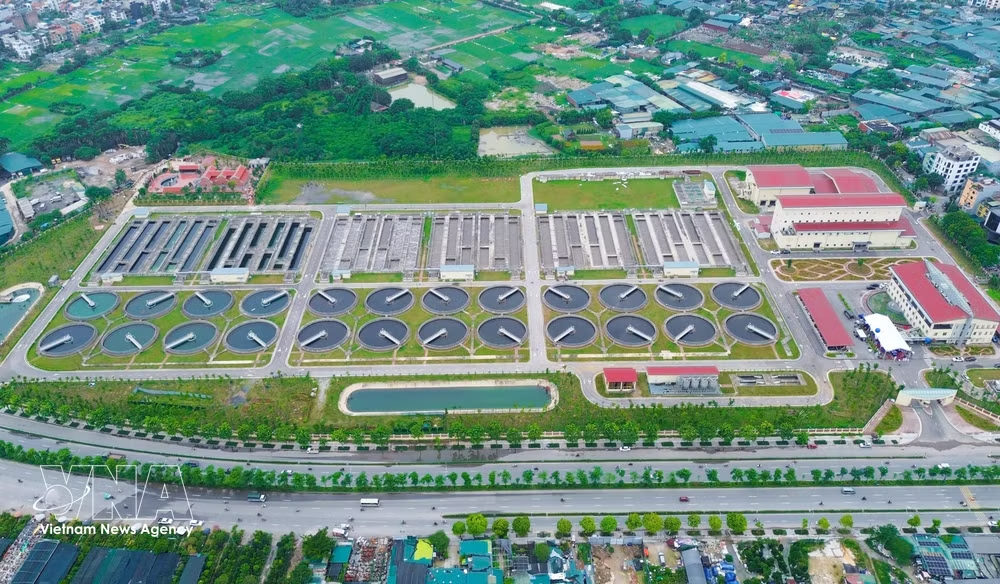
vnanet-wastewater-treatment.jpg
The Yen Xa wastewater treatment plant project funded by the Japan International Cooperation Agency (2013–2025) aims to improve living conditions and restore the natural ecosystem. (Photo: VNA)

The Deputy PM tasked the Ministry of Finance with prioritising ODA resources for major projects, large-scale loans and budget support operations.

He also requested the Ministry of Finance to propose revisions to regulations governing medium-term and annual capital planning to remove obstacles affecting public investment projects financed through foreign capital.

Meanwhile, the Ministry of Foreign Affairs was instructed to provide the Ministry of Finance with detailed information on challenges faced by foreign donors in ODA and concessional loan projects before June 20, and coordinate efforts to resolve outstanding issues.

Ministries, ministerial-level agencies and local authorities, meanwhile, were requested to implement synchronised measures in line with the PM’s directions on monetary and fiscal policy management for 2026 and the review and adjustment of public investment plans, while reporting matters beyond their authority directly to the Government leader./.
VNA

See more

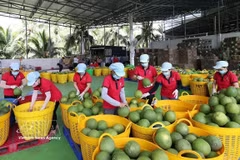
Sorting green-skinned pomelos for export at the processing facility of Vina T&T Group in Vinh Long province. (Photo: VNA)

Vietnamese fruits strengthen foothold in China

The expansion of fruit trade has been supported by the implementation of the Regional Comprehensive Economic Partnership (RCEP) and ongoing efforts to upgrade the China – ASEAN Free Trade Area.

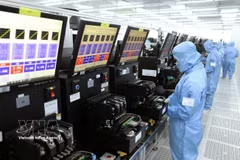
Production line for camera modules and electronic components at the factory of the Korean-invested MCNEX VINA Co., Ltd, located in Phuc Son Industrial Park, Ninh Binh province. (Photo: VNA)

High-tech FDI attraction set as strategic priority: official

The resolution sets out a number of specific targets for foreign investment attraction during the 2026–2030 period. Annual registered FDI is targeted at between 40 billion USD and 50 billion USD, while realised capital is expected to reach approximately 30–40 billion USD per year.

Production of electronic components at DBG Technology Vietnam Co., Ltd. in Yen Binh Industrial Park, Thai Nguyen province. (Photo: VNA)

Vietnam’s trade surplus with EU expands amid economic headwinds

Trade between Vietnam and the EU maintained momentum during the January–May period, supported by the EU – Vietnam Free Trade Agreement (EVFTA) and sustained demand for key Vietnamese exports, even as the EU grappled with inflationary pressures and sluggish consumer spending.

Containers are unloaded at Nghi Son International Port in Nghi Son ward, Thanh Hoa province. (Photo: VNA)

Vietnam eyes to shape national maritime industrial ecosystem

These advantages provide a strong foundation for the development of the marine economy and logistics services. As a result, the marine economy has been identified as a national strategic priority, with the coordinated development of maritime transport, seaports and shipbuilding serving as a key pillar in shaping a sustainable national maritime industrial ecosystem.

The road to the VSIP Can Tho Industrial Park connecting with National Highway 80 is under construction. (Photo; VNA)

Vietnam draws harder line on FDI quality under new resolution

The Ministry of Finance’s Foreign Investment Agency reported that total registered FDI neared 25 billion USD in the first five months of this year, a jump of almost 35% from a year earlier, with new project registrations driving the bulk of the expansion.

According to Fortune’s latest list, Vinachem ranks 148th among Southeast Asia’s top 500 companies in 2026. (Photo: vinachem.com.vn)

Vinachem makes Fortune Southeast Asia 500 for the first time

According to Fortune’s latest list, Vinachem ranked 148th among Southeast Asia’s top 500 companies in 2026. The ranking is compiled using key financial indicators including revenue, profit and total assets, and covers enterprises from seven regional economies, namely Vietnam, Indonesia, Thailand, Malaysia, Singapore, Philippines and Cambodia.

Lien Khuong International Airport in the central province of Lam Dong (Photo: VNA)

Lien Khuong Airport expected to reopen in August

The project is invested by ACV, with a total investment of over 1 trillion VND (38 million USD), including the repair of the entire runway, taxiways, safety strips, and technical infrastructure and equipment to ensure flight operations.

Representatives of Ho Chi Minh City's tax agency address concerns and clarify tax-related issues raised by the FDI business community. (Photo: VNA)

Ho Chi Minh City moves to ease tax hurdles for FDI firms

The Ho Chi Minh City tax agency said it will maintain regular dialogue with businesses, push ahead with administrative reform and digital transformation, and identify implementation bottlenecks to recommend policy adjustments, facilitating investment and business activities for FDI enterprises.

A workshop on the Halal market is held in Ho Chi Minh City on June 16, 2026. (Photo: VNA)

Growing Halal market offers opportunities for Vietnamese businesses

The Halal market is becoming a promising avenue for businesses in Ho Chi Minh City. With its well-developed manufacturing, trade and service ecosystem and dynamic business community, the city is well positioned to strengthen its role in regional and global Halal supply chains.