Ho Chi Minh City moves to ease tax hurdles for FDI firms

The Ho Chi Minh City tax agency said it will maintain regular dialogue with businesses, push ahead with administrative reform and digital transformation, and identify implementation bottlenecks to recommend policy adjustments, facilitating investment and business activities for FDI enterprises.

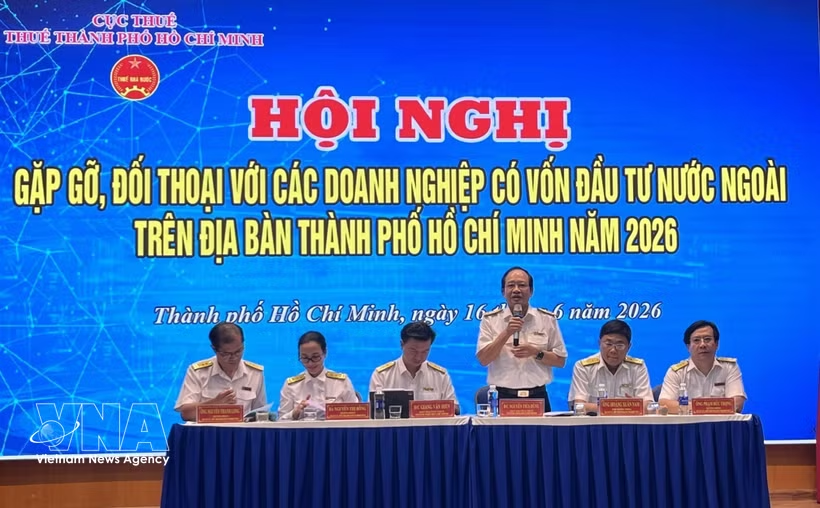
Representatives of Ho Chi Minh City's tax agency address concerns and clarify tax-related issues raised by the FDI business community. (Photo: VNA)

Ho Chi Minh City (VNA) – Ho Chi Minh City's tax authority has pledged continued support for foreign investors by addressing tax-related bottlenecks and improving the business climate, in line with the Politburo's newly-issued resolution on developing the foreign-invested sector.​

At a dialogue conference with foreign direct investment (FDI) enterprises on June 16, Doan Minh Dung, head of the Ho Chi Minh City tax agency, said the Party and State regard the FDI sector as a vital pillar of the economy, contributing to growth, economic restructuring and deeper global integration.

He noted that the city's tax sector has intensified support measures in recent years, particularly after the rollout of the two-tier local administration model, helping businesses navigate challenges, maintain operations and expand production.

Those efforts, combined with the contributions of the business community, have helped sustain robust budget revenue growth. The city has so far collected 332.77 trillion VND (12.65 billion USD), surpassing 53% of the Government's annual target and marking a 13.12% increase from a year earlier.

​Dung said FDI firms are also confronting new challenges arising from the rapid expansion of the digital economy, e-commerce, cross-border business models and increasingly complex global supply chains. Against this backdrop, the conference focused on key concerns such as value-added tax (VAT) refunds, corporate income tax incentives and new provisions under the Law on Tax Administration that will take effect from July 1.

He underscored the tax authority's transition from a "management" approach to a "taxpayer serving" mindset, with businesses placed at the centre of service delivery. The agency aims to promptly address concerns and recommendations from the FDI community through timely guidance and practical solutions.

The city will continue streamlining administrative procedures, accelerating digitalisation and improving service quality to help businesses fulfil their tax obligations more quickly, accurately and efficiently, he added.

The message comes shortly after Resolution No. 10-NQ/TW on the development of the foreign-invested sector was signed for promulgation by Party General Secretary and State President To Lam on June 8.

Vu Thi Thu Huong, Vice Chairwoman of the Vietnam's Association of Foreign Invested Enterprises (VAFIE), commended the city's tax authority for its open engagement with FDI businesses.

She said support from tax officials extends beyond dialogue events, with specialists regularly assisting enterprises in completing procedures, clarifying regulations and resolving emerging tax issues.

​According to Huong, VAT refunds, tax incentives and transfer pricing remain the top concerns among FDI businesses. Delays in VAT refunds, in particular, can directly affect cash flow, especially for firms that must report refund progress to their parent companies overseas.

She called for more flexible measures to shorten processing times while maintaining oversight and risk management.

FDI enterprises also sought clearer guidance on corporate e-identification requirements, eligibility for the 0% tax rate on exported services, and deductible expenses related to land leases and housing allowances for foreign experts.

The Ho Chi Minh City tax agency said it will maintain regular dialogue with businesses, push ahead with administrative reform and digital transformation, and identify implementation bottlenecks to recommend policy adjustments, facilitating investment and business activities for FDI enterprises./.
VNA

See more

Wave Alpha, Honda Vietnam’s best-selling manual motorcycle model each month. (Photo: Bnews/VNA)

Honda Vietnam posts strong car sales growth, leads motorcycle market

The company sold 172,299 motorcycles in June, up 4.7% from the same month last year, highlighting steady consumer demand even as the market gradually shifts towards greener transport options. For the first six months of 2026, motorcycle sales reached 515,743 units, up 0.6% year-on-year.

Rice harvest in Xuan Giang commune, Ninh Binh province. (Photo: VNA)

Plan issued to develop agricultural logistics system

A key target is that by 2030, all concentrated agricultural, forestry and fisheries production areas will have access to essential services, including product traceability, quarantine, testing, quality certification, processing and market development. The move reflects growing international demand for stricter food safety, quality and traceability standards, which have become increasingly important for agricultural exports.

Delegates at the signing ceremony (Photo: VNA)

Vietnam, RoK boost micro-business cooperation

Vietnam's young population, dynamic market, and big growth potential are a perfect fit for the strengths that Korean micro-businesses bring in K-brands, technology, and service expertise, said KFME President Song Chi Young.

Cars at a public parking lot in Hai Phong city. (Photo: VNA)

Vietnam's auto sales rise 15%, hybrid, imported vehicles continue to outperform

With auto loan interest rates remaining competitive, stable vehicle supply, and an increasingly diverse product range, Vietnam's automotive market is expected to maintain its growth momentum through the remainder of 2026. SUVs, MPVs, and hybrid vehicles are likely to remain the main drivers of overall market sales.

The MoU signing ceremony between Becamex VSIP Binh Dinh and PV Gas CNG in Gia Lai province on June 26, 2026 (Photo: nhandan.vn)

Gia Lai positions itself as magnet for sustainable investment

Vice Chairman of the provincial People's Committee Nguyen Huu Que said ESG is no longer a communications message or a cost burden, but an essential requirement for accessing global capital. Gia Lai has chosen ESG as a pillar for building new competitive advantages and achieving sustainable development.

Chairman of the Tay Ninh provincial People's Committee Le Van Han delivers remarks at the inauguration ceremony. (Photo: VNA)

Suntory PepsiCo inaugurates 300-million-USD plant in southern Tay Ninh province

Built on nearly 20 hectares at Huu Thanh Industrial Park, the facility is the company's largest and most advanced plant in Vietnam and the biggest production site in Suntory PepsiCo's Asian manufacturing network. The factory has a designed annual production capacity of over 1.24 billion litres and is equipped with highly automated production, filling and warehousing systems.

Ho Chi Minh City inaugurates a UAV postal route linking Can Gio commune and Vung Tau ward on February 12, 2026. (Photo: VNA)

Ho Chi Minh City promotes UAV applications to develop low-altitude economy

With its enlarged development space, Ho Chi Minh City now combines strengths in urban development, industry and services with high-tech agriculture, the marine economy, logistics and diverse ecological areas. These conditions provide an ideal testing ground for UAV applications in urban management, land administration, environmental monitoring, disaster prevention and response, agriculture, logistics and public services.

Workers produce outdoor wooden furniture for export to Europe at the factory of Hong Ngoc Co., Ltd. in Phu Tai Industrial Park, Quy Nhon Bac ward, Gia Lai province. (Photo: VNA)

Vietnam's wood exporters race to stay on growth path

Despite headwinds from Middle East tensions that have pushed up freight and logistics costs, exports of wood and wood products were estimated at 1.53 billion USD in June, lifting first-half export turnover to 8.54 billion USD, up 4.4% from a year earlier, according to the Ministry of Agriculture and Environment (MAE).

Workers make clothes for export to the Japanese market at Hung Viet Garment Company in Hung Yen province. (Photo: VNA)

Vietnam seeks stronger export growth in H2

Despite the encouraging performance, Vietnam's exports remain heavily dependent on a limited number of major markets and product groups, while the domestic value added of many export products remains relatively low because of their reliance on imported raw materials and components.

Hiep Phuoc Industrial Park in Hiep Phuoc commune, Ho Chi Minh City. (Photo: VNA)

Ho Chi Minh City: Industrial, export processing zones attract over 2.6 bln USD in H1

Speaking at the at the city's regular socio-economic press briefing on July 9, Deputy Head of the Ho Chi Minh City Export Processing and Industrial Zones Authority (HEPZA) Tran Viet Ha said that foreign direct investment (FDI) accounted for nearly 1.6 billion USD of the total, including 65 newly licensed projects worth more than 867 million USD and 83 existing projects that added over 707 million USD in registered capital.