Hanoi (VNA) – Vietnam’s agricultural product traceability system has been rolled out in 26 of the country’s 34 provinces and cities, covering 18,500 products across 112 categories as of June 12, 2026.
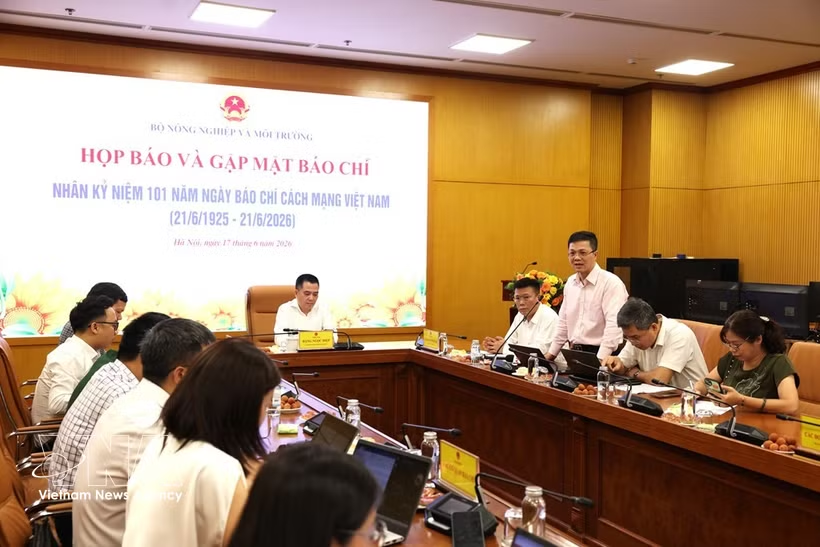
The system currently manages 919 consignments from 547 farming households, 255 cultivation areas and 149 enterprises, according to Nguyen Van Long, Director of the Department of Science and Technology under the Ministry of Agriculture and Environment (MAE), at the ministry’s press briefing on June 17.
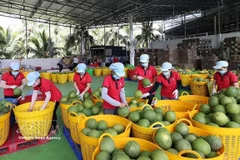
Long said that by May 10, three containers of durian had been successfully exported to China with full traceability information recorded through the platform, marking an important step in enhancing transparency and market access for Vietnamese agricultural products.
The MAE is working with businesses to expand the system from July 1 to a range of key commodities, including rice, meat, eggs, milk, pineapple, passion fruit and tea. Participating companies are expected to include major firms such as ThaiBinh Seed, Loc Troi, Masan and Dabaco, along with tea producers in Thai Nguyen province.
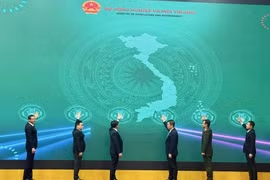
Launched on December 26, 2025, the traceability platform is operating steadily through dedicated online portals (https://traceviet.mae.gov.vn/ and https://txng.mae.gov.vn/) and is being complemented by a mobile application to facilitate participation by farmers and businesses.
In the coming period, the ministry plans to seek the Prime Minister’s direction for nationwide implementation of the system across ministries, sectors, localities and enterprises. Efforts will also focus on improving data connectivity, interoperability and verification while refining technical guidelines, operational procedures, data standards and information-sharing mechanisms.
The system will be gradually expanded to cover additional key agricultural products to support supply chain management, domestic distribution and exports. Training programmes will be increased for local authorities, enterprises, cooperatives and producers. Cooperation with industry associations and international partners will be enhanced to promote data recognition and connectivity, helping improve the competitiveness of Vietnamese farm produce in global markets.
The MAE will also work with the Ministry of Public Security, the Ministry of Science and Technology, the Ministry of Industry and Trade, and the Ministry of Health to integrate the agricultural traceability platform with relevant national databases and digital systems in line with regulations./.
See more
Trust seen as a defining asset for business success in AI age
In an era increasingly shaped by artificial intelligence, technology may accelerate growth and data may generate competitive advantages, but long-term business success ultimately depends on trust.
Vietnam emerges as ASEAN growth engine after 30 years of integration
Beyond trade, Vietnam has gradually shifted from being a beneficiary of regional integration to a contributor to ASEAN’s future development.
Vietnam, Brazil seek to step up cooperation in renewable energy
Vietnamese Ambassador to Brazil Bui Van Nghi said climate change and energy transition have become urgent global challenges while also serving as key drivers of green growth and economic competitiveness.
Reference exchange rate drops slightly on June 18
The State Bank of Vietnam set the daily reference exchange rate at 25,173 VND/USD on June 18, down 2 VND from the previous day.
Hon Khoai transport project gathers pace despite rainy season challenges
Together with the Ca Mau – Cai Nuoc and Cai Nuoc – Dat Mui expressway projects, the Hon Khoai route forms part of a trio of key infrastructure developments expected to strengthen regional connectivity, boost economic growth and reinforce the safeguarding of Vietnam’s southwestern maritime frontier once completed.
Prime Minister meets leaders of major Russian enterprises
During his meeting with Rosatom Director General Alexey Likhachev, PM Hung expressed his sincere thanks for the cooperation, support, and significant contributions of Rosatom and the Russian side to the development of Vietnam's atomic energy sector over the past four decades.
Vietnam, Russia forge stronger trade, investment collaboration
Building on the Comprehensive Strategic Partnership established in 2012, economic, trade and investment cooperation between Vietnam and Russia continues to expand, creating fresh momentum for businesses on both sides.
Thanh Hoa seeks stronger cooperation with Thai businesses
Mai Xuan Liem, Permanent Vice Chairman of the Thanh Hoa People’s Committee, said Thailand is one of the province’s important export markets, with export turnover reaching more than 12 million USD in the first five months of 2026.
Vietnam, Thailand strengthen investment ties, smart city cooperation
Thailand is currently Vietnam's largest trading partner within ASEAN, while Vietnam ranks as Thailand's sixth-largest trading partner globally. Bilateral trade reached 22.07 billion USD in 2025, with both sides aiming to increase the figure to 25 billion USD in the coming years. Thailand also has 805 valid investment projects in Vietnam with a combined registered capital of 15.4 billion USD.
Over 850 exhibitors join Vietnam’s leading manufacturing, automation fairs
The VIMF and VIAF 2026 showcase the latest technologies and solutions in manufacturing engineering, precision machining, industrial equipment, automation, robotics, artificial intelligence (AI), production management systems and smart logistics.
PM highlights supply chains, energy, innovation as priorities for ASEAN-Russia cooperation
Vietnam particularly welcomes and stands ready to facilitate deeper cooperation with Russian enterprises in areas such as artificial intelligence (AI), cybersecurity, digital education, and digital healthcare.
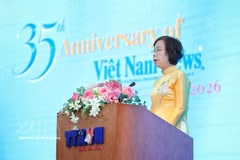
Viet Nam News celebrates 35 years of connecting Vietnam and the world
The newspaper’s establishment was a strategic decision by the VNA aimed at pioneering efforts to convey the image of a transformative, dynamic and responsible Vietnam to the international community.
Vietnam, Poland seek to boost cooperation in circular economy, green technology
Poland is investing heavily in green technologies, including natural resource management, environmental protection, and industrial decarbonisation, said Wojciech Kusak, Counsellor for Political and Economic Affairs at the Embassy of Poland in Vietnam.
Deputy PM requests faster disbursement of ODA-funded projects
As of June 15, the disbursement rate for public investment funded by external sources had reached only 9.99% of the assigned plan. Although the figure was higher than in the same period last year, it remained well below the national average. Notably, one out of eight ministries and central agencies and 13 localities had yet to disburse any allocated capital.
Vingroup ranks 26th in Fortune's 2026 Southeast Asia 500 list
Vingroup, the country’s largest private-sector conglomerate, leaps from 37th to 26th on 12.8 billion USD in revenue, a 69% jump that places it ninth among the fastest-growing companies on the list.
Vietnamese fruits strengthen foothold in China
The expansion of fruit trade has been supported by the implementation of the Regional Comprehensive Economic Partnership (RCEP) and ongoing efforts to upgrade the China – ASEAN Free Trade Area.
High-tech FDI attraction set as strategic priority: official
The resolution sets out a number of specific targets for foreign investment attraction during the 2026–2030 period. Annual registered FDI is targeted at between 40 billion USD and 50 billion USD, while realised capital is expected to reach approximately 30–40 billion USD per year.
Forum seeks to enhance digital leadership capacity for Vietnamese women entrepreneurs
By investing in trust, skills and collaboration, women-led enterprises can play a more active role in shaping the digital economy, said Erin Steinhauer, Country Representative for Vietnam at the Asia Foundation.
Vietnam’s trade surplus with EU expands amid economic headwinds
Trade between Vietnam and the EU maintained momentum during the January–May period, supported by the EU – Vietnam Free Trade Agreement (EVFTA) and sustained demand for key Vietnamese exports, even as the EU grappled with inflationary pressures and sluggish consumer spending.
Vietnam eyes to shape national maritime industrial ecosystem
These advantages provide a strong foundation for the development of the marine economy and logistics services. As a result, the marine economy has been identified as a national strategic priority, with the coordinated development of maritime transport, seaports and shipbuilding serving as a key pillar in shaping a sustainable national maritime industrial ecosystem.