Hanoi (VNA) – Vietnam’s merchandise trade turnover has surpassed 445 billion USD since the beginning of this year, reflecting not only the resilience of the country’s trade activities but also deeper structural shifts driven by rising imports of production materials, growing high-tech investment, and a transition towards industries with higher added value.
According to the Ministry of Industry and Trade, Vietnam’s exports reached 215.66 billion USD in the first five months of 2026, up 19.5% year-on-year. Twenty-six export items generated more than 1 billion USD in revenue each, including seven with turnover exceeding 10 billion USD.
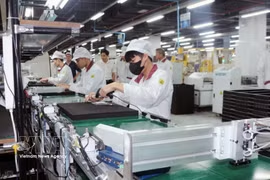
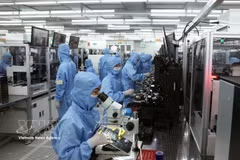
High-tech products continued to serve as the main engine of export growth. Exports of computers, electronic products and components exceeded 56 billion USD, soaring more than 46% compared to the same period last year. Shipments of phones and components reached nearly 29 billion USD, while machinery, equipment, tools and spare parts generated about 28 billion USD. Together, these three product groups accounted for more than half of the country’s total export value during the five-month period.
Compared with 3-5 years ago, Vietnam’s export structure has changed considerably. While textiles, footwear, wood products and agricultural goods were previously the main growth drivers, electronics, machinery and technology products now occupy an increasingly larger share.
Vu Ba Phu, Director of the Vietnam Trade Promotion Agency under the Ministry of Industry and Trade, said the shift demonstrates that Vietnam’s exports are not only expanding in volume but are also moving toward sectors with higher value-added content.
Cross-border e-commerce is also emerging as a new growth catalyst. According to Senior Account Manager at Amazon Global Selling Vietnam Huyen Vu, the number of products sold by Vietnamese businesses on Amazon has increased by 35%, while the number of firms generating annual sales of at least 1 million USD has risen by 65%.
The trend indicates that more Vietnamese enterprises are actively building their own brands and reaching global consumers directly through digital platforms, rather than relying solely on intermediary importers.
Export quality has also improved. Nguyen Yen Ngoc, Head of the Foreign Trade Remedies Investigation Division under the Trade Remedies Authority of Vietnam, noted that Vietnamese goods are currently involved in 321 trade remedy investigations worldwide. However, nearly half of these cases have been resolved with investigations terminated, helping many export sectors maintain competitiveness in key overseas markets.
Hi-tech investment waves
Although Vietnam recorded a trade deficit of approximately 13.8 billion USD, the ministry reported that 94.1% of total imports consisted of production materials, including machinery, equipment, components and raw materials for manufacturing.
The figure suggests that most import spending is being channelled into expanding production capacity and upgrading technology, laying the groundwork for export growth in the coming quarters.
Ly Kim Chi, Chairwoman of the Ho Chi Minh City Food and Foodstuff Association, said increasingly stringent requirements related to environmental, social and governance (ESG) standards, food safety, sustainability and traceability are creating a new threshold for exporters. To remain integrated in global supply chains, businesses must invest in technology, modernise production processes and improve product quality.
This transformation is being reinforced by a wave of high-tech investment flowing into Vietnam. In recent years, foreign direct investment has increasingly targeted electronics, semiconductors, artificial intelligence (AI), data centres and research and development activities.
Vietnam has so far attracted 241 foreign-invested semiconductor projects with total registered capital exceeding 14.2 billion USD. The sector has fostered an ecosystem of more than 50 chip design companies and around 7,000 semiconductor engineers.
According to Nguyen Ky Phung, Head of the Management Board of the Saigon Hi-Tech Park, Ho Chi Minh City granted investment certificates to four high-tech projects worth more than 1.23 billion USD in late April.
The developments underscore a broader shift in Vietnam’s export growth model - from labour-intensive processing and low-cost manufacturing to technology, innovation and deeper participation in global value chains. The transition is expected to provide a stronger foundation for sustainable export growth and higher value creation in the years ahead./.