Vietnam attracts wave of hi-tech investments as push for value chain advancement continues

Attracting next-generation high-tech FDI will require Vietnam to move beyond its low-cost advantage and strengthen domestic capabilities, enabling local firms to secure higher-value positions in global value chains.

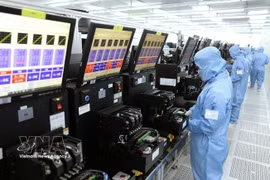
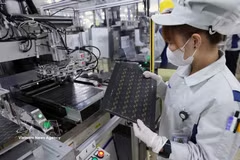
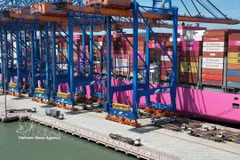
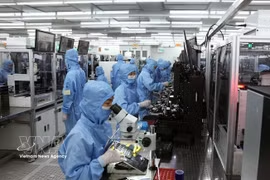
Vietnam is emerging as an attractive destination for foreign high-tech investment. (Photo: VNA)

Hanoi (VNA) – While Vietnam is attracting a wave of high-tech foreign direct investment (FDI), with major projects in semiconductors, electronics, artificial intelligence (AI) and advanced materials, experts say the country must strengthen its domestic capabilities to move beyond its role as a manufacturing hub and climb up global technology value chains.

High-tech FDI gains momentum

During the first four months of 2026, Vietnam secured several large-scale high-tech investments, reflecting an improvement in FDI quality as well as the country's strategy of selectively attracting projects that bring advanced technology, high added value and spillover effects for domestic firms.

Among the standout projects are Samsung Electro-Mechanics Vietnam's second facility with a total registered capital of 1.2 billion USD in Thai Nguyen province, and the over-2.2 billion-USD Quynh Lap LNG-fired power plant project in Nghe An province, both invested by the Republic of Korea (RoK). Others include an artificial graphite anode material plant for lithium-ion batteries worth 282 million USD of the RoK's Posco Future M in Thai Nguyen, and the plant expansion to nearly 891 million USD by Hong Kong's BYD Vietnam Electronics in Phu Tho province.

These projects demonstrate Vietnam's sustained attractiveness to investors in manufacturing, high technology and energy while highlighting the country's growing role as a favourite destination in the global reallocation of high-tech investment.

Dr. Dang Thao Quyen from RMIT University in Vietnam said investments in battery materials, electronics, data centres and AI signal a clear shift in investors’ priorities. The expansion of research and development activities by companies such as Qualcomm also suggests that Vietnam is emerging on the technology map of major global corporations.

While manufacturing remains dominant, the rising investment in energy and information and communications technology (ICT) indicates a transition from quantity to quality. The sharp increase in newly registered capital compared with 2025 further suggests that investors are choosing Vietnam for long-term production and innovation activities rather than simple assembly operations.

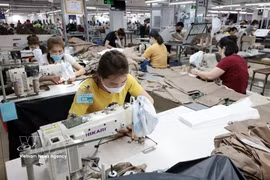
However, Quyen noted that most current projects focus on manufacturing and assembly while critical functions such as product design, advanced R&D and high-level supply chain management remain concentrated in countries that control core technologies, including the RoK, Japan and the US.

Quyen observed that Vietnam currently occupies a middle position in global value chains—a highly important role, but one that could be vulnerable to replacement if the country fails to upgrade its capabilities.

Enhancing domestic capabilities to move beyond strategic manufacturing hub

Economists say Vietnam should adopt a more selective approach to attracting FDI in the coming years, shifting from tax-based incentives toward other forms of support that are tied to investment outcomes and performance.

Greater participation by Vietnamese firms in supply chains, supporting industries and technology-intensive segments will benefit both local companies and foreign investors while enhancing the country's investment appeal, said Nguyen Van Toan, Vice Chairman of the Vietnam Association of Foreign Invested Enterprises.

He added that attracting next-generation high-tech FDI will require Vietnam to move beyond its low-cost advantage and strengthen domestic capabilities, enabling local firms to secure higher-value positions in global value chains.

Economist Dr Nguyen Minh Phong identified technological mastery and high-quality human resources as two of the most important factors of Vietnam's internal strength. He said that beyond long-term development strategies, financial capacity, innovation and adaptability, businesses need a skilled workforce capable of adapting to rapid advances in digitalisation, AI and automation.

Quyen noted that as global technology competition intensifies and technology blocs emerge, Vietnam's ability to attract high-tech investment also depends on institutional reliability, intellectual property protection and data governance.

Vietnam now has an opportunity to integrate more deeply into global technology supply chains. But turning investment inflows into genuine technological capability will require stronger R&D personnel, more effective technology transfer and incentive mechanisms linked to localisation and R&D, she added./.

VNA
See more

A worker of the Dong Nai Rubber Corporation harvest rubber latex. (Photo: VNA)

Global rubber prices surge, raising hopes for Vietnamese exporters

Rising geopolitical tensions and tightening supply are driving global rubber prices to their highest since 2017, creating opportunities for Vietnam’s industry, though experts urge exporters to diversify markets and meet sustainability standards to fully benefit.

Sellers learn about products at the event (Photo: VNA)

Amazon moves from sales channel to brand builder for Vietnamese exporters

With its strong manufacturing base, abundant raw materials, and rapidly growing digital commerce ecosystem, Vietnam can become a leading e-commerce export hub in Southeast Asia. Through platforms such as Amazon, Vietnamese products can not only increase export turnover but also gradually build globally competitive brands capable of conquering global markets.

Prime Minister Le Minh Hung speaks at the meeting on the Vietnam International Financial Centre. (Photo: VNA)

PM orders breakthrough mechanisms for VIFC in June

VIFC development still faces challenges amid a complex global environment, with financial centres worldwide competing intensely for capital. As a late entrant, Vietnam must adopt sufficiently strong mechanisms and policies to attract investors while maintaining effective oversight, controlling risks, safeguarding macroeconomic stability and ensuring sustainable growth.

The Vietnam Chamber of Commerce and Industry (VCCI) releases the 2025 Business Law Flow Report on June 2, 2026. (Photo: VNA)

VCCI report points to unprecedented pace of business law reforms

A defining feature of the year was the Politburo's issuance of four major resolutions covering science, technology and innovation, international integration, law-making and law enforcement reform, and private sector development. VCCI said the resolutions signalled a broader shift in governance, with policymaking increasingly focused on enabling growth, fostering innovation and unlocking development resources.

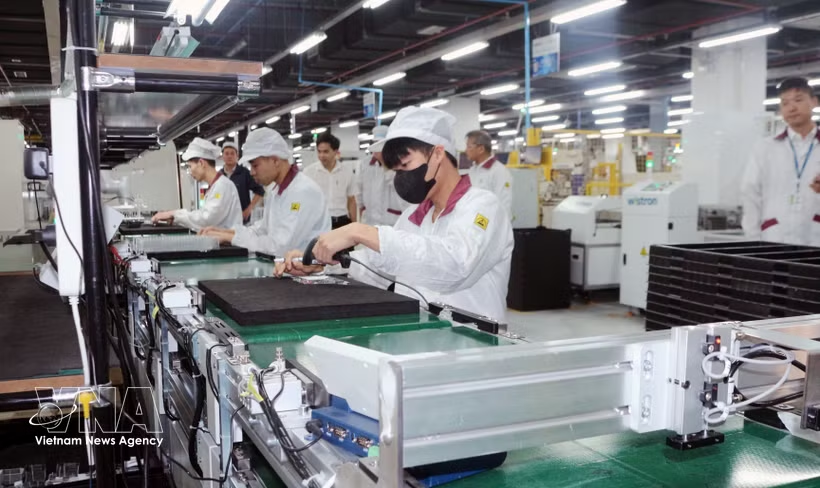
Production of printed circuit boards (PCBs) for electronic devices at the factory of Mektec Manufacturing Vietnam Co., Ltd, a Japanese-owned enterprise, in the Thang Long II Industrial Park, My Hao ward, Hung Yen province. (Photo: VNA)

Stronger local linkages key to unlocking greater value from FDI

Experts said Vietnam should introduce targeted incentives to attract investment in high-tech industries, renewable energy, green growth and the circular economy, while tightening screening of projects that are resource-intensive, environmentally damaging or generate limited added value.

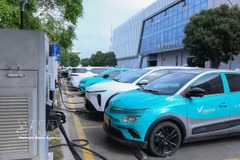
Electric vehicle charging stations and battery-swapping kiosks are becoming increasingly common across streets, parking areas and residential neighbourhoods in Hanoi. (Photo: VNA)

North – South Expressway expands EV charging infrastructure

ccording to the Department for Roads of Vietnam, the Vietnam National Petroleum Group (Petrolimex) is investing in nine rest stops. At the Mai Son–National Highway 45 rest area, 10 charging points have been installed on each side of the expressway. Each point has two charging ports, providing 20 EV charging spaces on each side.

Vietnamese durian is set to enter India’s 1.4-billion-consumer market. (Photo: VNA)

Vietnamese durian gains access to new markets

Le Anh Trung, Chairman of the Dak Lak Durian Association, said durian remains a relatively new product for Indian consumers. While the market is highly segmented, India has a large and growing middle- and upper-income population with the purchasing power to support premium fruit imports.

Children experience virtual reality technology at Nha Trang Centre shopping mall in Khanh Hoa province. (Photo: VNA)

Vietnam’s digital economy surpasses 72 billion USD in 2025: press briefing

The ministry reported that hi-tech exports accounted for 50.76% of the country’s total merchandise exports in the first quarter of 2026. Notably, Vietnam rose to 50th place in the 2026 Global Startup Ecosystem Index published by StartupBlink, climbing five positions from the previous year and achieving its highest ranking to date.