Hanoi (VNA) - Although Vietnam recorded a trade deficit of nearly 14 billion USD in the first five months of 2026, the agriculture sector continued to stand out as a major contributor to external trade, generating a surplus of 7.5 billion USD, or roughly 1.5 billion USD per month.
Resilience amid mounting headwinds
Although the sector maintained a substantial surplus, the figure declined 9.3% year-on-year as weaker global demand, geopolitical tensions and rising transport costs weighed on export performance.
The slowdown has made it more challenging for the agriculture sector to exceed the record trade surplus of 20.7 billion USD achieved in 2025. Even so, the sector has once again demonstrated its role as a stabilising force for the economy.
Rice exports illustrate this resilience. While export volumes and prices came under pressure earlier in the year, the industry’s trade surplus still rose 3.7% to 1.3 billion USD, aided by reduced imports. Export momentum recovered in May, with shipments reaching 1.1 million tonnes, while average export prices climbed to 500–520 USD per tonne, up 30–40 USD from the start of the year.
The anticipated return of El Niño could further support rice prices by reducing agricultural output across parts of Asia. Market observers believed prices may return to levels seen during the 2023–2024 El Niño cycle, when Vietnam exported 9.1 million tonnes of rice and earned 5.6 billion USD.
Prof. Dr Bui Chi Buu, former Director of the Southern Institute of Agricultural Sciences, said climate-related risks are expected to constrain global rice production over the longer term, creating opportunities for Vietnam to strengthen its position as a dependable supplier in international markets.
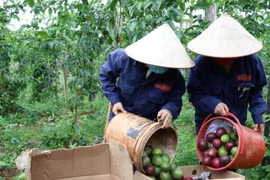
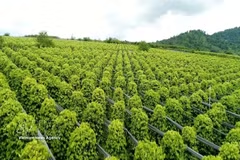
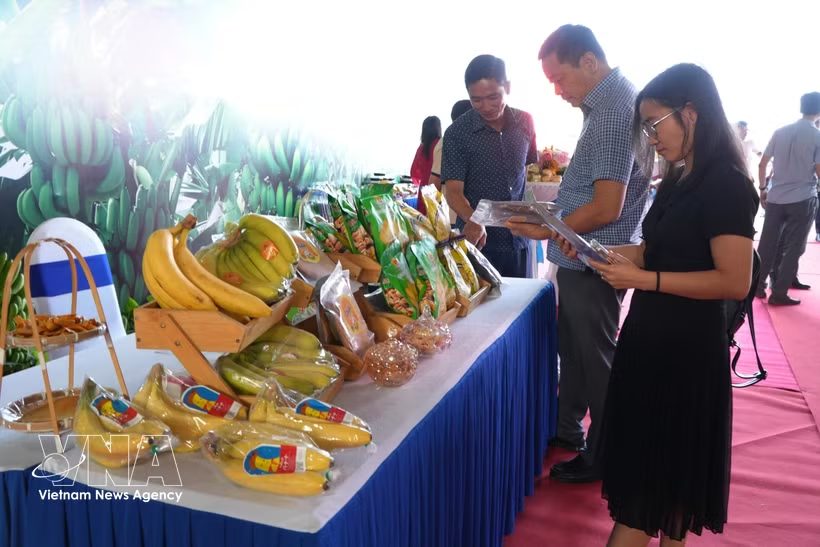
The fruit and vegetable sector also delivered solid results, posting a trade surplus of 1.4 billion USD, up 5.5% year-on-year. Growth is expected to accelerate as the durian harvest season gathers pace in the southern and Central Highlands regions.
According to Dang Phuc Nguyen, General Secretary of the Vietnam Fruit and Vegetables Association (Vinafruit), durian exports could generate 4–4.5 billion USD this year. With imports accounting for only a small share of the sector’s activity, most of the revenue contributes directly to the trade surplus. The industry is projected to achieve a surplus of around 6 billion USD in 2026 if current conditions remain favourable.
Other products, including fresh coconuts and pomelos, have also recorded robust growth. In addition to China, demand from European markets such as the Netherlands and Germany has continued to expand. Meanwhile, a decline in food safety complaints related to pesticide residues indicates improving compliance with international standards and a more market-driven export strategy.
Agriculture seen as a strategic advantage of Vietnam
As global attention increasingly focuses on food security, nutrition and sustainable development, agriculture is emerging as one of Vietnam’s most important strategic advantages.
The country has built strong global competitiveness across several key commodities. Rice has gained greater recognition in higher-value markets, and coffee continues to rank among the world’s leading export products, while tropical fruits such as durian, bananas, mangoes and dragon fruit are expanding their footprint in China, Japan, the Republic of Korea and other premium destinations. Seafood exports, particularly shrimp and pangasius, remain a major source of foreign exchange earnings.
Industry experts believed Vietnam can unlock further growth by moving deeper into global value chains through advanced processing, brand building, cold-storage logistics and circular agricultural models. Such measures would enable the sector to generate greater value while enhancing its contribution to economic growth.
Dr. Tran Huu Hiep from FPT University in Can Tho said agriculture should be recognised as a strategic economic sector rather than merely a support industry as Vietnam pursues higher growth targets.
He highlighted three priorities for the sector’s development: expanding investment in high-tech, green and value-added agriculture; improving climate-resilient infrastructure and water security in the Mekong Delta; and shifting from a production-oriented approach towards an agricultural economy model driven by market demand, international standards and consumer preferences, while strengthening national brands for key export products./.