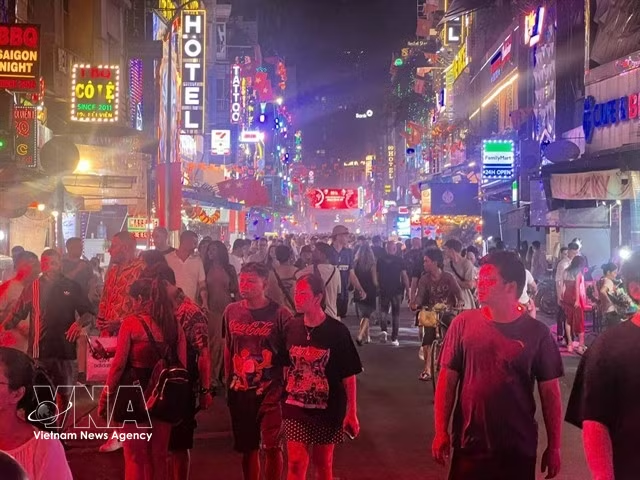
Ho Chi Minh City (VNS/VNA) - When the sun goes down, Ho Chi Minh City comes alive with glowing streets, crowded eateries and the restless energy that once earned it the name “the city that never sleeps”. Yet despite its vibrant nightlife and strong demand for entertainment, the city’s night-time economy has still not fully realised its potential.
What the city needs now is a comprehensive strategy and a sufficiently flexible regulatory framework to transform “Sai Gon by night” into a new engine of growth.
As darkness falls, Ho Chi Minh City remains brightly illuminated with bustling streets, lively eateries and crowds enjoying the city well into the night.
Yet behind this energetic façade, the city’s night-time economy continues to operate largely in a fragmented manner, with limited connectivity between services and an absence of integrated experiences capable of attracting and retaining international visitors.
According to economist Le Dang Doanh, former Director of the Central Institute for Economic Management, the greatest weakness at present is the absence of a dedicated coordinating body to serve as the “conductor” of the city’s entire night-time economy ecosystem.
“The night-time economy simultaneously involves tourism, transport, commerce, culture, public security, environmental management and urban planning. Without a single coordinating authority, development can easily become fragmented and uncoordinated,” Doanh said.
He suggested that such a “conductor” should take the form of an inter-agency steering committee operating under the Ho Chi Minh City People’s Committee, bringing together representatives from the departments of tourism, industry and trade, culture and sports, transport, public security, as well as the business community.
The body would be responsible for developing an overall strategy for the night-time economy, planning dedicated night-time districts, coordinating operating hours, integrating public transport services, ensuring security and managing issues such as noise control and service quality.
“Developing the night-time economy is not simply a matter of opening more bars or extending trading hours. What is needed is an entity capable of coordinating all elements into a seamless visitor journey, from dining and entertainment to shopping, transport and accommodation,” he added.
Tourism experts note that the key distinction between Ho Chi Minh City and leading night-time economy destinations such as Bangkok, Seoul and Singapore lies in their ability to create distinctive and well-coordinated night-time precincts.
In Bangkok, visitors can enjoy round-the-clock experiences through integrated night districts combining markets, massage services, street performances, dining and public transport operating almost 24 hours a day.
Meanwhile, Singapore’s Clarke Quay attracts visitors through its riverside entertainment model featuring lighting displays, music, pedestrian-friendly spaces and night-time cultural activities.
By contrast, many of Ho Chi Minh City’s existing night streets continue to replicate similar models centred on food outlets, bars and souvenir shops. After 10pm, international visitors often find few options beyond walking, dining or visiting pubs.
As a result, night-time spending remains below the potential expected of a metropolis with a population exceeding 10 million.
Economist Dinh Trong Thinh argued that if the city wishes to establish a genuine night-time economy sector, greater authority should be granted to the coordinating body to determine operational models tailored to individual districts.
“The coordinating authority must have the power to connect government departments, regulate operating hours, organise events and develop distinctive products for each area. Only then can the current piecemeal approach be avoided,” Thinh said.
Sleepless ambitions
According to Lai Minh Duy, Vice Chairman of the Ho Chi Minh City Tourism Association, international visitors today seek more than dining and shopping opportunities; they want to experience the city’s night-time lifestyle in its entirety.
“To encourage visitors to stay longer, the city must create a sense that there is always something new to discover after 10pm. That requires the development of a complete night-time economy ecosystem rather than a handful of isolated entertainment streets,” Duy said.
He suggested that the city should capitalise on its riverside setting, urban culture and open-minded social atmosphere to develop new night-time destinations such as riverside arts districts along the Sai Gon River, light festivals, creative markets, overnight river tourism services and large-scale performance complexes incorporating modern technologies.
More importantly, the city needs attractions of sufficient scale to provide continuous experiences from evening until dawn, rather than relying primarily on short-duration food and beverage activities.
From a tourism planning perspective, Nguyen Thi Thanh Thao, head of the Tourism Resource Development Planning Division under the municipal Department of Tourism, said the city should develop the night-time economy through distinct thematic clusters.
Under this approach, the central district would focus on entertainment, contemporary arts and shopping; Cho Lon would showcase Hoa (Chinese-Vietnamese) culture and traditional cuisine; while Can Gio would concentrate on coastal eco-tourism and nature-based night-time experiences.
According to Thao, as part of discussions surrounding the proposed Special Urban Areas Law, Ho Chi Minh City is seeking a range of dedicated mechanisms to unlock the growth potential of the country’s largest metropolitan area.
Under the proposal, the city would gain greater autonomy in determining night-time economy models suited to individual districts, including zoning arrangements, business operating hours and service regulations.
If approved, restaurants, pubs, lounges and beer clubs could be permitted to operate until 2am, karaoke venues until 4am, while selected areas meeting specific requirements could operate throughout the night.
These measures would be supported by electronic management systems capable of monitoring noise levels, public order and visitor flows in real time.
After-dark future
Beyond special regulatory mechanisms, many economists argue that the city should introduce stronger incentives for businesses investing in the night-time economy, including tax incentives for cultural projects, support for festivals and performances taking place after midnight, and encouragement for investment in digital entertainment, immersive light installations and virtual reality experiences.
Pham Huy Binh, director of the city’s Department of Tourism, said sustainable development of the night-time economy would also require integrated investment in supporting infrastructure, including night bus services, parking facilities, smart lighting systems, public toilets and round-the-clock visitor assistance centres.
“Public transport must take the lead. Only then will visitors be willing to travel more extensively and increase spending at night,” Binh said.
Meanwhile, Nguyen Nguyen Phuong, Deputy Director of the municipal Department of Industry and Trade, stressed that the night-time economy should not be viewed solely as a means of increasing tourism revenue.
“It is also an opportunity to restructure urban spaces in a more modern, creative and culturally distinctive direction,” he said.
Phuong added that the city should accelerate digital transformation in night-time economy management, applying artificial intelligence and big data analytics to better understand visitor behaviour, strengthen security management, oversee business operations and optimise urban services after dark.
In the longer term, if Ho Chi Minh City can overcome existing constraints relating to planning, infrastructure and governance, it has every opportunity to transform “Sai Gon by night” into one of Southeast Asia’s defining after-dark destinations — a city where the lights never truly fade, and where visitors stay not only for the food and nightlife, but for the energy, culture and experiences that continue long after midnight./.
Night-time economy drives growth of Hanoi’s cultural industries
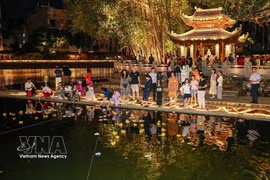
Under the Politburo’s Resolution No. 80-NQ/TW on the development of Vietnamese culture, Hanoi has been given fresh opportunities to leverage its cultural, historical, tourism and creative assets. The city’s recently approved project on developing the night-time economy for 2026–2030, with a vision to 2045, is expected to create momentum for cultural industry growth while enhancing Hanoi’s standing as a creative and modern city with a distinctive identity.