Night-time economy drives growth of Hanoi’s cultural industries

Under the Politburo’s Resolution No. 80-NQ/TW on the development of Vietnamese culture, Hanoi has been given fresh opportunities to leverage its cultural, historical, tourism and creative assets. The city’s recently approved project on developing the night-time economy for 2026–2030, with a vision to 2045, is expected to create momentum for cultural industry growth while enhancing Hanoi’s standing as a creative and modern city with a distinctive identity.

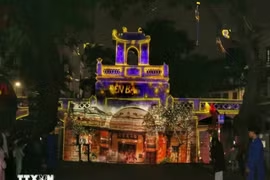
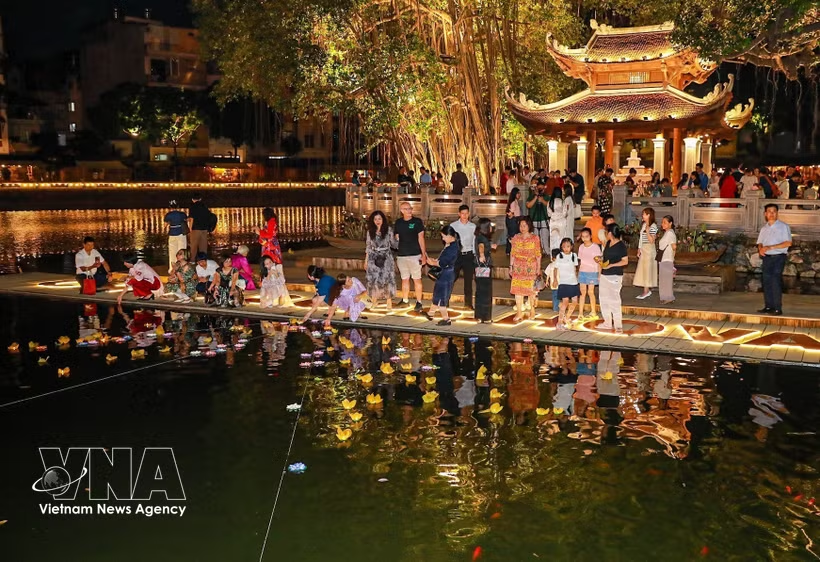
People join the “Ho Van Lantern Festival Night” programme at the special national relic site of the Van Mieu–Quoc Tu Giam (Temple of Literature) in Hanoi. (Photo: VNA)

Hanoi (VNA) – Hanoi is well positioned to transform its rich cultural resources into a new engine of economic growth, with the night-time economy emerging as a key catalyst for the development of the capital city’s cultural industries.

Under the Politburo’s Resolution No. 80-NQ/TW on the development of Vietnamese culture, Hanoi has been given fresh opportunities to leverage its cultural, historical, tourism and creative assets. The city’s recently approved project on developing the night-time economy for 2026–2030, with a vision to 2045, is expected to create momentum for cultural industry growth while enhancing Hanoi’s standing as a creative and modern city with a distinctive identity.

For Hanoi, cultural industries can become a high-value-added economic sector, contributing to the city’s competitiveness and sustainable development. Beyond preserving heritage, Hanoi needs to build a vibrant cultural marketplace where cultural products can reach wider audiences and generate stable revenues.

The night-time economy provides an ideal platform for the commercialisation of cultural products and services. Music, cinema, performing arts, creative design, handicrafts, fashion, cuisine and cultural tourism can all benefit from a dynamic evening economy. As more visitors participate in night-time activities, demand for artistic performances, creative products and cultural experiences is expected to increase.

This also opens new opportunities for artists, designers, creative enterprises and event organisers. Instead of relying on occasional programmes, they can become part of a regular chain of cultural activities, creating sustainable income streams and encouraging innovation.

As a member of the UNESCO Creative Cities Network, Hanoi enjoys a significant advantage in building a more dynamic creative ecosystem.

According to Dr. Tran Viet Dung, Dean of the Faculty of Creative Management and Economy under the University of Social Sciences and Humanities and Arts of the Vietnam National University-Hanoi, the capital possesses favourable conditions for developing the night-time economy, including its rich cultural heritage, high concentration of historical sites and strong appeal to international visitors.

He said the city is well suited to developing a model centred on cultural markets and creative services.

Assoc. Prof. Dr. Bui Hoai Son, a full-time member of the National Assembly’s Committee for Culture and Society, noted that Hanoi’s thousand-year history and diverse heritage resources provide abundant material for cultural storytelling. Every street, bridge and architectural landmark contributes to the unique appeal of the capital, offering valuable assets for night-time cultural activities.

One example is Ho Van (Literature Lake), part of the special national relic site of the Van Mieu–Quoc Tu Giam (Temple of Literature). In recent years, creative cultural activities, exhibitions and music performances held there have attracted growing interest from both domestic and international visitors.

The “Ho Van Lantern Festival Night” programme has emerged as a new night-time tourism product that combines art, cuisine and Vietnamese cultural traditions. Running from 5 p.m. to 9 p.m. on weekdays, the programme allows visitors not only to explore the heritage site but also to interact directly with cultural experiences.

Nguyen Lien Huong, Deputy Director of the Van Mieu–Quoc Tu Giam Centre for Cultural and Scientific Activities, said plans are underway to develop Ho Van into a representative creative cultural space and eventually a cultural industry hub of Hanoi. The centre aims to expand cooperation with artists and tourism businesses while introducing contemporary cultural products into the heritage space./.

VNA
See more

Efforts made to preserve, promote values of Non Nuoc Cao Bang Global Geopark

Efforts made to preserve, promote values of Non Nuoc Cao Bang Global Geopark

First recognised by UNESCO on April 12, 2018, the Non Nuoc Cao Bang Global Geopark in the northern province of Cao Bang is a land shaped by more than 500 million years of geological history. Covering over 3,683 sq.km and encompassing all or part of 36 communes and wards, the geopark is home to numerous scenic landscapes, as well as historical and cultural sites of exceptional value.

Scenic views of Da Nang featured in the film "Love in Vietnam" (Photo: VNA)

Da Nang Asian Film Festival 2026 set to launch with expanded international focus

Through this coordinated effort, Da Nang aims to establish DANAFF not only as an annual film event but also as a distinctive cultural landmark, helping position the city as a reputable destination for regional film and cultural events and enhancing its international profile, Vice Chairwoman of the municipal People’s Committee Nguyen Thi Anh Thi, said.

Co Bo Temple in Thanh Hoa province (Photo: nhandan.vn)

Thanh Hoa taps spiritual heritage to boost cultural tourism

Experts have called for stronger implementation of heritage management regulations under the Cultural Heritage Law, clearer responsibilities for site management boards and stricter action against activities that distort cultural traditions.

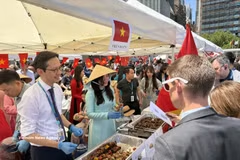
Ambassador Do Hung Viet, Vietnam's Permanent Representative to the United Nations, and his spouse introduce Vietnamese dishes to visitors at the 2026 UN International Bazaar in New York on June 3. (Photo: VNA)

Vietnam leaves strong impression at 2026 UN International Bazaar

A wide range of traditional handicrafts reflecting Vietnam’s rich cultural heritage, including ceramics, lacquerware, silk products, brocade textiles and other items, attracted considerable attention from visitors. Many products sold out early in the day.

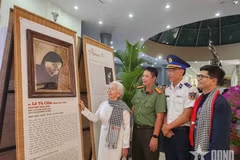
Former political prisoner Le Tu Cam is moved as she views a portrait of herself, digitally restored from archival photographs and crafted from lotus leaves, on display at the Con Dao Museum. (Photo: VNA)

Digital innovation breathes new life into Vietnam’s museums

Technology is similarly enriching exhibitions at the Vietnam Women’s Museum in Hanoi. Wartime letters, a typewriter and other artefacts linked to former Vice President Nguyen Thi Binh have been digitally integrated with collections held at the War Remnants Museum in Ho Chi Minh City. Through projection mapping, 3D displays and a virtual reality recreation of the Paris Peace Agreement, visitors can engage more deeply with the life and achievements of one of Vietnam’s most prominent diplomats.

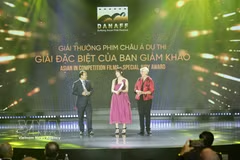
At the award ceremony of the Da Nang Asian Film Festival 2025. (Photo: VNA)

Da Nang Asian Film Festival 2026: Bridging Asia and the world

The festival is expected to bring together around 900 artists, producers and film professionals from Vietnam and abroad, including more than 200 international guests. This marks the largest edition since DANAFF was first launched in 2023, highlighting its growing appeal within the film industry.

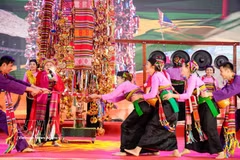
Performance showcasing excerpts from the Pon Poong festival of the Muong ethnic community in Thanh Hoa province. (Photo: VNA)

Vietnam’s culture development in digital era

Under the Politburo's Resolution No. 80-NQ/TW, issued on January 7, 2026, culture is defined as the spiritual foundation of society, an important endogenous resource, a driver of socio-economic development and a source of national soft power. In the new era, cultural values are expected to permeate all aspects of life, serving as a foundation, resource, catalyst and regulatory force for the country’s rapid and sustainable development.

Students experience virtual reality games. (Photo: VNA)

Vietnamese team crowned FFWS SEA esports champion

The triumph marked a breakthrough moment for Vietnamese Free Fire esports, with SECRET WAG becoming the first Vietnamese squad to lift an FFWS SEA trophy on home soil. The result underscored the rising stature and growing competitiveness of Vietnam’s esports scene in Southeast Asia.

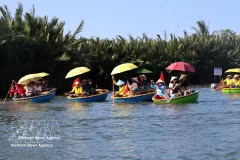
Beyond the bustling streets of Hoi An, the waterways of Cam Thanh Nipa Palm Village offer a slower rhythm of life, where basket boats glide beneath dense green palms and the sounds of river culture still echo through the breeze. (Photo: VNA)

Cam Thanh Coconut village adds fresh charm to Da Nang

Located about 3km southeast of Hoi An and 31km from central Da Nang, the village stretches along the banks of the Hoai, Thu Bon and De Vong rivers. Combined with the area’s tropical climate, the waterways nurture a thriving nipa palm ecosystem rich in biodiversity and scenic beauty. ​