Building materials sector pushed beyond raw extraction

​Rising costs, carbon pressure and supply shortages are forcing the construction materials industry towards greener and higher-value production.

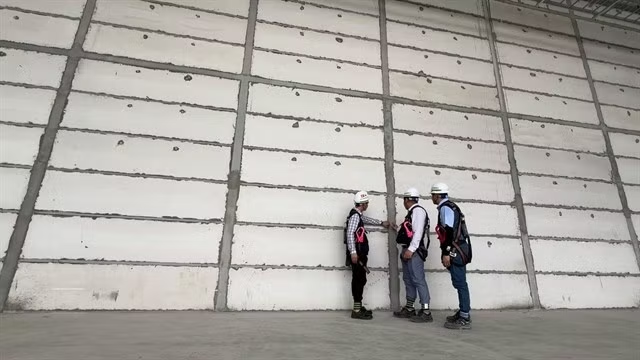
Engineers inspect lightweight autoclaved aerated concrete (ALC) wall panels at a Viglacera factory, as demand grows for greener construction materials in Vietnam. (Photo: viglacera.com.vn)

Hanoi (VNS/VNA) - A construction boom fuelled by expressways, airports and mega urban projects is exposing growing cracks in Vietnam’s building materials industry, where soaring prices, tightening supplies and mounting carbon pressures are forcing companies to rethink a model long built on cheap extraction and low-cost production.

The sharp rise in costs is emerging just as the Government accelerates major public investment projects, including expressways, airports and urban developments. But contractors say the bigger threat is no longer price volatility alone, but also the risk of supply shortages disrupting construction schedules.

In some localities, sand prices have risen by up to 45% year-on-year, with certain areas nearing 1 million VND (38 USD) per cubic metre. Asphalt prices have climbed nearly 32%, while cement and construction stone have also recorded strong increases.

Nguyen Quoc Hiep, Chairman of the Vietnam Association of Construction Contractors (VACC), warned that even short-term disruptions in the supply of fill materials could delay large infrastructure projects and trigger rising financing costs across the sector.

The pressure is reinforcing concerns that Vietnam’s traditional growth model for construction materials has reached its limits.

Despite being one of the world’s largest cement producers, Vietnam remains concentrated in low-value manufacturing. Many steel and cement plants continue to rely heavily on fossil fuels, consume large amounts of energy and generate high carbon emissions.

Economists said the industry can no longer rely on extracting and exporting raw resources while competing mainly on low costs. Instead, future growth will increasingly depend on technology, recycling capacity and carbon reduction.

The shift is also being driven by global trade pressure.

From 2026, steel and cement exporters will face growing pressure from mechanisms such as the EU’s Carbon Border Adjustment Mechanism (CBAM), which could raise costs and weaken the competitiveness of manufacturers that continue to rely on carbon-intensive production.

At a recent meeting on industrial development strategy, Party General Secretary and State President To Lam called for the construction materials sector to move towards greener, more sustainable and technology-driven production, while reducing dependence on raw resource extraction.

Green transition

Deputy Minister of Construction Nguyen Van Sinh said the "greening" of the industry was no longer optional, but had become critical to the survival of many businesses.

Some major producers have already begun investing in energy-saving technologies and waste heat recovery systems. However, companies say the financial burden of transition remains severe.

Executives in the cement industry say they face growing pressure from international carbon mechanisms. Failing to decarbonise could mean losing export markets, but investing heavily in green technology without sufficient domestic policy support could weaken cash flow and profitability.

Businesses also argue that green materials still struggle to compete in the domestic market because procurement systems continue to favour traditional materials.

According to VACC Chairman Nguyen Quoc Hiep, low-carbon materials often cost 15-20% more, yet public bidding frameworks do not fully reflect those additional costs.

The recycling sector also remains underdeveloped. Vietnam generates around 9.6 million tonnes of construction waste annually, but most of it is still sent to landfills. Only 30-50% of construction and industrial waste is recycled, compared with 70-90% in advanced Asian economies.

Experts said the main obstacle is no longer technology, but outdated regulations and pricing systems.

Le Trung Thanh, former director of the Department of Science, Technology, Environment and Building Materials under the Ministry of Construction, said the sector needed a more coordinated policy framework.

He said policies should both secure short-term material supply for infrastructure projects and create stronger economic incentives for businesses to invest in low-carbon production.

Future materials

He argued that regulators were still “using the rules of the past to manage the materials of the future”, while standards and pricing systems for recycled materials remained underdeveloped.

Many recycled materials that meet technical standards are still excluded from public projects because of missing procurement guidelines and technical frameworks.

Some analysts have called for higher resource taxes on raw extraction to better reflect environmental costs. They argue that environmental damage linked to the mining of materials such as river sand is still not fully reflected in market prices, making recycled materials less competitive in Vietnam.

According to industry experts, the future competitiveness of Vietnam’s building materials sector will depend on its ability to move beyond resource-intensive production and embrace innovation-driven growth.

That shift will require stronger investment in research and development, enabling manufacturers to transform industrial waste into high-value materials for advanced applications rather than low-end construction products.

At the same time, policymakers are seeking to tackle long-standing market inefficiencies through greater price transparency and improved coordination of material supplies across regions.

Measures aimed at curbing localised price surges and lowering logistics costs could help ease pressure on producers and improve the sector’s overall efficiency./.


VNA
See more

Aircraft at Noi Bai International Airport. (Photo: VNA)

Hanoi bets on aviation network to power economy

The capital’s newly approved master plan places aviation infrastructure at the centre of long-term economic development, with a second international airport and low-altitude transport network expected to reshape urban growth, logistics and high-tech industries.

Green SM Global CEO Nguyen Van Thanh and Haryana's Minister of Industries and Commerce Rao Narbir Singh, together with delegates, press the button to officially launch the service. (Photo: VNA)

Vietnamese electric taxi service launched in India

The launch of Green SM Limo in India further expanded the company’s international footprint and brought its all-electric mobility model and service standards, already established in several markets, to users in one of the world’s most dynamic economies.

At the Vietnam – Cambodia - Laos border trade connectivity conference (Photo: VNA)

Vietnam, Cambodia, Laos promote border trade connectivity

The Mekong Delta spans more than 40,500 sq.km, holds roughly 18 million people and shares a nearly 386km border with Cambodia, making it a key gateway to the Greater Mekong Sub-region. An Giang has emerged as a major agro-fisheries hub, with seaports and strategic trade hubs delivering maritime advantages and creating a seamless corridor to Cambodia and beyond.

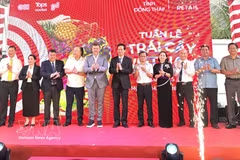
Delegates at the opening ceremony of the fifth Vietnam Fruit Week 2026. (Photo: VNA)

Fifth Vietnam Fruit Week 2026 opens in Dong Thap

Vietnam Fruit Week 2026 is being held simultaneously at GO!, Tops Market and mini go! supermarkets nationwide from June 4–7, offering discounts of up to 50% on dozens of fruit products, alongside promotional activities and livestream sales programmes.

Data from Batdongsan.com.vn shows that buyers purchasing apartments for short-term speculation now account for only around 4 per cent of the market. (Photo: VNS/VNA)

Hanoi apartment boom loses momentum

Hanoi’s once red-hot apartment market is showing clear signs of cooling, with slowing liquidity and cautious buyers forcing many short-term investors to retreat after years of rapid gains.

A corner of K-Med Expo 2026 in Ho Chi MInh City (Photo: K-Med Expo Vietnam)

RoK medical equipment firms eye stronger export to Vietnam

The K-Med Expo, organised annually since 2023 by KINTEX and the Korea Medical Devices Industry Association, attracts around 300 Korean medical device companies each year. For this year’s consultation conference, KOTRA invited about 100 buyers, including Vietnamese hospitals and medical equipment distributors, to meet with 71 Korean exhibitors.

Gemalink Port boasts the most modern infrastructure and equipment in the country and enjoys the most advantageous location within the Cai Mep - Thi Vai port cluster (Photo: VNA)

WB sees strong potential for Vietnam's double-digit growth goal

Vietnam is among those few emerging market economies where an immense array of reforms is currently unfolding, generating considerable excitement and optimism. The reforms that the Government has been pushing over the last two years are the most significant since the Doi Moi (Renewal) era – a comprehensive, fast-paced reorganisation and restructuring of the state that could be potentially transformative if implemented well.

Vietnamese Ambassador to Egypt Nguyen Nam Duong has a meeting with Egyptian Deputy Foreign Minister for International Cooperation Samar Al-Ahdal in Cairo on June 4 (Photo: VNA)

Vietnam, Egypt step up implementation of comprehensive partnership

Vietnamese Ambassador to Egypt Nguyen Nam Duong had a meeting with Egyptian Deputy Foreign Minister for International Cooperation Samar Al-Ahdal in Cairo on June 4 to discuss measures aimed at advancing bilateral relations following the elevation of ties to a Comprehensive Partnership in August 2025.

VinFast reports record sales for new-generation VF 8

VinFast reports record sales for new-generation VF 8

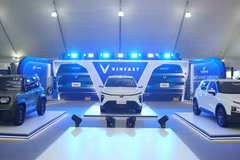
Vietnamese electric vehicle (EV) maker VinFast on June 4 announced it had received 12,728 orders for the new-generation VF 8 premium D-segment electric SUV during an eight-day early reservation campaign running from May 27 to June 3, 2026.

Vehicles moving through the Huu Nghi International Border Gate (Photo: VNA)

Modern logistics creates new growth opportunities for Lang Son’s border-gate economy

Lang Son has a diverse border-gate system, including the Huu Nghi International Border Gate, Dong Dang International Railway Border Gate, Chi Ma and Tan Thanh border gates. Capitalising on these advantages and mobilising non-budgetary investment, the province has upgraded border-gate infrastructure and logistics facilities, including warehouses, parking areas, and customs services.

Illustrative image (Photo: Shutterstock)

Vietnam promotes trade, investment links with Israel

As Israel’s first free trade agreement with a Southeast Asian country, Vietnam–Israel Free Trade Agreement has unlocked new avenues for cooperation and offers considerable potential for further growth in two-way trade.

A customer has his motorcycle refilled with E10 RON95-V biofuel at a Petrolimex station in Pho Hien ward, Hung Yen province. (Photo: VNA)

Petrol, diesel prices fall in June 4 adjustment

The price of E5 RON92 biofuel is capped at 21,784 VND (0.83 USD) per litre, down 1,474 VND from the previous maximum price while that of 0.05S diesel is set at no more than 26,866 VND per litre, a decrease of 785 VND.