Vietnam’s IPv6 rate hits 67.68%, ranks second in ASEAN

Vietnam now sits among the global front-runners in the shift to IPv6, outpacing many far larger economies, with 95 million broadband subscribers actively using IPv6 services.

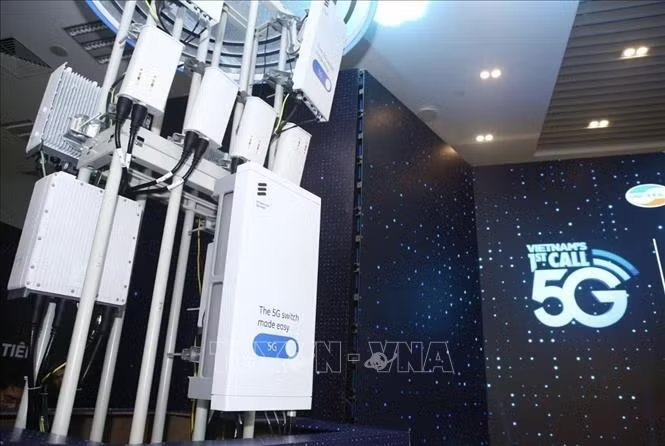
Illustrative image (Photo: VNA)

Ho Chi Minh City (VNA) - Vietnam’s adoption rate for IPv6, the next-generation internet protocol, has climbed to 67.68%, placing the country second in ASEAN and seventh in the world, according to data presented at a conference reviewing the 2021–2025 IPv6 for Gov Programme held in Ho Chi Minh City June 18 .

The country now sits among the global front-runners in the shift to IPv6, outpacing many far larger economies, with 95 million broadband subscribers actively using IPv6 services.

After spending its early years absorbing international best practice, Vietnam has, over the past half-decade, become a case study for other countries keen to learn from its nationwide rollout.

The migration to IPv6 has turned into a necessity. IPv6 and IPv6+ are now seen as critical to the internet’s future and the delivery of new digital services, as well as the bedrock for digital infrastructure, e-government, and national digital transformation.

Deputy Minister of Science and Technology Pham Duc Long said the Internet is entering a new phase where IPv6 is no longer just a technical checkbox but a core platform for national digital infrastructure, digital transformation, artificial intelligence (AI), the Internet of Things (IoT), big data, cloud computing, and next-generation digital services. Pushing ahead with IPv6 and moving to IPv6-only networks, he argued, is a long-term strategic task tied to building a modern, autonomous, secure, and sustainable national digital backbone.

Vietnam spotted the importance of IPv6 early and has stuck to a national roadmap without interruption since 2008. The nationwide shift to IPv6 for government agencies for the 2021 - 2025 period (IPv6 for Gov Programme) has created a strong impetus for Vietnam's IPv6 transition process, with a host of government information systems, portals, digital platforms, and online public services now running stably on the protocol.

The programme has also prompted a discernible shift in mindset and action across ministries, agencies and local authorities, gradually fostering a broad IPv6 ecosystem in the public sector. So far, 86% of ministries, agencies and localities have switched on IPv6 for their web and public service portals, while 73% have built networks using independent IP/ASN resources and deployed the protocol in their data centres. The migration to IPv6 has proceeded in tandem with the modernisation and restructuring of network infrastructure to buttress national digital ambitions.

As the world edges towards IPv6-only environments and the slow phasing out of IPv4, Vietnam is entering a new chapter. In response, the Ministry of Science and Technology has unveiled a national IPv6-only transition programme for 2026 – 2030, designed to push comprehensive adoption and construct a synchronous, modern digital and internet infrastructure.

The key goal for 2026 – 2030 is to lift IPv6 adoption to 90% – 100% across the country’s Internet ecosystem, progressively phase out IPv4, and keep Vietnam among the world’s top 10 – 20 in IPv6 transition.

IPv6 addresses were first introduced in Vietnam in 2004 by the Vietnam Internet Network Information Centre (VNNIC) under the Ministry of Information and Communications (now the Ministry of Science and Technology)./.


VNA

See more

Vietnamese delegates visit a booth at the Eurosatory 2026. (Photo: VNA)

Vietnamese tech firm showcases innovations at Eurosatory 2026

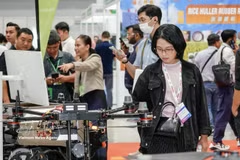
As the only Vietnamese tech firm exhibiting directly at the event, Gremsy's participation highlights the growing ability of domestic enterprises to integrate into global technology value chains and compete in high-tech international markets.

Engineers monitor and operate the power system at the central control room at the Northern Power Corporation (EVNNPC)’s Thanh Hoa Power Company in May 2025. (Photo: VNA)

Vietnam boosts financial investment to drive innovation

Resolution No. 57-NQ/TW of the Politburo on the development of science, technology, innovation and national digital transformation states that these areas are becoming not only prerequisites but also a historic opportunity for the country to achieve prosperity and strengthen national competitiveness in a new era of development.

An automated robot demonstrates at the National Forum on the Development of Vietnamese Technology Enterprises in 2025. (Photo: VNA)

Vietnam targets at least 10 large strategic technology firms by 2030

Deputy Prime Minister Ho Quoc Dung has signed a decision approving a plan to develop large domestic strategic technology enterprises in the 2026–2030 period, aimed at advancing digital infrastructure, digital human resources, digital data, strategic technologies and cybersecurity.

Visitors explore technology exhibition booths during the Data & AI Forum in Ho Chi Minh City on May 8, 2026. (Photo: VNA)

AI, social media redefines corporate communications

It has become part of Vietnam’s national digital transformation agenda under Politburo Resolution No. 57-NQ/TW dated December 22, 2024, which seeks to establish data, technology, innovation and digital governance as new pillars of economic competitiveness.

Illustrative image (Photo: VOV)

Valuing IP: Global standards and Vietnam’s realities

Vietnam’s legal framework already enables intangible asset valuation, and international methodologies can be applied. Yet IP valuation remains a knotty problem for regulators, valuation firms, universities, research institutes and businesses, all of whom are hunting for clearer roadmaps.

Deputy Prime Minister Ho Quoc Dung speaks at the meeting on June 17 (Photo: VNA)

Deputy PM urges faster completion of science, technology, digital transformation regulations

Deputy PM Ho Quoc Dung stressed the need for close coordination among the Ministry of Science and Technology, the Ministry of Justice and the Government Office to finalise and submit for issuance key decrees guiding the implementation of the Law on High Technology and the Law on Digital Transformation within this month, thus enabling them to be brought into practice as soon as possible.

Can Tho city has guaranteed that at least 1% of its total budget expenditure will be allocated to science, technology, and innovation (Photo: VNA)

New tax incentives expected to boost science, technology enterprises

The incentives are also expected to attract and retain scientists and technology experts while providing enterprises with additional resources to enhance competitiveness in strategic sectors such as artificial intelligence, semiconductors, software and biotechnology.

An engineer at the Digital Transformation Centre under the Khanh Hoa provincial Department of Science and Technology performs equipment maintenance. (Photo: VNA)

Efforts needed to safeguard data security in digital era

Vietnam’s cybersecurity landscape has witnessed a notable shift in recent years. While the number of cyberattacks recorded in 2025 showed signs of decline, the proportion of organisations suffering actual damage rose to 52.3%. Cyberattacks increasingly target critical sectors, including banking, finance, energy, telecommunications, and government agencies.

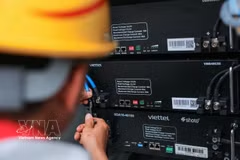
A worker from Hanoi branch of the Viettel Construction Corporation is connecting and installing 5G BTS station equipment. (Photo: VNA)

Vietnam expects digital economy to contribute 30% of GDP by 2030

The country also aims to support at least 500,000 small and medium-sized enterprises in digital transformation, develop a minimum of five digital technology companies capable of competing with counterparts in advanced economies, and establish at least five operational data exchanges.

The international conference takes place in Varna city, Bulgaria, from June 10 to 12. (Photo: VNA)

Vietnam hopes to enhance nuclear energy cooperation with Bulgaria: ambassador

Highly valuing Bulgaria's extensive experience in operating the Kozloduy nuclear power plant and training specialised personnel, Ambassador Nguyen Thi Minh Nguyet proposed boosting bilateral cooperation in specialist training, scientific research, and the sharing of management, operational, and nuclear safety expertise.

Visitors explore agricultural production equipment on display at Agri & Biotech Vietnam 2026 in Ho Chi Minh City. (Photo: VNA)

Agri-biotech exhibition series underway in Ho Chi Minh City

In addition to the exhibition activities, Agri & Biotech Vietnam 2026, lasting until June 12, is set to host a series of specialised forums and seminars. Topics of particular interest to businesses include farming exports, sustainable development of the pepper and spice industries, low-emission agriculture, carbon credits, the circular economy, biotechnology and innovative start-ups.

At Expo Tel Aviv in Israel (Photo: VNA)

Digital transformation fuels demand for cybersecurity talent

According to the National Cybersecurity Association (NCA), cyberattacks are rising in both frequency and severity. Attackers are targeting critical infrastructure, personal data, and public services with increasingly advanced methods. This isn't just a technical glitch, but a systemic vulnerability requiring a workforce that can analyse and respond in real time.

Billionaire Eric Schmidt, former Chairman and CEO of Google and former Chairman of the US National Security Commission on Artificial Intelligence (NSCAI) (Photo: NIC/VietnamPlus)

Vietnam well-positioned to become global AI hub: Eric Schmidt

Vietnam possesses significant advantages and strong potential to emerge as a global centre for artificial intelligence (AI), according to billionaire Eric Schmidt, former Chairman and CEO of Google and former Chairman of the US National Security Commission on Artificial Intelligence (NSCAI).

Vietnamese Ambassador to Austria Vu Le Thai Hoang speaks at the event. (Photo: VNA)

Vietnam shows off homegrown humanoid robots in Austria

The event paired a robotics showcase with an innovation networking session, spotlighting Vietnamese companies’ research, development and technological mastery in robotics, automation and artificial intelligence.