Int’l cooperation boosts resources for science, technology, innovation

Strengthening international cooperation not only helps mobilise research resources but also enables Vietnamese scientists to integrate more deeply into global research networks, access advanced technologies and gradually enhance the country’s innovation capacity.

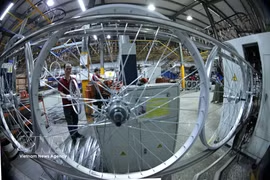
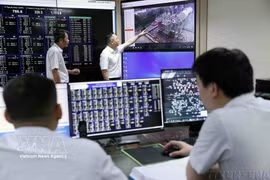
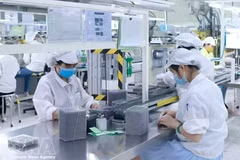
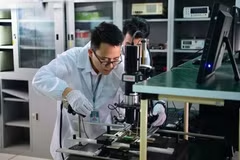
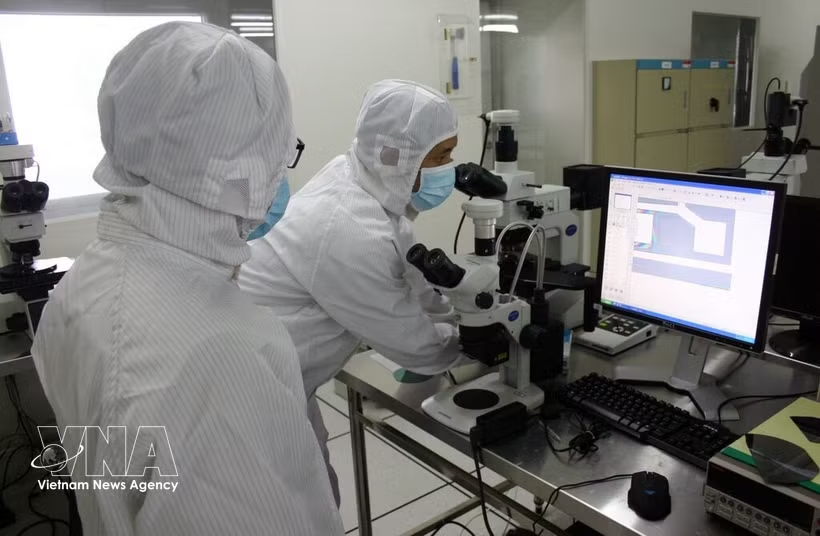
Scientific research at an R&D centre of the Saigon High-Tech Park in Ho Chi Minh City (Photo: VNA)

Hanoi (VNA) – As science, technology and innovation increasingly underpin national competitiveness and development, international cooperation has become a key channel for Vietnam to access new knowledge, mobilise research resources and strengthen domestic scientific and technological capacity.

Politburo Resolution No. 57-NQ/TW on breakthroughs in science – technology development, innovation and national digital transformation identifies the enhancement of international cooperation and the mobilisation of external resources as priorities for national development. Recent initiatives show that science, technology and innovation have emerged as bright spots in Vietnam’s relations with global partners.

Expanding resources for scientific research

One notable development is the launch of the 2026 Joint Research Funding Programme under the Australia – Vietnam Science, Technology and Innovation Cooperation Initiative (AVSTICI).

The programme focuses on three priority areas: renewable and new energy technologies, sustainable marine economy, and waste recycling and management. These fields are critical to sustainable development, green growth and environmental resilience. An outstanding feature is the joint funding mechanism, enabling scientists from both countries to form collaborative research teams, undertake joint projects and share resources.

Vietnam’s National Foundation for Science and Technology Development (NAFOSTED) will coordinate and manage the programme.

NAFOSTED Director Dao Ngoc Chien said the initiative translates bilateral commitments on science and technology cooperation into concrete action while laying the groundwork for collaboration in emerging technologies.

Australia’s Chief Scientist Tony Haymet said Australia is particularly interested in Vietnam’s approach to setting national priorities in science, technology and innovation, as well as its plans for high-performance computing, supercomputing and artificial intelligence (AI).

Australia’s interest reflects the expanding scope of bilateral cooperation in advanced technologies and the increasing need to strengthen research links in the fields strategically important to both sides' furture development. Beyond Australia, Vietnam is expanding partnerships with a wide range of international partners through joint research programmes, co-funded projects and stronger connections among scientific institutions, creating additional resources for domestic research.

A notable trend is the growing focus on strategic technologies. At a recent forum marking the 35th anniversary of ASEAN – Russia dialogue relations in Kazan, Russia, Minister of Science and Technology Vu Hai Quan proposed expanding Vietnam – Russia cooperation in AI, quantum technology, space technology and low-Earth-orbit satellites. He also called for more jointly funded research projects and stronger links among young scientists, research institutes and universities in both countries. Russian officials welcomed the proposals and expressed support for broader cooperation in cutting-edge technologies.

The seventh session of the Vietnam – Russia Committee on Education, Science and Technology Cooperation is scheduled to take place in Russia later this year, alongside a conference for young Vietnamese and Russian scientists and a meeting of the bilateral subcommittee on education, science and technology.

The inclusion of AI, quantum technology and space technology in cooperation agendas reflects a growing shift toward emerging technologies expected to drive future gains in productivity, competitiveness and sci-tech advancement.

Growing demand for joint product development programmes


The need for international cooperation is also evident in emerging technology sectors.

Prof. Dr. Tran Hong Thai, President of the Vietnam Academy of Science and Technology, noted that Vietnamese researchers in biopharmaceuticals and cosmetics have mastered many stages of extraction, isolation, structural analysis and biological activity assessment, particularly using the country’s rich and unique medicinal resources. However, capabilities in pilot-scale processing, formulation technology, active ingredient standardisation and product development to international standards remain limited.

The Republic of Korea, by contrast, has strong expertise in translating research into commercial products. Through joint laboratories and co-development programmes, bilateral cooperation could create high-value biopharmaceutical and cosmetic products based on Vietnam’s indigenous resources.

A similar opportunity exists in hydrogen technology. Vietnamese scientists have begun researching hydrogen storage materials and hydrogen carriers for energy transport, but most results remain at the laboratory stage. Partners such as the Republic of Korea possess strengths in moving technologies from laboratory research to market deployment.

Thai said structured cooperation programmes and pilot projects could help scale up research outcomes and gradually strengthen Vietnam’s position in the global hydrogen value chain.

Recent cooperation initiatives demonstrate that international partners are supporting Vietnam across multiple segments of the science, technology and innovation ecosystem, including strategic technologies. Strengthening international cooperation not only helps mobilise research resources but also enables Vietnamese scientists to integrate more deeply into global research networks, access advanced technologies and gradually enhance the country’s innovation capacity./.

VNA
See more

A speaker from the Internal Political Security Division under the Can Tho Department of Public Security delivers a cybersecurity awareness session for students at Can Tho University. (Photo: VNA)

Can Tho students gain tools to navigate misinformation in digital era

Recently, the Can Tho campus of the Saigon College of Technology held a seminar on information literacy in the digital age. The programme focused on practical skills such as searching for, filtering and evaluating online information, while also introducing students to regulations on cybersecurity, intellectual property rights, digital citizenship and the responsible use of generative AI.

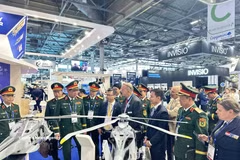
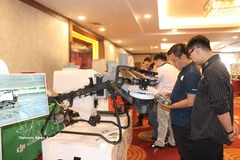
Vietnamese delegates visit a booth at the Eurosatory 2026. (Photo: VNA)

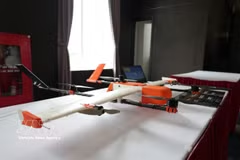
Vietnamese tech firm showcases innovations at Eurosatory 2026

As the only Vietnamese tech firm exhibiting directly at the event, Gremsy's participation highlights the growing ability of domestic enterprises to integrate into global technology value chains and compete in high-tech international markets.

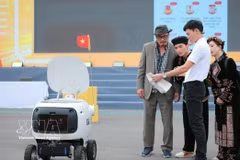
An automated robot demonstrates at the National Forum on the Development of Vietnamese Technology Enterprises in 2025. (Photo: VNA)

Vietnam targets at least 10 large strategic technology firms by 2030

Deputy Prime Minister Ho Quoc Dung has signed a decision approving a plan to develop large domestic strategic technology enterprises in the 2026–2030 period, aimed at advancing digital infrastructure, digital human resources, digital data, strategic technologies and cybersecurity.

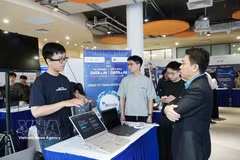
Visitors explore technology exhibition booths during the Data & AI Forum in Ho Chi Minh City on May 8, 2026. (Photo: VNA)

AI, social media redefines corporate communications

It has become part of Vietnam’s national digital transformation agenda under Politburo Resolution No. 57-NQ/TW dated December 22, 2024, which seeks to establish data, technology, innovation and digital governance as new pillars of economic competitiveness.

Illustrative image (Photo: VOV)

Valuing IP: Global standards and Vietnam’s realities

Vietnam’s legal framework already enables intangible asset valuation, and international methodologies can be applied. Yet IP valuation remains a knotty problem for regulators, valuation firms, universities, research institutes and businesses, all of whom are hunting for clearer roadmaps.

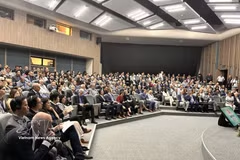
Deputy Prime Minister Ho Quoc Dung speaks at the meeting on June 17 (Photo: VNA)

Deputy PM urges faster completion of science, technology, digital transformation regulations

Deputy PM Ho Quoc Dung stressed the need for close coordination among the Ministry of Science and Technology, the Ministry of Justice and the Government Office to finalise and submit for issuance key decrees guiding the implementation of the Law on High Technology and the Law on Digital Transformation within this month, thus enabling them to be brought into practice as soon as possible.

Can Tho city has guaranteed that at least 1% of its total budget expenditure will be allocated to science, technology, and innovation (Photo: VNA)

New tax incentives expected to boost science, technology enterprises

The incentives are also expected to attract and retain scientists and technology experts while providing enterprises with additional resources to enhance competitiveness in strategic sectors such as artificial intelligence, semiconductors, software and biotechnology.

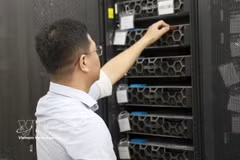
An engineer at the Digital Transformation Centre under the Khanh Hoa provincial Department of Science and Technology performs equipment maintenance. (Photo: VNA)

Efforts needed to safeguard data security in digital era

Vietnam’s cybersecurity landscape has witnessed a notable shift in recent years. While the number of cyberattacks recorded in 2025 showed signs of decline, the proportion of organisations suffering actual damage rose to 52.3%. Cyberattacks increasingly target critical sectors, including banking, finance, energy, telecommunications, and government agencies.

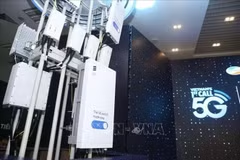
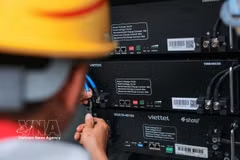
A worker from Hanoi branch of the Viettel Construction Corporation is connecting and installing 5G BTS station equipment. (Photo: VNA)

Vietnam expects digital economy to contribute 30% of GDP by 2030

The country also aims to support at least 500,000 small and medium-sized enterprises in digital transformation, develop a minimum of five digital technology companies capable of competing with counterparts in advanced economies, and establish at least five operational data exchanges.

The international conference takes place in Varna city, Bulgaria, from June 10 to 12. (Photo: VNA)

Vietnam hopes to enhance nuclear energy cooperation with Bulgaria: ambassador

Highly valuing Bulgaria's extensive experience in operating the Kozloduy nuclear power plant and training specialised personnel, Ambassador Nguyen Thi Minh Nguyet proposed boosting bilateral cooperation in specialist training, scientific research, and the sharing of management, operational, and nuclear safety expertise.

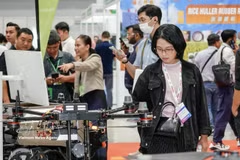
Visitors explore agricultural production equipment on display at Agri & Biotech Vietnam 2026 in Ho Chi Minh City. (Photo: VNA)

Agri-biotech exhibition series underway in Ho Chi Minh City

In addition to the exhibition activities, Agri & Biotech Vietnam 2026, lasting until June 12, is set to host a series of specialised forums and seminars. Topics of particular interest to businesses include farming exports, sustainable development of the pepper and spice industries, low-emission agriculture, carbon credits, the circular economy, biotechnology and innovative start-ups.