PM calls for greater focus on developing high-impact strategic products

science, technology and innovation must become a key driver of double-digit economic growth, as well as improvements in productivity, quality and efficiency, and the enhancement of national competitiveness and self-reliance, said Prime Minister Le Minh Hung.

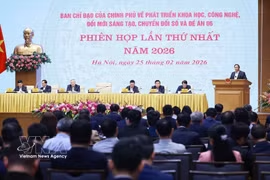
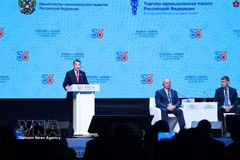
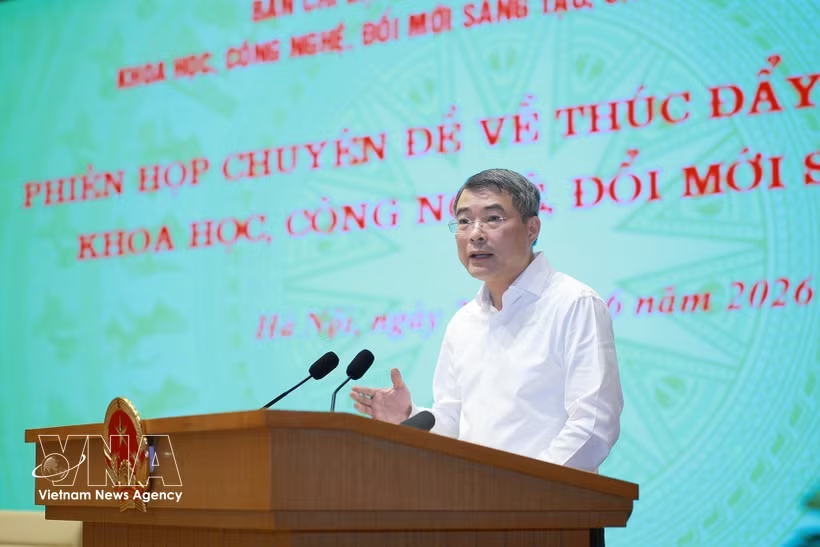
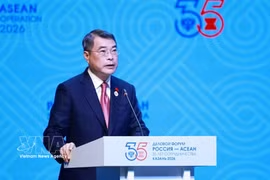
Prime Minister Le Minh Hung speaks at the hybrid thematic meeting of the Government’s Steering Committee on science-technology development, innovation, digital transformation and Project 06 on June 23. (Photo: VNA)

Hanoi (VNA) - Prime Minister Le Minh Hung has called for concentrating resources on developing core technologies and strategic products with the potential to drive growth and improve national competitiveness.

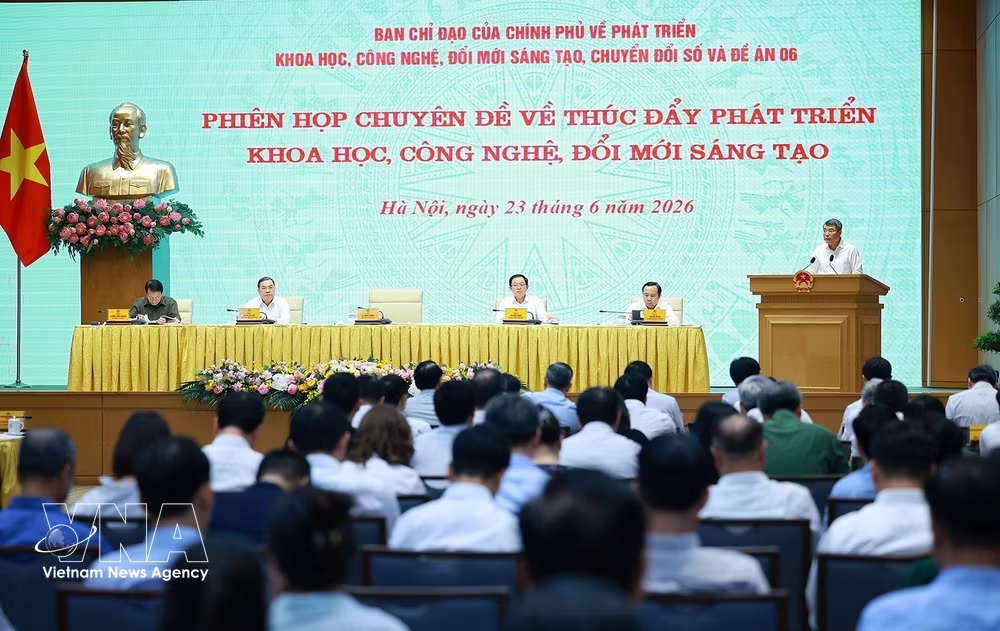
Chairing a hybrid thematic meeting on June 23 of the Government’s Steering Committee on science-technology development, innovation, digital transformation and Project 06 to speed up the implementation of Resolution No. 57-NQ/TW, PM Hung stressed that science, technology and innovation must become a key driver of double-digit economic growth, as well as improvements in productivity, quality and efficiency, and the enhancement of national competitiveness and self-reliance.

The PM, who is also head of the Steering Committee, called for a shift from process-based management to output-based evaluation, focusing on real-world application, commercialisation potential and measurable contributions to economic growth, and state management in ministries and sectors, and localities.

​He also stressed the need to clearly delineate responsibilities across different levels and sectors, noting that efforts should focus on strategic technologies, core infrastructure and major challenges at the national level, forming inter-regional value chains at the regional and sectoral levels, and developing distinctive products with immediate value-creation potential at the local level.
vnanet-pm2.jpg
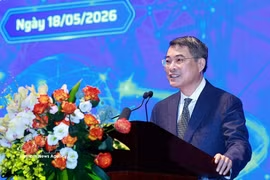
Prime Minister Le Minh Hung chairs the hybrid thematic meeting of the Government’s Steering Committee on science-technology development, innovation, digital transformation and Project 06 on June 23. (Photo: VNA)

The PM affirmed that the State plays a facilitating role by building institutions, setting standards, commissioning tasks, creating testing environments, and sharing risks in a controlled manner, while not replacing enterprises, research institutes and universities in providing knowledge and technology, or in production, commercialisation, and market development.

He also underscored the need to align national missions with regional and local strengths as well as global value chains, and to firmly address fragmented, overlapping, and inefficient investment.

​Ministers, heads of sectors, and leaders of local authorities must directly lead, direct, and take responsibility for progress, quality, and effectiveness, he said, adding that implementation outcomes must be quantified and used as a basis for evaluating performance and task completion.

Regarding future orientations, the PM said ministries and agencies should identify major challenges with strong spillover effects, closely aligned with their functions and mandates, while ensuring coordination with localities. Local authorities, he added, should select products based on their comparative strengths and practical needs.

According to the Government leader, enterprises should be involved throughout the entire process, from problem identification and technology selection to investment, piloting, and market development. Research institutes and universities are expected to align their research with commissioned needs, while the State focuses on building institutions, standards, testing conditions, and an initial enabling market.

Bottlenecks in commissioning mechanisms, funding, procurement of first products, intellectual property valuation, and risk acceptance must be urgently removed, he said, noting that priority should be given to core technologies, highly commercialisable products, and high-impact solutions, alongside more effective use of laboratories, research infrastructure, and expert teams.

Ministries, agencies, and local authorities are required to review all assigned tasks and fully resolve any overdue assignments. No requests for deadline extensions will be considered unless the causes, responsibilities, and remedial measures have been clearly identified. All tasks must be completed by June 30, he ordered.

The cabinet leader said in 2026, each locality is to select at least one product whose value can be quantified. From 2027 onwards, each locality will annually select and implement two to three key products. Each product must have a designated lead agency responsible to the end, with participation from enterprises, clear application sites, allocated resources, implementation timelines, and specific socio-economic contribution targets.

Regarding high-quality human resource training, the PM assigned the Ministry of Education and Training, in coordination with the Ministry of Science and Technology and relevant ministries, to comprehensively review training programmes, as well as mechanisms for attracting, utilising, and providing incentives for talent.

​He further requested that in the third quarter of 2026, thematic conferences of the Steering Committee be organised to promote double-digit economic growth. They will be chaired by Deputy Prime Ministers in charge of relevant sectors and fields./.
VNA

See more

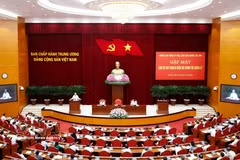
Party General Secretary and State President To Lam presides over the meeting with officials included in the personnel planning scheme under the management of the Politburo. (Photo: VNA)

Strategic-level personnel planning crucial to Party’s future: Top leader

Strategic-level personnel planning is not merely a personnel matter serving a single Party Congress, term of office or organisational structure. Rather, it is an integral part of strategic governance aimed at preparing future Party leadership and the country’s long-term development, said top leader To Lam.

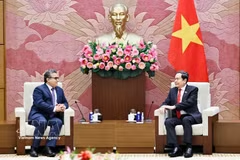
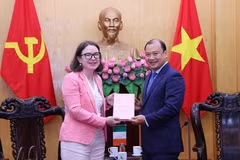
Assoc. Prof. Dr. Le Hai Binh, Standing Vice President of the Ho Chi Minh National Academy of Politics (right), and Irish Ambassador to Vietnam Deirdre Ni Fhallúin. (Photo: VNA)

HCMA eyes expanded research, training cooperation with Ireland

The Ho Chi Minh National Academy of Politics (HCMA) hopes to expand cooperation with Irish partners through global-scale joint research programmes, as well as scholarships and short-term training courses aimed at developing strategic human resources, particularly mid- and high-level officials of the Vietnamese Party and State.

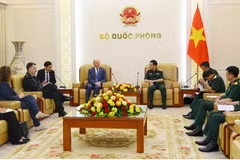
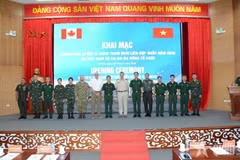
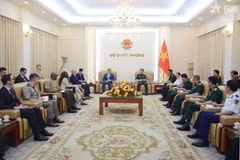
The meeting between Deputy Prime Minister and Minister of National Defence General Phan Van Giang and Canadian Ambassador to Vietnam James Nickel in Hanoi on June 23 (Photo: nhandan.vn)

Vietnam, Canada seek to promote defence cooperation

Expressing his satisfaction with the positive and increasingly substantive development of the Vietnam – Canada Comprehensive Partnership, Deputy Prime Minister and Minister of National Defence General Phan Van Giang noted that based on the existing agreements, bilateral defence ties have been effectively advanced across a range of areas, including delegation exchanges, dialogue and consultations, training, United Nations peacekeeping operations, defence industry and maritime security.

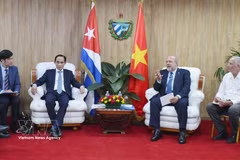
At the meeting between Politburo member and Minister of Foreign Affairs Le Hoai Trung (L) - Special Envoy of General Secretary of the Communist Party of Vietnam (CPV) Central Committee and State President To Lam - and Cuban Prime Minister Manuel Marrero Cruz (Photo: VNA)

Vietnam, Cuba promote comprehensive cooperation in new development stage

During the visit, from June 20 to 22, Trung held meetings with First Secretary of the Communist Party of Cuba (PCC) Central Committee and President of Cuba Miguel Diaz-Canel and Prime Minister Manuel Marrero Cruz, and conducted talks with Politburo member and Minister of Foreign Affairs Bruno Rodriguez Parrilla.

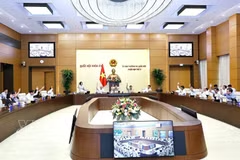
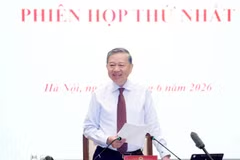
Party General Secretary and State President To Lam chairs the first meeting of the central steering committee for institutional perfection and law enforcement in Hanoi on June 22, 2026. (Photo: VNA)

Top leader calls for measurable progress in institutional perfection

Party General Secretary and State President To Lam emphasised that assignments must not be reduced to slogans and rejected situations where agencies report that initiatives have been launched, studied or disseminated without being able to identify completed deliverables, promulgated legal documents, simplified administrative procedures, resolved legal inconsistencies, and accountability at leadership level.

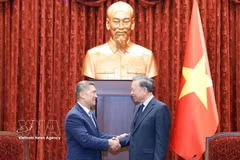
General Secretary of the Communist Party of Vietnam Central Committee and State President To Lam (R) meets with Acting US Secretary of the Navy Hung Cao in Hanoi on June 22. (Photo: VNA)

Top leader welcomes Acting US Secretary of the Navy

Vietnam always considers the US one of its most strategically important partners, and wants to work closely with Washington to deliver on the Comprehensive Strategic Partnership framework, advancing ties in a substantive, comprehensive and effective manner for the benefit of their people and for peace, stability and prosperity in the region and the world.

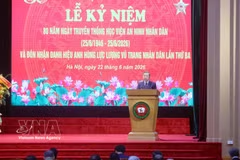
Party General Secretary and State President To Lam addresses the ceremony in Hanoi on June 22 marking the 80th founding anniversary of the People's Security Academy. (Photo: VNA)

Top leader asks for building security workforce fit for new era

Party General Secretary and State President To Lam noted that as Vietnam advances into a new stage of development with greater security challenges, the requirement of safeguarding national security is becoming higher and more comprehensive. This places new responsibilities on the academy, not only in training officers with strong political mettle, professional competence and absolute loyalty to the Party, the Fatherland and the people, but also in nurturing digital literacy, innovative thinking, lifelong learning capacity, adaptability, global cooperation skills and digital citizenship.

Deputy Prime Minister and Minister of National Defence General Phan Van Giang hosts a reception in Hanoi on June 22 for Acting US Secretary of the Navy Hung Cao. (Photo; qdnd.vn)

Vietnam, US seek stronger defence cooperation

The minister reaffirmed that Vietnam’s Ministry of National Defence would continue to coordinate closely and facilitate efforts to search for US personnel missing in action (MIA) during the war. He also called on the US to share more information, documents and belongings related to Vietnamese soldiers and support Vietnam in enhancing DNA analysis capabilities to identify war martyrs’ remains.

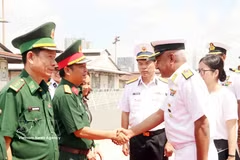
Representatives from the Department of Foreign Affairs of the Ministry of National Defence welcome Rear Admiral Alok Ananda (right), Flag Officer Commanding Eastern Fleet of the Indian Navy on June 22. (Photo: VNA)

Indian Navy flotilla begins goodwill visit to Ho Chi Minh City

The visit is expected to contribute to strengthening the traditional friendship and the Enhanced Comprehensive Strategic Partnership between Vietnam and India, particularly defence cooperation, while maintaining exchanges and interactions between the two navies.