Hanoi (VNA) - Vietnam’s public investment spending is accelerating sharply, cementing its role as a critical growth engine as global trade and economic uncertainty undercut traditional drivers.
Disbursement reached 227.2 trillion VND (8.73 billion USD) as of June 4, equal to 22.4% of the Prime Minister’s annual plan, the Ministry of Finance said. That was up from 198.4 trillion VND a week earlier, meaning more than 28.8 trillion VND was disbursed in the May 29–June 4 period alone, about 1.8 times the prior week’s pace.
The Government has allocated 1.01 quadrillion VND in state investment for 2026, including 363.2 trillion VND from central coffers and 650.2 trillion VND from local ones. An additional 18.1 trillion VND in central budget investment has subsequently been approved, while local authorities have topped up their own balanced-budget investment allocations by 13.3 trillion VND beyond what the PM originally assigned.
Speaking at a discussion as part of the Vietnam Investment Forum 2026 - Summer Summit, experts said disbursement hit 21.6% of the annual plan as of May 31. The amount of disbursed capital jumped by more than 34.8 trillion VND, an 18.9% increase from the plan.
With traditional growth engines facing high global interest rates, exchange rate volatility, rising oil prices and an increasingly unpredictable trade landscape, public investment is emerging as a more reliable source of economic stability and a key cushion against external shocks.
Vietnam has set a target of fully disbursing its public investment budget in 2026, a goal lawmakers and analysts said will be tough to achieve.
Phan Duc Hieu, a standing member of the National Assembly’s Committee for Economic and Financial Affairs, said delays vary widely from project to project, making one-size-fits-all policy prescriptions far less effective.
He argued that authorities should zero in on clearing individual bottlenecks rather than adopting uniform solutions nationwide. Given the scale of spending, delays in land preparation, project adjustments, material supplies or payment procedures can have an outsized drag on overall disbursement.
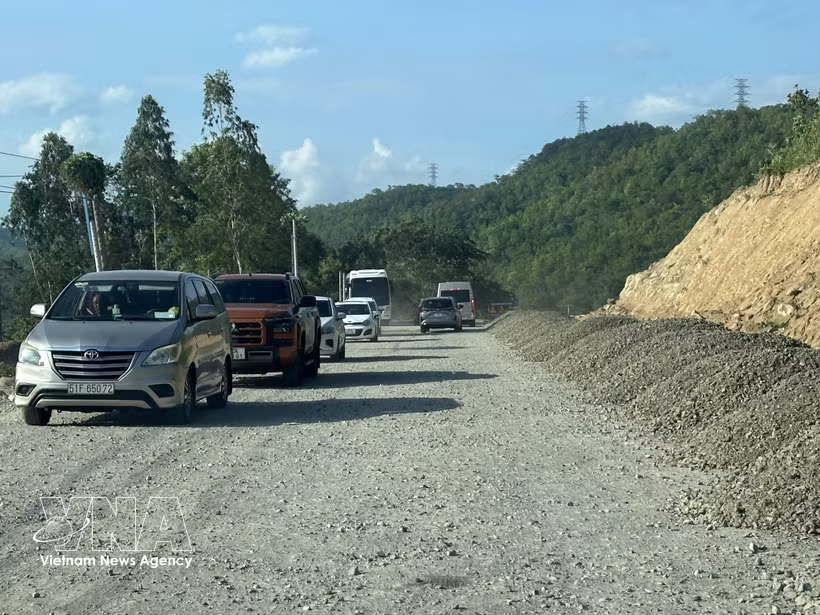
The most frequently cited obstacles are shortages of fill materials and construction inputs, along with rising material costs.
According to him, some provinces have been granted special mechanisms that let them accelerate licensing and access to construction materials. Extending those flexibilities nationwide could help quicken project timelines and capital spending.
Another headwind is cost inflation for construction and equipment. Contractors are increasingly seeking revisions to project budgets and investment estimates as input prices rise. Investors have called for greater state support in sharing cost increases, particularly for fixed-price and lump-sum contracts, while pushing for more frequent adjustments to pricing mechanisms that reflect market conditions.
Nguyen Xuan Thanh, a senior lecturer at the Fulbright School of Public Policy and Management, said this year’s performance should be seen alongside 2025, when Vietnam also targeted 100% disbursement. The country missed that mark within the calendar year, but the rate ultimately climbed to 98% after accounting for the extended budget settlement period, a record high.
Achieving full disbursement in 2026 will be challenging given an unprecedented investment plan exceeding 1 quadrillion VND. Even so, a 95% rate would still deliver a substantial fiscal jolt to the economy, he said.
He added that a 95% outcome is within reach because many large projects have entered their final stages, reducing land acquisition risks and shifting the focus toward equipment installation and completion.
The main challenge now is managing cost overruns as contractors seek adjustments to account for rising prices of construction materials, machinery and equipment. Greater flexibility across ministries, agencies and local authorities will be critical to enable timely budget reallocations and investment plan revisions without getting tangled in lengthy approval processes.
Analysts also pressed for stricter enforcement of capital reallocation rules, under which funding is stripped from delayed projects and redirected to those that can deploy it faster.
If executed effectively, public investment is poised to remain one of Vietnam’s most stable and predictable growth drivers in an increasingly uncertain global environment, helping underpin economic expansion through the rest of the year./.