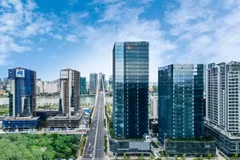
Ho Chi Minh City (VNA) – Business sentiment in Vietnam is rebounding strongly despite a challenging operating environment marked by rising costs and growing global uncertainties, including prolonged geopolitical tensions and trade-related pressures, according to the recently released Business Outlook Study 2026 by the United Overseas Bank (UOB).
The study found that 85% of Vietnamese enterprises reported positive business sentiment, a sharp increase from 48% in 2025, when business confidence was weighed down by uncertainties surrounding US tariff policies and related trade developments.
Energy management becomes strategic priority
The outlook remains highly optimistic, with nine out of 10 businesses expecting improved performance in 2026 and forecasting stronger revenue growth in 2027–2028.
However, macroeconomic challenges continue to exert pressure on business operations. Nearly half of the surveyed firms reported higher costs linked to tariff measures and geopolitical tensions, underscoring the urgent need for solutions that enhance operational efficiency, strengthen cost management, and support sustainable business transformation in an increasingly complex operating environment.
In addition to persistent concerns over trade and geopolitical uncertainties, energy management is emerging as a top strategic priority for Vietnamese businesses. Even before the recent escalation of tensions in the Middle East, the study found that 96% of enterprises in Vietnam considered efficient energy management and use important, significantly higher than the regional average of 87%.
More than half of the surveyed firms (55%) identified ensuring a stable and sustainable energy supply for their operations as a key priority, while 53% focused on optimising energy use and 47% sought to reduce energy consumption and improve energy efficiency.
To achieve these goals, companies are increasing investments in energy-saving equipment (43%) and solar power solutions (42%), aiming to strike a balance between cost management and long-term operational sustainability.
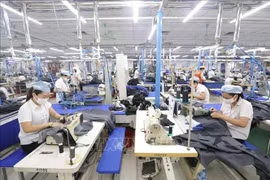
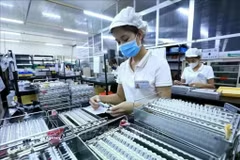
At the same time, Vietnamese firms are accelerating their digital transformation efforts, with artificial intelligence (AI) gradually emerging as a key driver of growth. Although adoption remains at an early stage, eight in ten enterprises have begun implementing AI solutions. However, only around 25% have reached an advanced level of AI utilisation.
AI is already delivering tangible benefits for businesses, with 49% of the surveyed firms reporting improved productivity, 47% achieving cost savings, and 46% posting revenue growth. Reflecting growing confidence in the technology’s potential, two-thirds of businesses plan to increase their AI investment budgets by more than 25% in 2026.
However, AI adoption continues to face several challenges. The main obstacles cited by businesses include high costs and limited financial resources (49%), constraints related to AI solutions and partner ecosystems (48%), as well as limitations in data availability and system readiness (47%).
Strong focus on supply chain diversification
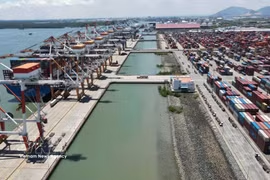
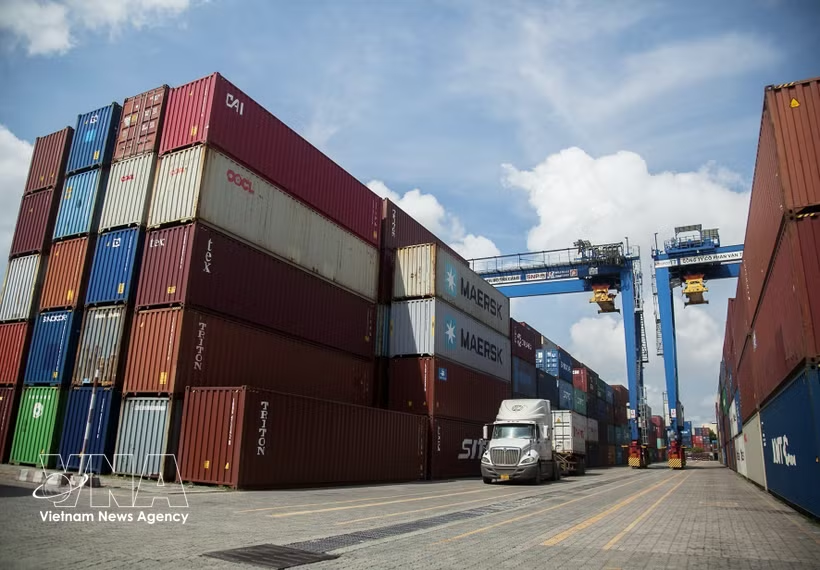
Supply chain management continues to be a top priority, with 97% of Vietnamese businesses identifying it as critical. While disruptions have eased compared with previous years, challenges persist, particularly from geopolitical risks and procurement complexity. Regulatory ambiguity also remains a concern, affecting 88% of businesses.
To strengthen resilience, Vietnamese companies are actively diversifying their supply chains. Four in five businesses plan to expand their supplier networks in 2026, with more than half looking to increase suppliers within ASEAN and 23% focusing on domestic sourcing.
Nearshoring strategies are also gaining momentum. About one in three intend to establish or expand operations in Vietnam, while many are also considering broader ASEAN expansion (43%), reinforcing the region’s role as a key manufacturing and supply chain hub.
This shift is strongly driving a wave of international expansion. Seven in ten Vietnamese businesses expanded their operations overseas in 2025, while nine in ten plan to further expand internationally over the next three years. Likewise, 80% of Vietnamese enterprises intend to invest abroad within the next two years, with the average planned investment exceeding 28 million USD.
ASEAN remains the preferred destination for expansion, with 65% of Vietnamese firms identifying the region as their top choice. Among ASEAN markets, Thailand, Singapore and Indonesia are the most attractive destinations. However, companies continue to face a number of challenges, particularly in meeting legal, regulatory, compliance and tax requirements (36%), finding suitable local partners (36%), and gaining access to partnership opportunities with large corporations or government-linked organisations.
Pham Nhu Anh, head of Wholesale Banking at UOB Vietnam, said that Vietnamese businesses are demonstrating remarkable resilience and adaptability in an increasingly volatile global environment./.
See more
Agricultural exports increase, but face climate-related challenges
In addition to market pressures, the agricultural sector is facing growing risks from extreme weather events expected in the latter months of the year due to El Niño.
Lychee prices soar as output drops by more than 50%
The province is home to more than 29,800ha of “thieu” lychee orchards, with total output expected to reach around 125,000 tonnes in 2026. As the peak harvest season gets underway, growers are rushing to bring in the crop.
Vietnam retains cost competitiveness amidst regional challenges: JLL report
Despite challenges, Ho Chi Minh City maintains a competitive edge concerning office fit-out costs in the region, with an average cost of 1,150 USD per square metre for medium-quality corporate offices—significantly lower by 26% compared to the regional average of 1,550 USD per sq.m.
Resolution 10-NQ/TW redefines foreign capital attraction
Resolution 10-NQ/TW marks a significant reset of Vietnam’s foreign investment strategy, introducing broad reforms to create a more unified and effective framework for attracting foreign capital.
Reference exchange rate goes up further on June 23
With the current trading band of +/- 5%, the ceiling rate applicable for commercial banks during the day is 26,448 VND/USD, and the floor rate 23,930 VND/USD.
National traceability system for agro-forestry-fishery products to be launched on July 1
Pilot implementation has been conducted for several major export commodities, notably durian. Initial results indicate that the system has effectively supported the traceability of export shipments, improving transparency and helping enterprises meet increasingly stringent international requirements.
Vietnam Report unveils top 10 reputable commercial banks for 2026
The top 10 are Vietcombank, VietinBank, Techcombank, MB, BIDV, Agribank, ACB, VPBank, HDBank, and SHB.
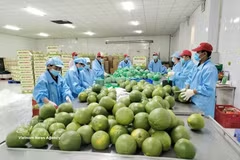
Vinh Long scales up green-skinned pomelo farming for export
Vinh Long farmers are scaling up specialised growing zones and tightening production standards, aiming to lock in sustainable growth for pomelo cultivation and more prosperity across the Mekong Delta province.
Ho Chi Minh City eyes smart manufacturing transformation through industrial park restructuring
It’s time for the city to accelerate the restructuring of IPs and EPZs towards high technology, smart manufacturing, integrated logistics and deeper participation in global supply chains to enhance competitiveness.
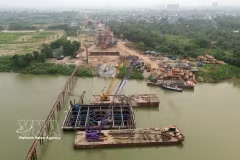
Many Red River bridge projects race to finish before APEC 2027
Several major bridges spanning the Red River are being built simultaneously in Hanoi, with several key projects targeted for completion before the Asia-Pacific Economic Cooperation (APEC) Economic Leaders' Meeting in 2027
Coteccons continues rising on Fortune Southeast Asia 500, anchoring foundation for quality growth phase
The Fortune Southeast Asia 500 is an annual ranking compiled by Fortune magazine (USA) to honor the 500 largest enterprises by revenue across seven Southeast Asian nations.
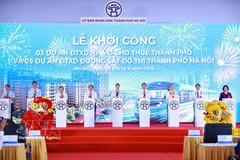
Hanoi launches construction of five metro lines spanning over 300 km
The projects form a key part of Hanoi's strategy to develop a mass rapid transit network, gradually realise its urban railway master plan and support urban expansion in multiple directions.
Efficiency measures needed to safeguard national energy security: experts
The Government now requires state agencies and businesses to develop energy-saving plans, set key performance indicators (KPIs) on energy efficiency, establish energy consumption benchmarks, and tighten technical standards and regulations in production and export.
Vietnam is key priority for US investment fund: DFC Chief Policy Officer
Vietnam is a key priority market for the US International Development Finance Corporation (DFC) as it looks to expand its investment footprint in the Southeast Asian country. Caroline Vik, Chief Policy Officer at the DFC told the Vietnam News Agency (VNA) during her visit to Vietnam from June 19 to 21.
PM attends ground-breaking ceremony of Hanoi’s rental housing, metro line projects
The three rental housing projects include the Phap Van–Tu Hiep new urban area in Yen So ward, the city rental housing development project in Viet Hung ward, and the Him Lam Long Bien mixed-use housing complex. Together, they are expected to provide thousands of apartments, helping to meet growing housing demand among workers, students, civil servants, members of the armed forces, and low- and middle-income residents.
Reference exchange rate rises slightly at week’s beginning
The State Bank of Vietnam set the daily reference exchange rate at 25,183 VND/USD on June 22, up 2 VND from the last working day of the previous week.
Bac Ninh seeks high-quality foreign investment for sustainable growth
According to Vice Chairman of the provincial People’s Committee Pham Van Thinh, the province aims to maintain stable and sustainable growth, improve the competitiveness of both the economy and local businesses, and make better use of free trade agreements (FTAs) to expand and diversify export markets.
Vietnamese media navigate economics of journalism in digital age
For decades, the country's press sector relied largely on two traditional sources of revenue: print circulation and advertising. However, the rise of social media and cross-border digital platforms has fundamentally altered that equation, forcing newsrooms to rethink how they operate and generate income.
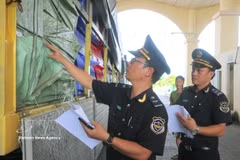
Customs force tightens crackdown on intellectual property-infringing goods
As offenders adopt increasingly sophisticated tactics, customs authorities are tightening controls at border gates, stepping up the use of technologies and refining enforcement measures to intercept illicit goods at the import and transit stages.
Hanoi to start construction on five key metro lines
Five key metro lines are scheduled to begin construction in Hanoi on June 22, providing fresh momentum for the development of public transport and urban growth.