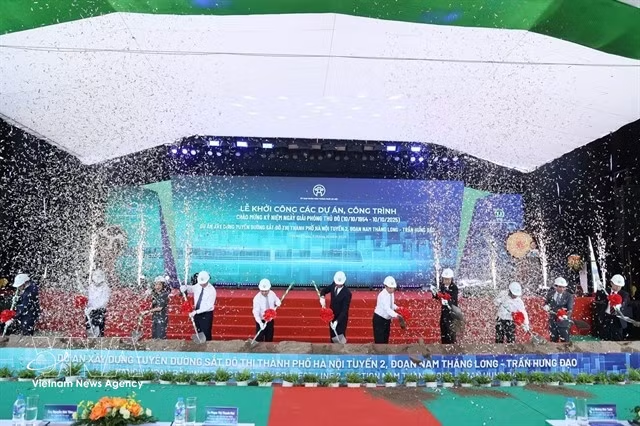
Hanoi (VNS/VNA) - Five key metro lines are scheduled to begin construction in Hanoi on June 22, providing fresh momentum for the development of public transport and urban growth.
The concurrent start of the five urban rail lines marks a new phase in the capital’s strategy for transport infrastructure development and restructuring of its urban space.
According to Nguyen Ba Son, Deputy Director of the Hanoi Metropolitan Railway Management Board (MRB), implementing five metro lines at the same time represents a fundamental shift in investment mindset.
Although the city previously developed lines individually, it is now moving to coordinate investment across multiple routes, aiming to complete a high-capacity public transport network in a shorter time frame.
This is also the first time Hanoi has launched an urban rail investment programme on such a large scale, laying the foundation for a modern, integrated and interoperable transport system.
Under the capital’s master plan for 2021–2030, Hanoi authorities intend to develop 18 urban rail lines with a total length of approximately 979km. The city aims to complete around 500km of urban rail by 2035, with the remainder to be invested in the 2035–2045 period.
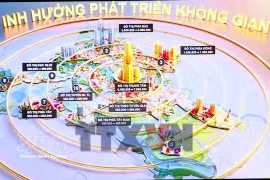
The five metro lines due to start on June 22 are expected to become backbone transport corridors, steering urban development towards a polycentric, multi-directional model. In addition to easing traffic pressure, the urban rail lines will expand development space, promote the formation of new urban areas and refurbish existing districts.
The projects are being implemented against a backdrop of special mechanisms enacted by the National Assembly to support urban rail development, such as Resolution 188/2025/QH15, Resolution 258/2025/QH15 and the amended Law on Capital.
These measures simplify investment procedures and shorten project preparation time by removing the previous requirement to prepare and approve an investment policy stage.
Notably, land clearance has been separated into an independent project, allowing early implementation once route alignments are approved and ensuring the handover of cleared land to contractors.
According to the MRB, all five selected lines play strategic roles within the capital’s future transport network.
All five lines are planned for completion by 2030. Once operational, they will connect with Line 3 and Line 5, forming an integrated public transport network across the city.
Alongside the new lines, Hanoi is accelerating progress on Metro Line 3, particularly the underground section, with the objective of completing the entire line by the end of 2027. Line 5 is currently undergoing design finalisation and a dual-use feasibility study as directed by the Government.
The simultaneous start of five urban rail lines is expected to usher in the largest phase of transport infrastructure development Hanoi has ever seen, providing further impetus for economic growth and the construction of a green, smart and sustainably connected city.
Line 1 is approximately 81km long, linking the Hung Vuong Stadium area, Ngoc Hoi, Hanoi Station, Gia Lam and Noi Bai International Airport. It will serve as an important north–south corridor, connecting the urban rail network with the national railway, high-speed rail and the airport.
The 56.5km-long Line 2 also connects the capital to Noi Bai airport, going through the historic city centre via Nam Thang Long, Hoan Kiem Lake, Tran Hung Dao, Thuong Dinh and southern urban areas.
Line 8 is roughly 91km in length, linking the Hoa Lac High‑Tech Park with logistics zones, industrial parks and eastern growth centres of the capital.
A closed circular route, Line 10 is approximately 43km long and connects Co Loa, Vo Chi Cong, Ring Road 3, Ring Road 2.5 and Times City before returning to Co Loa, helping to reduce traffic pressure in the inner city.
Line 14 is around 32km long, connecting the Thang Long Bridge and Ciputra area through central Hanoi to Ocean Park and the city’s eastern districts, supporting new urban development and strengthening regional links./.
Hanoi prepares to launch 1.5-billion-USD Metro 2A extension project
The Hanoi Metropolitan Railway Management Board (MRB) announced that it will organise an Early Market Engagement (EME) event for the project on June 18-19 in Hanoi to collect feedback from domestic and international businesses and consultants before the official bidding process begins.