Hanoi (VNA) – The rapid expansion of cross-border e-commerce is creating major opportunities for international trade, but it is also increasing the risk of counterfeit, imitation and intellectual property (IP)-infringing goods entering markets.
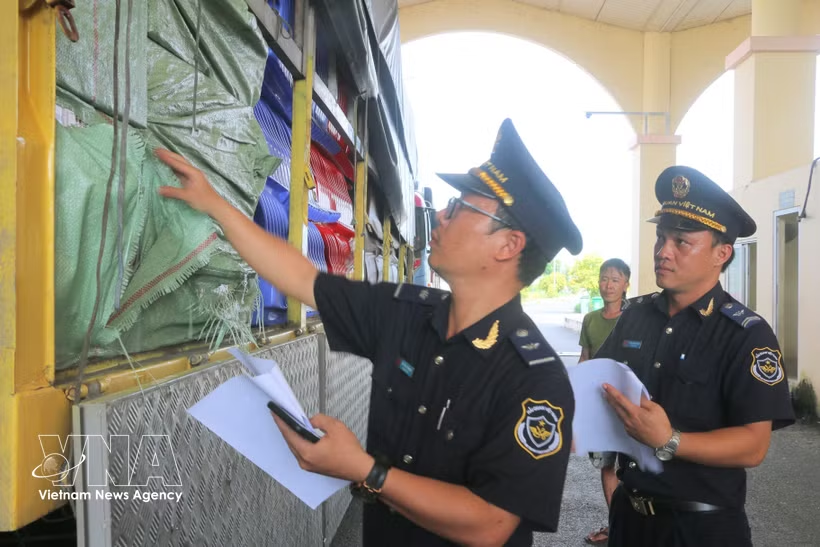
As offenders adopt increasingly sophisticated tactics, customs authorities are tightening controls at border gates, stepping up the use of technologies and refining enforcement measures to intercept illicit goods at the import and transit stages.
Cross-border e-commerce has significantly altered the way goods are transported and distributed. Whereas infringing products were previously moved in large volumes through formal import channels, there is now a growing trend of splitting shipments into smaller consignments and sending them via express delivery services, international post or under the guise of transit operations. The range of infringing products has also widened, spanning fashion, cosmetics, electronics, technology accessories and children’s toys.
According to the Department of Customs, during a recent nationwide campaign implementing the Prime Minister’s Official Dispatch No. 38/CD-TTg on combating counterfeit goods and intellectual property violations, the customs force detected and seized thousands of suspected counterfeit products, trademark-infringing goods and imports failing to meet regulatory requirements. The results underscore both the complexity of the issue and customs authorities’ determination to tighten oversight across borders and ports of entry.
Violations are no longer concentrated solely along the northern border, where trade flows with China are highest. Cases have also emerged along transit transport routes and at major southern seaports.
A series of recent cases indicates that IP-infringing goods are appearing across multiple trade routes and import-export categories. Of particular concern is the growing exploitation of cross-border e-commerce platforms to channel counterfeit and imitation products into the domestic market through small-scale orders, complicating inspection and monitoring efforts.
To respond to these challenges, the customs sector is accelerating the adoption of information technology, digital transformation, and risk-based management. Databases on intellectual property rights, protected trademarks and alerts issued by rights holders are being continuously updated to help customs officers identify suspect goods more effectively.
Alongside tighter inspections at border checkpoints, customs authorities are also improving the legal framework to strengthen enforcement against counterfeit and IP-infringing products. Recently, the Department of Customs issued a document to standardise appraisal procedures for exported, imported and transit goods suspected of infringement.
Under the new guidance, where a rights holder or authorised representative has already confirmed an infringement in writing, customs authorities may proceed directly with enforcement without requiring an expert assessment. In cases where evidence remains insufficient, customs officers will collect samples for appraisal or coordinate with relevant agencies for further verification.
The measure is expected to shorten investigation timelines, speed up case handling and strengthen prevention efforts directly at points of entry.
The customs sector is also enhancing cooperation with trademark owners, industry associations and international organisations to exchange information, support authentication of genuine products and strengthen enforcement capacity. This is seen as an essential response as intellectual property violations become increasingly sophisticated, cross-border in nature and closely linked to the growth of e-commerce./.
See more
Hanoi to start construction on five key metro lines
Five key metro lines are scheduled to begin construction in Hanoi on June 22, providing fresh momentum for the development of public transport and urban growth.
Son La province’s Arabica coffee affirms position on international market
From just 278 hectares in the 1980s, the province had expanded its coffee-growing area to more than 33,600 hectares across 48 communes, making coffee one of its key agricultural industries.
E-commerce opens new growth opportunities for Vietnam’s fashion industry
Vietnam’s fashion industry is poised for a new phase of growth as e-commerce adoption accelerates, though businesses must overcome challenges in branding, sustainability and digital transformation to fully capture the opportunity.
Vietnam-Singapore trade reflects deeper integration in supply chains
According to the Vietnam Trade Office in Singapore, Vietnam remained Singapore’s 10th largest trading partner in the first five months of 2026, with bilateral trade reaching 23.3 billion SGD (18.02 billion USD), up 43.4% year-on-year.
Da Nang, Copenhagen strengthen ties for green development
The event “Da Nang – Copenhagen: A green journey along the Han river”, which opened at APEC Park on June 20, marks the 55th anniversary of Vietnam–Denmark diplomatic relations (1971–2026) while promoting exchanges and collaboration on sustainable urban development.
Vietnam enhances transparency, counterfeit control on cosmetics market
Combating counterfeit goods and protecting consumer rights are key priorities that contribute to a fair competitive environment and the sustainable development of the domestic market.
MoU expected to support Vietnamese businesses in Czech Republic
The signing marked a new step forward in enhancing connectivity between Czech state management agencies and the Vietnamese business community and household businesses, helping citizens gain faster and more accurate access to legal regulations related to business activities in the Czech Republic.
FPT links Vietnamese, French businesses to advance AI transformation
Present in France since 2008, FPT now serves as a technology partner to major enterprises including La Poste, Air Liquide, Quadient, Sagemcom, SNCF and Geopost. It aims to become one of the top 50 IT firms in France while further expanding its footprint across French-speaking markets.
Petrovietnam signs two major oil, gas agreements
The agreements underscore the commitment of Petrovietnam, the Petrovietnam Exploration Production Corporation (PVEP) and their partners to advancing oil and gas exploration, development and production activities, contributing to national energy security, optimising existing resources and creating new growth drivers for Vietnam’s energy industry.
Tay Ninh seeks Belgian investment across sectors
Tay Ninh wishes to become a trusted partner of the Belgium business community, particularly in areas such as circular economy, clean energy, environmental technology, biotechnology and advanced agriculture.
Vietnam affirms position in ASEAN, creating new growth space
Vietnam has emerged as an increasingly important driver of regional economic integration over the past three decades, with two-way trade with ASEAN soaring to approximately 91 billion USD in 2025 from only 3.26 billion USD in 1995.
Da Nang seeks opportunities in emerging fintech, Web3 wave
With special policy mechanisms approved by the National Assembly, plans for a free trade zone, an international financial centre and regional semiconductor and AI hubs, Da Nang has significant opportunities to pilot new technology and financial models while maintaining effective risk controls.
Ho Chi Minh City targets AI, semiconductor investment in new-generation FDI drive
To prepare for a new generation of FDI attraction in line with Resolution No. 10-NQ/TW on the development of the foreign-invested sector, the city is expanding its high-tech development space. A newly approved 194.84ha expansion area in Long Phuoc ward is being planned under a “Green–Clean–Digital” model, with the goal of achieving carbon neutrality before 2050.
Lam Dong eyes opportunities in multi-trillion-dollar Halal market
Lam Dong boasts a diverse range of high-quality agricultural products, including vegetables, flowers, coffee, tea, fruit and processed food products, providing a strong foundation for developing Halal-certified goods and services for markets in the Middle East, South Asia, Southeast Asia and Africa.
Electric vehicle adoption accelerates in Vietnam
In the period leading up to 2030, the construction sector will prioritise areas with strong potential for reducing urban air pollution, particularly rail and road transport. Relevant agencies are developing criteria for green rest stops, green railway stations, green seaports, and green airports. These standards are expected to be finalised in 2026 and widely applied from 2027.
Vietnamese, Cambodian localities boost investment cooperation
Permanent Vice Chairman of the Gia Lai People’s Committee Nguyen Tuan Thanh said the conference not only showcased Stung Treng’s investment potential and business environment, but also served as a practical platform for local authorities and enterprises of the two countries to exchange information, strengthen connections and explore new cooperation opportunities in investment, trade, agriculture, tourism, logistics and other sectors of mutual interest.
Vietnamese poultry eggs enter Japanese market
The first shipment to Japan not only reflects Vinh Thanh Dat’s efforts to enhance the value of Vietnamese eggs but also opens new opportunities for processed egg products to access demanding international markets.
Vietnam advances long-term rental housing to meet growing housing demand
The accelerated development of social housing, along with the gradual formation of a long-term rental housing market, is expected to create a more diversified housing ecosystem that meets the needs of various groups, contributing to developing a more sustainable social welfare policy in the time to come
Genoa–Da Nang conference strengthens Vietnam–Italy local cooperation
Addressing the opening session, Vietnamese Ambassador to Italy Nguyen Phuong Anh highlighted the strong momentum in bilateral ties, noting that the depth of the relationship extends beyond trade, investment and economic growth figures.
Vietnam, Austria enhance cooperation in firefighting, disaster response
Vietnam and Austria are seeking to expand cooperation in firefighting, rescue operations and disaster response, building on decades of successful collaboration in community safety and emergency management.