Solutions needed to turn science, technology, innovation into key growth driver

Development efforts should properly recognise and leverage the role of science and technology in creating new economic models based on emerging resources.

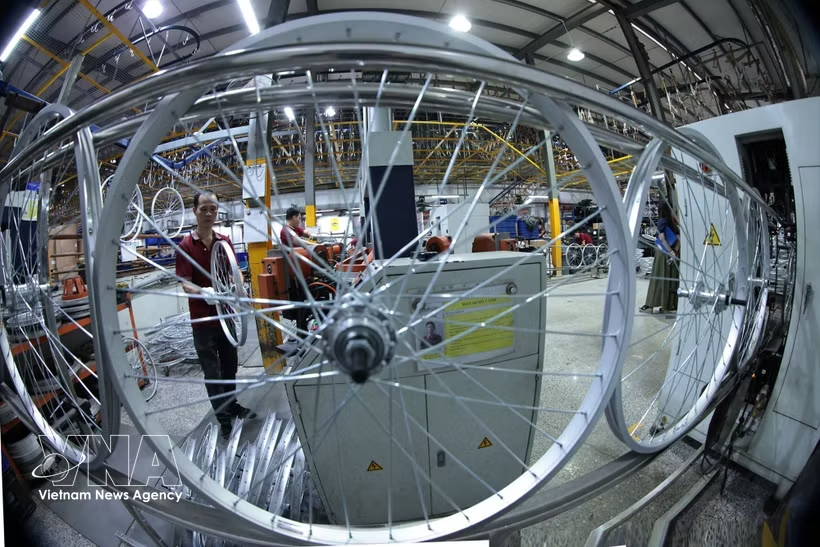
An automated bicycle rim inspection machine (replacing work previously carried out by 20 workers) at Hanoi Thong Nhat JSC. (Photo: VNA)

Hanoi (VNA) – To make science, technology, innovation and digital transformation the central drivers of economic growth, further solutions are needed to translate policies, legal frameworks and strategic directions into practical outcomes.

Associate Professor Dr Vu Sy Cuong of the Academy of Finance said the Politburo’s Resolution No. 57-NQ/TW marks a major strategic shift, moving Vietnam away from a growth model based on capital and low-cost labour towards one driven by productivity, science, technology and innovation. At the same time, the Politburo’s Resolution No. 68-NQ/TW on the private economic sector's development identifies the sector as a pioneering force in advancing science, technology, innovation and digital transformation.

In recent years, the National Assembly has also translated these orientations into practice by passing a series of strategic laws designed to establish a stronger legal foundation and create momentum for science, technology, innovation and digital transformation to become key engines of economic growth.

However, experts and researchers held that significant obstacles remain in the practical operation of the economy. These include an overly administrative approach and rigid management of scientific activities, shortages in financial resources and shortcomings in allocation mechanisms, as well as a persistent gap between laboratory research and commercial markets. In addition, businesses have yet to be fully positioned at the centre of the innovation ecosystem, while issues surrounding intellectual property, valuation and appraisal of research assets remain unresolved.

Former Deputy Director of the Central Institute for Economic Management Tran Kim Chung said greater focus should be placed on developing strategic industries and technologies, including artificial intelligence and big data, while stepping up the training and effective use of high-quality human resources. Development efforts should also properly recognise and leverage the role of science and technology in creating new economic models based on emerging resources.

According to Associate Professor Dr Cuong, procedures for disbursing funds from financial support programmes for small- and medium-sized enterprises should be streamlined, alongside simplifying access to policy incentives. He also proposed introducing co-financing mechanisms for corporate research and development and piloting public procurement or commissioning schemes for innovative products to help create market demand for start-ups.

Notably, state management agencies should improve financial governance mechanisms for the public sector's science and technology activities and adopt a more streamlined, outcome-based budgeting approach with greater accountability for final results, he suggested.

There is a need to restructure State budget management for science, technology, innovation and digital transformation. This would involve shifting from invoice- and document-based audits towards evaluation based on outputs and performance outcomes.
vnanet-egg.jpg
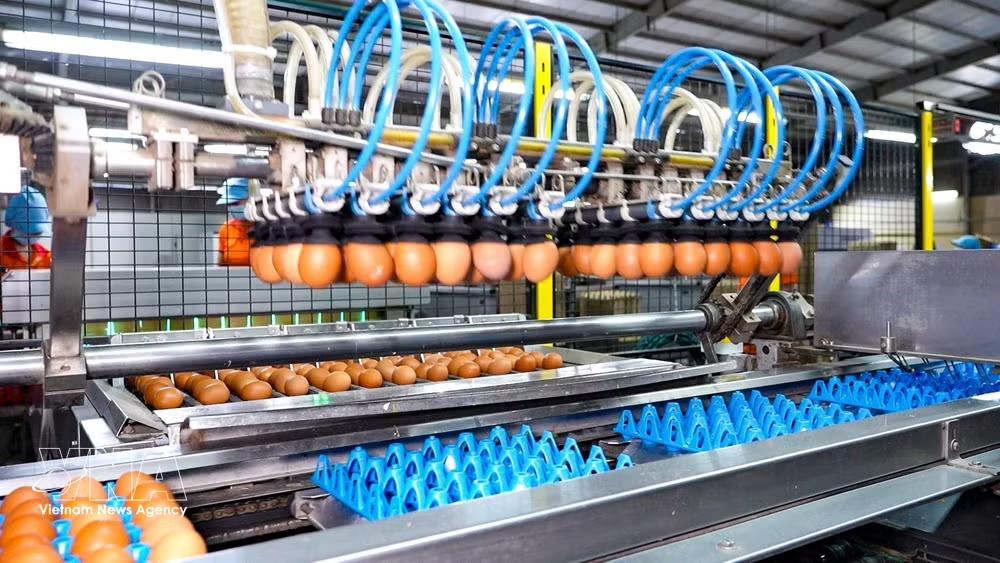
The egg collection and sorting line at QL Vietnam Agroresources Co., Ltd. in Tay Ninh province. (Photo: VNA)

Experts said the industry needs to establish mechanisms that grant full ownership rights – including usage, valuation and transfer rights – over patents and intellectual assets developed through public funding to research institutions or directly to scientists.

Once these assets are successfully valued and contributed as capital to spin-off enterprises that generate commercial returns, the State could recover its investment through corporate and personal income tax revenues generated from newly created value chains, thereby reinforcing science, technology, innovation and digital transformation as the central drivers of economic growth./.

VNA

See more

Vietnamese delegates visit a booth at the Eurosatory 2026. (Photo: VNA)

Vietnamese tech firm showcases innovations at Eurosatory 2026

As the only Vietnamese tech firm exhibiting directly at the event, Gremsy's participation highlights the growing ability of domestic enterprises to integrate into global technology value chains and compete in high-tech international markets.

Engineers monitor and operate the power system at the central control room at the Northern Power Corporation (EVNNPC)’s Thanh Hoa Power Company in May 2025. (Photo: VNA)

Vietnam boosts financial investment to drive innovation

Resolution No. 57-NQ/TW of the Politburo on the development of science, technology, innovation and national digital transformation states that these areas are becoming not only prerequisites but also a historic opportunity for the country to achieve prosperity and strengthen national competitiveness in a new era of development.

Visitors explore technology exhibition booths during the Data & AI Forum in Ho Chi Minh City on May 8, 2026. (Photo: VNA)

AI, social media redefines corporate communications

It has become part of Vietnam’s national digital transformation agenda under Politburo Resolution No. 57-NQ/TW dated December 22, 2024, which seeks to establish data, technology, innovation and digital governance as new pillars of economic competitiveness.

Illustrative image (Photo: VOV)

Valuing IP: Global standards and Vietnam’s realities

Vietnam’s legal framework already enables intangible asset valuation, and international methodologies can be applied. Yet IP valuation remains a knotty problem for regulators, valuation firms, universities, research institutes and businesses, all of whom are hunting for clearer roadmaps.

An engineer at the Digital Transformation Centre under the Khanh Hoa provincial Department of Science and Technology performs equipment maintenance. (Photo: VNA)

Efforts needed to safeguard data security in digital era

Vietnam’s cybersecurity landscape has witnessed a notable shift in recent years. While the number of cyberattacks recorded in 2025 showed signs of decline, the proportion of organisations suffering actual damage rose to 52.3%. Cyberattacks increasingly target critical sectors, including banking, finance, energy, telecommunications, and government agencies.

A worker from Hanoi branch of the Viettel Construction Corporation is connecting and installing 5G BTS station equipment. (Photo: VNA)

Vietnam expects digital economy to contribute 30% of GDP by 2030

The country also aims to support at least 500,000 small and medium-sized enterprises in digital transformation, develop a minimum of five digital technology companies capable of competing with counterparts in advanced economies, and establish at least five operational data exchanges.

The international conference takes place in Varna city, Bulgaria, from June 10 to 12. (Photo: VNA)

Vietnam hopes to enhance nuclear energy cooperation with Bulgaria: ambassador

Highly valuing Bulgaria's extensive experience in operating the Kozloduy nuclear power plant and training specialised personnel, Ambassador Nguyen Thi Minh Nguyet proposed boosting bilateral cooperation in specialist training, scientific research, and the sharing of management, operational, and nuclear safety expertise.

Visitors explore agricultural production equipment on display at Agri & Biotech Vietnam 2026 in Ho Chi Minh City. (Photo: VNA)

Agri-biotech exhibition series underway in Ho Chi Minh City

In addition to the exhibition activities, Agri & Biotech Vietnam 2026, lasting until June 12, is set to host a series of specialised forums and seminars. Topics of particular interest to businesses include farming exports, sustainable development of the pepper and spice industries, low-emission agriculture, carbon credits, the circular economy, biotechnology and innovative start-ups.

At Expo Tel Aviv in Israel (Photo: VNA)

Digital transformation fuels demand for cybersecurity talent

According to the National Cybersecurity Association (NCA), cyberattacks are rising in both frequency and severity. Attackers are targeting critical infrastructure, personal data, and public services with increasingly advanced methods. This isn't just a technical glitch, but a systemic vulnerability requiring a workforce that can analyse and respond in real time.

Billionaire Eric Schmidt, former Chairman and CEO of Google and former Chairman of the US National Security Commission on Artificial Intelligence (NSCAI) (Photo: NIC/VietnamPlus)

Vietnam well-positioned to become global AI hub: Eric Schmidt

Vietnam possesses significant advantages and strong potential to emerge as a global centre for artificial intelligence (AI), according to billionaire Eric Schmidt, former Chairman and CEO of Google and former Chairman of the US National Security Commission on Artificial Intelligence (NSCAI).

Vietnamese Ambassador to Austria Vu Le Thai Hoang speaks at the event. (Photo: VNA)

Vietnam shows off homegrown humanoid robots in Austria

The event paired a robotics showcase with an innovation networking session, spotlighting Vietnamese companies’ research, development and technological mastery in robotics, automation and artificial intelligence.