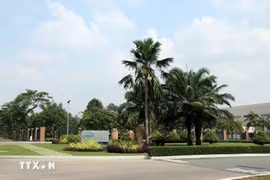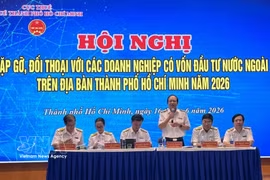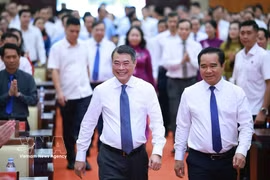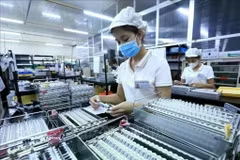
Ho Chi Minh City (VNA) – Ho Chi Minh City is poised for a major transformation as the Law on Special Urban Areas will soon be issued for the southern metropolis, expected to provide breakthrough mechanisms in decentralisation, investment, finance, land management and modern industrial-urban development, while laying an important legal foundation for restructuring export processing zones (EPZs) and industrial parks (IPs) towards smart, high-tech manufacturing.
Following its merger with the neighbouring provinces of Binh Duong and Ba Ria-Vung Tau, Ho Chi Minh City is well positioned to build a regional industrial, logistics and high-tech ecosystem with stronger international integration. At the same time, the traditional industrial development model is facing growing challenges, including shrinking industrial land reserves, mounting pressure on urban infrastructure and rising production costs. Investors are also placing greater emphasis on digital infrastructure, green energy and smart supply chains.
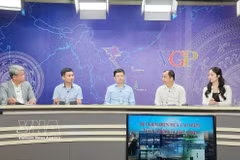
According to Nguyen Trung Tin, Deputy Head of the Ho Chi Minh City Export Processing and Industrial Zones Authority (HEPZA), global economic volatility, supply chain shifts, digital transformation and sustainability requirements are creating an urgent need to modernise the development model of EPZs and IPs.
It’s time for the city to accelerate the restructuring of IPs and EPZs towards high technology, smart manufacturing, integrated logistics and deeper participation in global supply chains to enhance competitiveness, he stated.
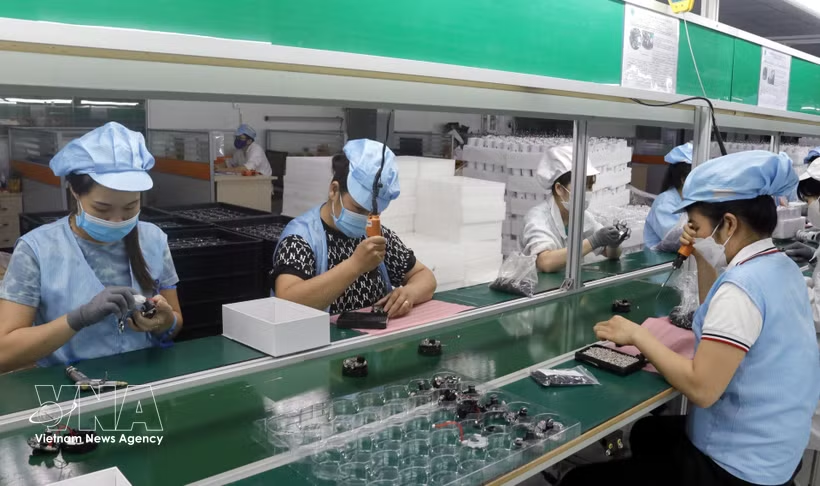
HEPZA is preparing a report on the transformation of IPs and EPZs and the restructuring of key industries linked to high technology, eco-industries and next-generation smart industrial parks. The authority is also promoting the development of smart and eco-industrial parks in line with international standards.
Under the city’s development orientation, central Ho Chi Minh City will serve as an international financial and commercial hub, a centre for innovation, high technology and high-quality services, and a regional supply chain command centre. Priority sectors include the digital and green economies, research and development, semiconductors, artificial intelligence and international finance.
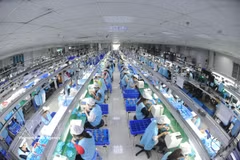
The former Binh Duong area is envisioned as a centre for high-tech industry, eco-industrial development, smart manufacturing and domestic logistics. Existing IPs and EPZs will be restructured in line with green, digital and circular economy models, prioritising electronics, semiconductors, precision engineering, automation, data centres and high-value supporting industries.
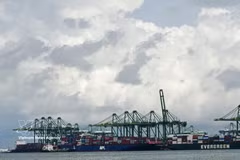
Meanwhile, the former Ba Ria–Vung Tau area is expected to become a hub for the marine economy, international transshipment ports, logistics, energy and port-linked industries, leveraging the advantages of the Cai Mep–Thi Vai port complex.
The integration of these three development zones is expected to create a complete supply chain ecosystem spanning research, manufacturing, logistics and exports, helping the city attract strategic foreign direct investment (FDI) and strengthen its regional competitiveness.
Industrial businesses believe that the planned establishment of a free trade zone in the former Ba Ria–Vung Tau area will provide a new impetus for logistics, seaport development, international trade and value-added services, while enhancing supply chain connectivity across southern Vietnam.
Experts have called for the effective implementation of the National Assembly's Resolution No. 98/2023/QH15 and Resolution No. 260/2025/QH15 and Government Resolution No. 66/NQ-CP to simplify administrative procedures and create a transparent and favourable investment environment for IPs and EPZs.
Le Van Danh, Deputy Director of the municipal Department of Industry and Trade, said the NA's Resolution No. 260/2025/QH15, together with the Prime Minister’s Decision No. 2229/QD-TTg, provides breakthrough mechanisms for developing industrial parks, export processing zones, high-tech parks and logistics centres.
He stressed that building a smart manufacturing ecosystem linked with logistics and free trade zones is a long-term strategy to transform Ho Chi Minh City into a modern, sustainable and internationally competitive economic hub./.
VNA