Top leader calls for measurable progress in institutional perfection

Party General Secretary and State President To Lam emphasised that assignments must not be reduced to slogans and rejected situations where agencies report that initiatives have been launched, studied or disseminated without being able to identify completed deliverables, promulgated legal documents, simplified administrative procedures, resolved legal inconsistencies, and accountability at leadership level.

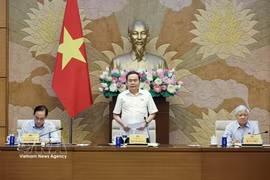
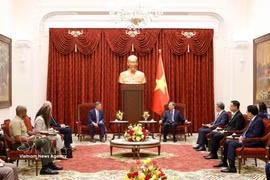
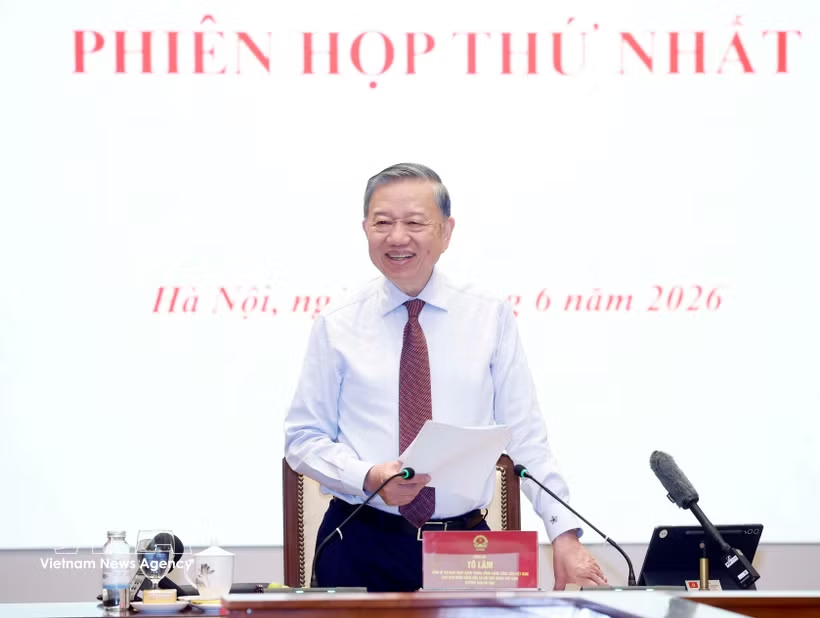
Party General Secretary and State President To Lam chairs the first meeting of the central steering committee for institutional perfection and law enforcement in Hanoi on June 22, 2026. (Photo: VNA)

Hanoi (VNA) – Measurable progress must be achieved by the end of 2026 in reducing administrative procedures, removing institutional bottlenecks and improving legal frameworks across key sectors, Party General Secretary and State President To Lam stressed while chairing the first meeting of the central steering committee for institutional perfection and law enforcement in Hanoi on June 22.

The event saw the presence of Prime Minister Le Minh Hung, deputy head of the central steering committee; National Assembly Chairman Tran Thanh Man, deputy head; and Permanent member of the Party Central Committee's Secretariat Tran Cam Tu, standing deputy head; among others.

The top leader, who also serves as head of the steering committee, called for efforts to accelerate the finalisation and effective operation of the committee’s working mechanism and inter-agency coordination arrangements. He also urged thorough preparation of major draft laws, resolutions and policy proposals for submission to the National Assembly, while addressing delays in issuing implementation guidelines.

General Secretary and President Lam requested that following the meeting, relevant agencies move immediately to implementation, develop plans to monitor, supervise and inspect the execution of the meeting’s conclusions, and provide regular reports on completed tasks, delays, difficulties, issues beyond authority and matters requiring resolution.

He emphasised that assignments must not be reduced to slogans and rejected situations where agencies report that initiatives have been launched, studied or disseminated without being able to identify completed deliverables, promulgated legal documents, simplified administrative procedures, resolved legal inconsistencies, and accountability at leadership level.

The meeting reviewed four groups of issues, including foundational documents serving the steering committee’s operations; specialised reports on major mechanisms, policies and solutions to institutionalise Party guidelines in areas such as state-run economic sector development, foreign-invested economic sector development and air pollution control in big cities; a report on reviewing, amending, issuing and abolishing legal provisions to streamline administrative procedures and unreasonable business conditions in 2026; and a proposal on the revision of the Criminal Procedure Code to meet judicial reform requirements in the new period.
vnanet-june22-tl2.jpg
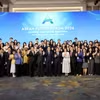
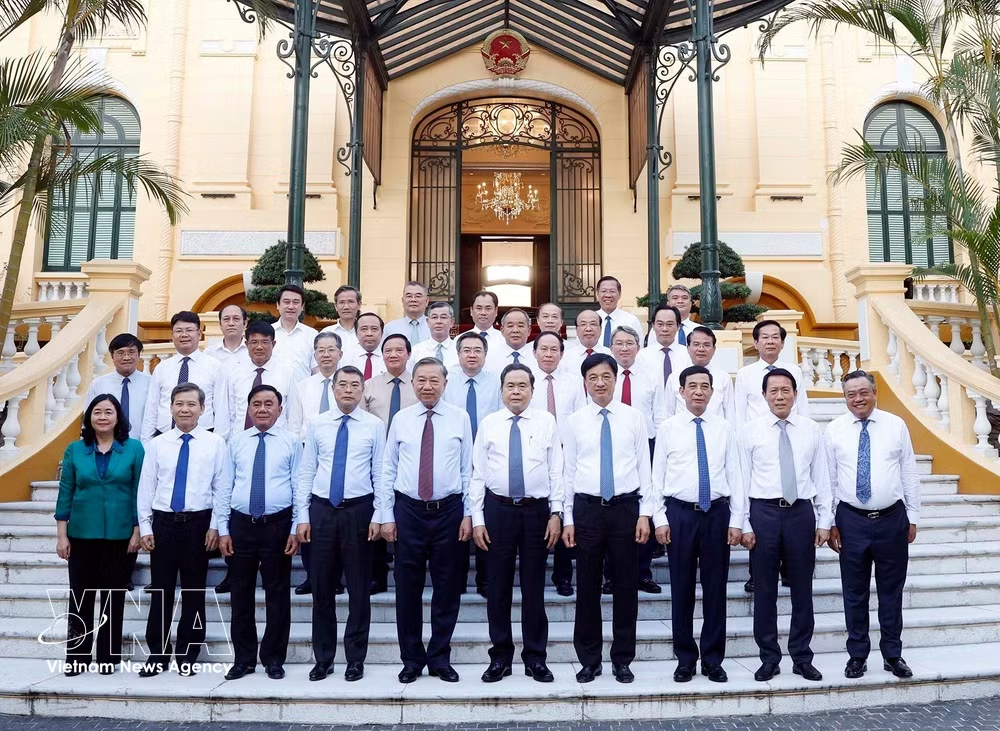
Party General Secretary and State President To Lam in a group photo with participants of the first meeting of the central steering committee for institutional perfection and law enforcement in Hanoi on June 22, 2026. (Photo: VNA)

The steering committee called for continued alignment around a renewed understanding of the state economy as an integrated whole comprising the state budget, public assets, land, natural resources, infrastructure, national reserves, state-owned enterprises, state-owned credit institutions, state capital in enterprises and public service units.

It stressed that improving the efficiency of state resource utilisation should remain central to institutional reform, while priority should be given to removing bottlenecks affecting national strategic resources and creating breakthroughs in the governance of state-owned enterprises.

Regarding the development of the foreign-invested sector, the committee urged the timely and fully institutionalisation of Party policies, with priority placed on developing targeted, competitive and preferential investment support mechanisms tied to performance and commitments linked to technology, research and development, technology transfer, workforce training, domestic value creation, local supplier development, green transition, and digital transformation.

It also called for mechanisms to select, manage and supervise strategic investors, alongside stronger national coordination and regional connectivity in attracting foreign investment.

On tackling air pollution in major cities, the steering committee advocated a shift from controlling separate emission sources towards outcome-based air quality management. It also called for the development of an integrated and modern environmental data system, stronger monitoring and early-warning mechanisms, and clearer accountability for each sector, locality and emission source.

The committee further requested ministries and ministry-level agencies to treat the reduction and simplification of administrative procedures and unreasonable business conditions as a continuous and regular task rather than a short-term campaign. It also urged a transition from pre-approval controls to post-inspection management based on risk governance, alongside tighter control over the introduction of new administrative procedures and business requirements.

Regarding the proposed revision of the Criminal Procedure Code, the committee requested continued research and refinement of procedural mechanisms to strike a balance between safeguarding justice and combating crime, while also encouraging remediation, asset recovery, the removal of obstacles and mobilisation of resources to support socio-economic development./.
VNA

See more

Director of the General Department of Politics under the Vietnam People’s Army General Nguyen Trong Nghia inspects the ongoing search and recovery operation for martyrs’ remains at Le Thi Rieng Park in Ho Chi Minh City. (Photo: VNA)

Senior military officer inspects martyrs’ remains search at Le Thị Rieng Park

Nghia described the ongoing 500-day campaign as a sacred mission that embodies the Vietnamese tradition of remembering those who served and sacrificed for the nation. The current generation, he said, must spare no effort in carrying out the Party’s policy and fulfilling the aspirations of the people, particularly the families of the fallen.

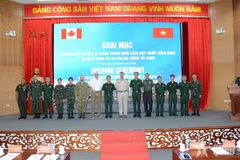
Prime Minister Le Minh Hung (L) presents the First-Class and Second-Class Fatherland Protection Orders to the collectives for their achievements in search and rescue, humanitarian assistance and disaster relief operations in Venezuela. (Photo: VNA)

PM calls for building elite, professional international search and rescue force

During its mission from June 29 to July 7, the team worked around the clock under extremely hazardous conditions amid heavily damaged and contaminated disaster zones. Despite the challenges, rescue personnel recovered 57 victims' bodies and handed them over to local authorities and families. They also identified and reported several suspected locations where additional victims might be trapped.

People gather at Den Thuong (Upper Temple) during the Hung Kings' Commemoration Day in Phu Tho province. (Photo: VNA)

📝 OP-ED: Respect for history, gratitude a lasting cultural value of Vietnamese people

In Vietnamese cultural life, gratitude toward preceding generations has long been preserved as an integral part of the nation's identity. This tradition is reflected in ancestor worship practiced in families, the Worship of the Hung Kings, village deities, national heroes and eminent cultural figures, as well as tributes to generations who sacrificed their lives for the nation's independence and freedom.

General Phan Van Giang (R) and General Khamlieng Outhakaysone plant a tree at Thanh Thuy border gate. (Illustrative photo: VNA)

Border community twinning strengthens Vietnam–Laos friendship

Over the past decade, the twinning relationship between Thuy Phong village in Nghe An’s Kim Bang commune, and Xop Tuong village in Nam On commune, Xaychamphone district, Bolikhamxay province of Laos, has become a model for fostering a shared border of peace, friendship and cooperation.

Delegates from the two nations, along with military attachés from several countries accredited to Vietnam, lay flowers in tribute to the Cuban military experts at the memorial monument within the Vietnam Military History Museum in Hanoi on July 10. (Photo: VNA)

Vietnam, Cuba pay tribute to fallen Cuban military experts

Cuba and Vietnam on July 10 commemorated six Cuban military experts who lost their lives 60 years ago while supporting the Vietnamese people's resistance war, reaffirming the enduring solidarity and defence ties forged through the two countries' shared history.

Vietnamese Ambassador to Thailand Pham Viet Hung (third from left) poses for a commemorative photo with Honorary Consul Thaneth Tantipiriyakij and officials from several southern Thai provinces in front of the Honorary Consulate of Vietnam in Phuket. (Photo:VNA)

Vietnam opens first honorary consulate in Phuket

The ambassador said the establishment of Vietnam's first honorary consulate in Phuket reflects both countries' commitment to enhancing cooperation with the Andaman sea economic gateway while meeting growing demand for consular services and better support for Vietnamese citizens and the Vietnamese community in southern Thailand.

Spokeswoman of the Vietnamese Ministry of Foreign Affairs Pham Thu Hang speaks at the press conference on July 9. (Photo: VNA)

Vietnam seeks early signing of trade deal with EFTA

Vietnam will continue working closely with the European Free Trade Association (EFTA) member states to sign their free trade agreement (FTA) at an early date and effectively implement its commitments.