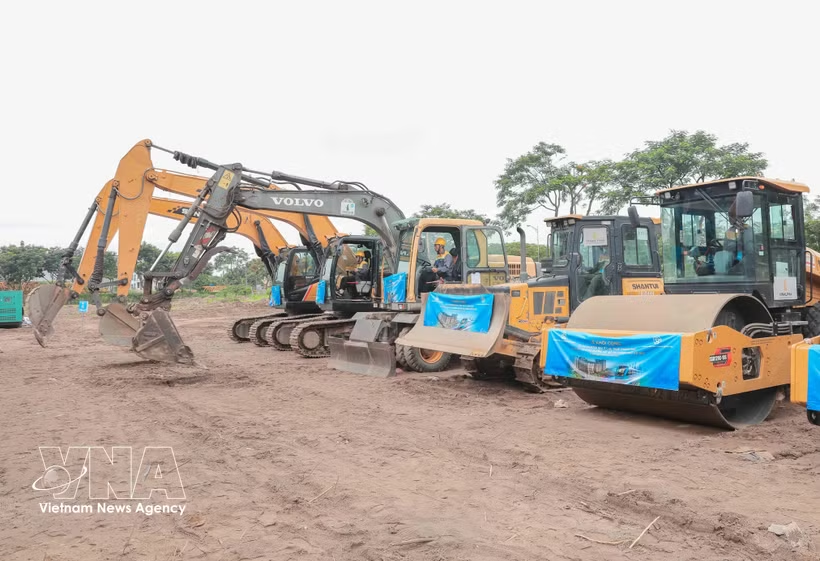
Hanoi launches construction of five metro lines spanning over 300 km

The projects form a key part of Hanoi's strategy to develop a mass rapid transit network, gradually realise its urban railway master plan and support urban expansion in multiple directions.

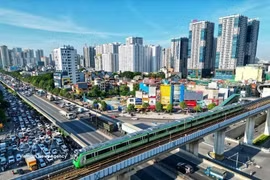
The five new urban railway projects, for which the Vinhomes–VinSpeed consortium serves as the EPC (engineering, procurement and construction) contractor, are scheduled for completion by 2030. (Photo: VNA)

Hanoi (VNA) - Hanoi is embarking on its largest-ever urban railway investment programme with the simultaneous launch of five metro lines stretching more than 300 km, aimed at strengthening connectivity between Noi Bai International Airport, Hoa Lac Hi-Tech Park, emerging urban areas and the city centre, while shaping the capital's development landscape for decades to come.

Construction on metro lines No. 1, 2, 8, 10 and 14 officially began on June 22. The projects form a key part of Hanoi's strategy to develop a mass rapid transit network, gradually realise its urban railway master plan and support urban expansion in multiple directions. The Vinhomes–VinSpeed consortium has been appointed as the EPC contractor (engineering, procurement and construction) for all five projects. The city aims to substantially complete the lines by 2030.

Among the projects, Line 1 is the largest in terms of investment scale. The 81-km route has an estimated investment of 389.53 trillion VND (14.8 billion USD). Line 1 links the Hung Vuong Stadium area, Ngoc Hoi, Hanoi Station, Gia Lam and Noi Bai International Airport. It will serve as an important north–south corridor, connecting the urban rail network with the national railway, high-speed rail and the airport.

The 56.5km-long Line 2 also connects the capital to Noi Bai airport, going through the historic city centre via Nam Thang Long, Hoan Kiem Lake, Tran Hung Dao, Thuong Dinh and southern urban areas.

Line 8 is roughly 91km in length, linking the Hoa Lac High‑Tech Park with logistics zones, industrial parks and eastern growth centres of the capital.

A closed circular route, Line 10 is approximately 43km long and connects Co Loa, Vo Chi Cong, Ring Road 3, Ring Road 2.5 and Times City before returning to Co Loa, helping to reduce traffic pressure in the inner city.

Line 14 is around 32km long, connecting the Thang Long Bridge and Ciputra area through central Hanoi to Ocean Park and the city’s eastern districts, supporting new urban development and strengthening regional links.

Under the capital’s master plan for 2021–2030, Hanoi authorities intend to develop 18 urban rail lines with a total length of approximately 979km. The city aims to complete around 500km of urban rail by 2035, with the remainder to be invested in the 2035–2045 period.

The simultaneous launch of five metro projects marks a major milestone in the development of Hanoi's public transport system and lays the groundwork for the long-term expansion of its urban railway network./.
VNA

See more

Vietnam is key priority for US investment fund: DFC Chief Policy Officer

Vietnam is key priority for US investment fund: DFC Chief Policy Officer

Vietnam is a key priority market for the US International Development Finance Corporation (DFC) as it looks to expand its investment footprint in the Southeast Asian country. Caroline Vik, Chief Policy Officer at the DFC told the Vietnam News Agency (VNA) during her visit to Vietnam from June 19 to 21.

Electronics production line at Suntech Company in Thanh Van industrial cluster, Bac Ninh province. (Photo: VNA)

Bac Ninh seeks high-quality foreign investment for sustainable growth

According to Vice Chairman of the provincial People’s Committee Pham Van Thinh, the province aims to maintain stable and sustainable growth, improve the competitiveness of both the economy and local businesses, and make better use of free trade agreements (FTAs) to expand and diversify export markets.

Journalistic products of the Vietnam News Agency. (Photo: VNA)

Vietnamese media navigate economics of journalism in digital age

For decades, the country's press sector relied largely on two traditional sources of revenue: print circulation and advertising. However, the rise of social media and cross-border digital platforms has fundamentally altered that equation, forcing newsrooms to rethink how they operate and generate income.

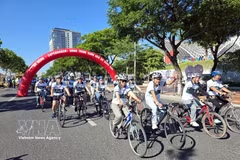
Delegates take part in a cycling event to promote a green lifestyle message. (Photo: VNA)

Da Nang, Copenhagen strengthen ties for green development

The event “Da Nang – Copenhagen: A green journey along the Han river”, which opened at APEC Park on June 20, marks the 55th anniversary of Vietnam–Denmark diplomatic relations (1971–2026) while promoting exchanges and collaboration on sustainable urban development.

Czech Deputy Prime Minister and Finance Minister Alena Schillerová expresses her delight at meeting the Vietnamese community in Brno. (Photo: VNA)

MoU expected to support Vietnamese businesses in Czech Republic

The signing marked a new step forward in enhancing connectivity between Czech state management agencies and the Vietnamese business community and household businesses, helping citizens gain faster and more accurate access to legal regulations related to business activities in the Czech Republic.

Delegates at the France-Vietnam Business Forum 2026 (Photo: VNA)

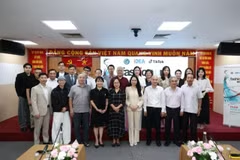
FPT links Vietnamese, French businesses to advance AI transformation

Present in France since 2008, FPT now serves as a technology partner to major enterprises including La Poste, Air Liquide, Quadient, Sagemcom, SNCF and Geopost. It aims to become one of the top 50 IT firms in France while further expanding its footprint across French-speaking markets.

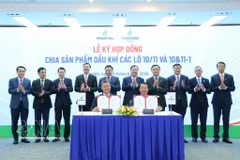
Participants at the signing ceremony (Photo: VNA)

Petrovietnam signs two major oil, gas agreements

The agreements underscore the commitment of Petrovietnam, the Petrovietnam Exploration Production Corporation (PVEP) and their partners to advancing oil and gas exploration, development and production activities, contributing to national energy security, optimising existing resources and creating new growth drivers for Vietnam’s energy industry.

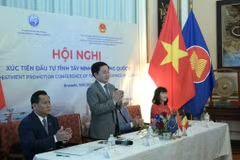
At the investment promotion conference in Belgium on June 19 (Photo: VNA)

Tay Ninh seeks Belgian investment across sectors

Tay Ninh wishes to become a trusted partner of the Belgium business community, particularly in areas such as circular economy, clean energy, environmental technology, biotechnology and advanced agriculture.