Ho Chi Minh City (VNS/VNA) - Vietnam must urgently build an autonomous national quantum capability to protect its digital sovereignty against future decryption threats, experts said at a major national scientific conference in Ho Chi Minh City last week.
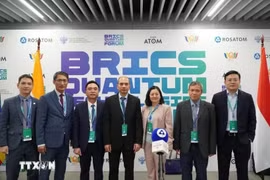
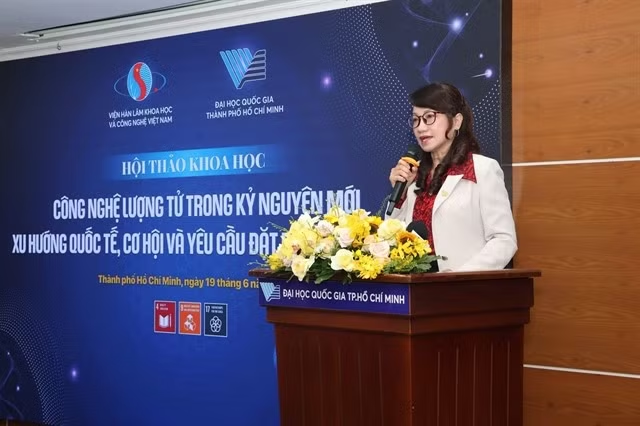
The conference entitled "Quantum technology in the new era: International trends, opportunities, and requirements for Vietnam", was co-hosted by Vietnam National University-Ho Chi Minh City (VNU-HCM) and the Vietnam Academy of Science and Technology (VAST).
It brought together top policymakers, scientists, and representatives from the Ministries of Public Security and National Defence to chart a strategic roadmap for the country.
Speaking at the conference, Professor Nguyen Thi Thanh Mai, President of VNU-HCM, said quantum technology has rapidly evolved from academic theory into a critical national security asset.
"The question is no longer whether quantum technology should be a priority, but how Vietnam can develop the speed, foundation, and autonomy to master this field, reduce external dependency, and integrate deeply into the global value chain," she said.
Delegates warned of a pressing non-traditional security risk known as the "harvest now, decrypt later" strategy, where malicious actors intercept and store encrypted data today to decrypt it once quantum computers become sufficiently powerful.
Because of this, experts urged that developing post-quantum cryptography and protecting national digital infrastructure must begin immediately.
To eliminate fragmented investments and maximise resources, the conference introduced a proposed "Hub-and-Nodes" strategic network architecture for the 2026-2045 period.
Under this framework, a single national centre will act as the coordinating ‘hub’ to manage and distribute resources to five specialised ‘nodes’: the Ministry of Public Security, the Ministry of National Defence, VNU-Hanoi, VNU-HCM, and VAST.
This model is expected to bridge the gap between laboratory research and commercial industries, helping technologies cross the innovation “valley of death".
Prof. Mai outlined three core pillars to achieve these strategic goals:
The first is Interdisciplinary Human Resources: Focusing on training young scientists and attracting leading overseas Vietnamese experts from advanced global tech hubs, including the US, Japan, Europe, and Singapore.
The second is Targeted Applications: Prioritising immediate national security needs, such as post-quantum cryptography, alongside practical applications in material sciences (semiconductors and batteries), pharmaceuticals, logistics, and smart city infrastructure.
The third is Tripartite Ecosystems: Establishing sustainable partnerships between research institutes, universities, and businesses. Tech enterprises are encouraged to engage early by commissioning software solutions, funding scholarships, or co-developing application laboratories.
Professor Tran Hong Thai, President of VAST, said the global quantum race involves an expansive ecosystem including secure communications, high-precision sensing, photonics, and advanced materials.
To ensure Vietnam can realistically compete, delegates recommended significant institutional reforms. These include establishing policy “sandboxes" to test emerging technologies and adopting a "stage-gate" risk-management model to evaluate state-funded projects periodically.
Furthermore, the Government should shift its funding focus from purchasing standalone equipment (CapEx) to financing the long-term operation and maintenance of shared research infrastructure (OpEx), according to scientists.
The conference’s findings will serve as a foundation for completing Vietnam’s upcoming national strategy, aiming to turn quantum technology into a driving force for socio-economic growth and national defence./.
See more
Can Tho students gain tools to navigate misinformation in digital era
Recently, the Can Tho campus of the Saigon College of Technology held a seminar on information literacy in the digital age. The programme focused on practical skills such as searching for, filtering and evaluating online information, while also introducing students to regulations on cybersecurity, intellectual property rights, digital citizenship and the responsible use of generative AI.
Solutions needed to turn science, technology, innovation into key growth driver
Development efforts should properly recognise and leverage the role of science and technology in creating new economic models based on emerging resources.
Season two of AI game show launched to cultivate tech talent
This is the largest prize ever offered in a Vietnamese AI competition, reflecting the bank’s long-term commitment to advancing science and technology, innovation and digital transformation in line with Politburo Resolution No. 57.
Vietnam News Agency launches first digital-specialised information platform
The VNA not only has a responsibility to communicate and promote the spirit of innovation across society but must also take the lead in applying technology, modernising journalism practices and developing practical, high-value media products for the public.
Vietnam accelerates tourism digitalisation via AI, data ecosystems
Under this blueprint, tourism is designated as a high-priority sector to enhance the use of digital technology to improve management capabilities, service quality, and the visitor experience.
Vietnamese tech firm showcases innovations at Eurosatory 2026
As the only Vietnamese tech firm exhibiting directly at the event, Gremsy's participation highlights the growing ability of domestic enterprises to integrate into global technology value chains and compete in high-tech international markets.
Vietnam’s IPv6 rate hits 67.68%, ranks second in ASEAN
Vietnam now sits among the global front-runners in the shift to IPv6, outpacing many far larger economies, with 95 million broadband subscribers actively using IPv6 services.
Vietnam boosts financial investment to drive innovation
Resolution No. 57-NQ/TW of the Politburo on the development of science, technology, innovation and national digital transformation states that these areas are becoming not only prerequisites but also a historic opportunity for the country to achieve prosperity and strengthen national competitiveness in a new era of development.
Vietnam targets at least 10 large strategic technology firms by 2030
Deputy Prime Minister Ho Quoc Dung has signed a decision approving a plan to develop large domestic strategic technology enterprises in the 2026–2030 period, aimed at advancing digital infrastructure, digital human resources, digital data, strategic technologies and cybersecurity.
AI, social media redefines corporate communications
It has become part of Vietnam’s national digital transformation agenda under Politburo Resolution No. 57-NQ/TW dated December 22, 2024, which seeks to establish data, technology, innovation and digital governance as new pillars of economic competitiveness.
Valuing IP: Global standards and Vietnam’s realities
Vietnam’s legal framework already enables intangible asset valuation, and international methodologies can be applied. Yet IP valuation remains a knotty problem for regulators, valuation firms, universities, research institutes and businesses, all of whom are hunting for clearer roadmaps.
Deputy PM urges faster completion of science, technology, digital transformation regulations
Deputy PM Ho Quoc Dung stressed the need for close coordination among the Ministry of Science and Technology, the Ministry of Justice and the Government Office to finalise and submit for issuance key decrees guiding the implementation of the Law on High Technology and the Law on Digital Transformation within this month, thus enabling them to be brought into practice as soon as possible.
New tax incentives expected to boost science, technology enterprises
The incentives are also expected to attract and retain scientists and technology experts while providing enterprises with additional resources to enhance competitiveness in strategic sectors such as artificial intelligence, semiconductors, software and biotechnology.
Efforts needed to safeguard data security in digital era
Vietnam’s cybersecurity landscape has witnessed a notable shift in recent years. While the number of cyberattacks recorded in 2025 showed signs of decline, the proportion of organisations suffering actual damage rose to 52.3%. Cyberattacks increasingly target critical sectors, including banking, finance, energy, telecommunications, and government agencies.
Vietnam’s startup ecosystem gains momentum, eyes global competitiveness
Vietnam is among the fastest-growing countries within the group ranked between 21st and 50th globally in StartupBlink’s 2026 report. Hanoi, Ho Chi Minh City, Da Nang and Hai Phong are now listed among the world’s top 1,000 startup ecosystems.
Vietnam expects digital economy to contribute 30% of GDP by 2030
The country also aims to support at least 500,000 small and medium-sized enterprises in digital transformation, develop a minimum of five digital technology companies capable of competing with counterparts in advanced economies, and establish at least five operational data exchanges.
Vietnam hopes to enhance nuclear energy cooperation with Bulgaria: ambassador
Highly valuing Bulgaria's extensive experience in operating the Kozloduy nuclear power plant and training specialised personnel, Ambassador Nguyen Thi Minh Nguyet proposed boosting bilateral cooperation in specialist training, scientific research, and the sharing of management, operational, and nuclear safety expertise.
Korean firm aims to provide assistive technology solutions for visually impaired people in Vietnam
Dot Inc. is working with Google and an AI education partner in Vietnam to explore the deployment of assistive technologies in schools and educational institutions.
Agri-biotech exhibition series underway in Ho Chi Minh City
In addition to the exhibition activities, Agri & Biotech Vietnam 2026, lasting until June 12, is set to host a series of specialised forums and seminars. Topics of particular interest to businesses include farming exports, sustainable development of the pepper and spice industries, low-emission agriculture, carbon credits, the circular economy, biotechnology and innovative start-ups.
Vietnam, Iran seek stronger cooperation in ICT, AI, nanotechnology
Vietnamese Ambassador to Iran Nguyen Luong Ngoc said greater understanding of each side’s strengths and potential, particularly in AI and information technology, will provide a solid foundation for expanding future cooperation.