Six patients given new lease on life through organ transplants from single donor

Using organs and tissues donated by the brain-dead donor, the Hue Central Hospitalsuccessfully carried out six transplant procedures, including one heart, one liver, two kidney, and two corneal transplants. All recipients have recovered well and have since been discharged from hospital.

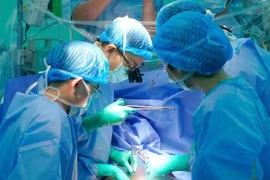
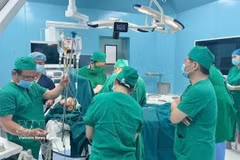
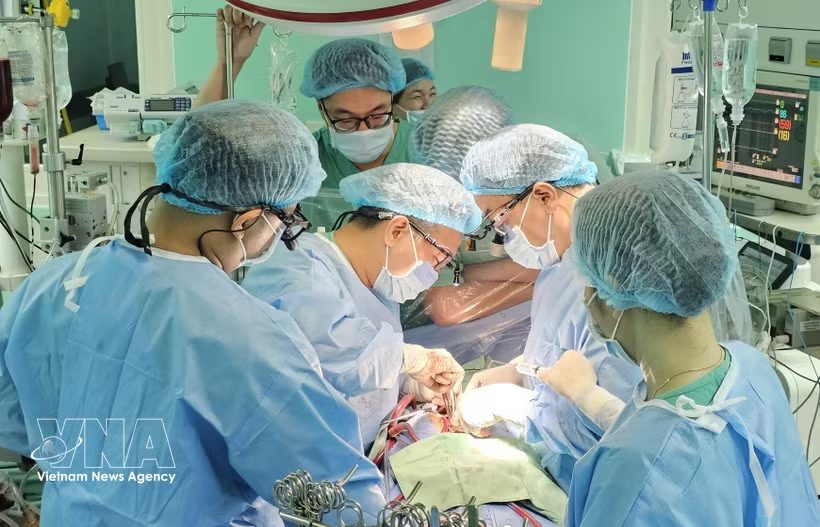
Doctors at the Hue Central Hospital perform the hospital’s 20th heart transplant case. (Illustrative photo: VNA)

Hue (VNA) – The Hue Central Hospital announced on June 22 that a 41-year-old resident of My Thuong ward in Hue city has made a stable recovery and been discharged after receiving a heart transplant from a brain-dead donor.

Prior to the transplant - the 23rd of its kind conducted at the hospital, P.M.D. was suffering from end-stage heart failure, with a left ventricular ejection fraction of only 25%. The patient required extracorporeal membrane oxygenation (ECMO) and an intra-aortic balloon pump to maintain circulation. Following surgery, his condition improved significantly. He no longer experiences shortness of breath, while his left ventricular ejection fraction has risen to 65%, with biochemical and hematological indicators remaining stable.

Earlier, the hospital’s Organ Transplant Centre received the organ donation wish of the family of M.D.T. who had sustained a severe traumatic brain injury in a traffic accident. Despite intensive treatment, the patient did not survive and was subsequently declared brain-dead by the hospital’s medical council. The hospital’s Organ Transplant Council then coordinated with the National Coordination Centre for Human Organ Transplantation to identify suitable recipients.

Using organs and tissues donated by the brain-dead donor, the hospital successfully carried out six transplant procedures, including one heart, one liver, two kidney, and two corneal transplants. All recipients have recovered well and have since been discharged from hospital.

Among them, the 64-year-old liver transplant recipient has regained normal liver function and recovered well from surgery. The two kidney transplant recipients have shown marked improvement in renal function and returned to normal daily activities. Meanwhile, the two corneal transplant recipients have partially regained their vision after enduring long periods of visual impairment.

Expressing profound gratitude to the donor and the donor’s family for their noble humanitarian gesture, Prof. Dr. Pham Nhu Hiep, Director of the Hue Central Hospital, said that their deed created life-saving opportunities for many others./.

VNA
See more

At the launch of the 14th national red journey blood donation campaign in Ho Chi Minh City on June 11. (Photo: VNA)

National Red Journey blood donation campaign 2026 launched

Addressing the opening ceremony, Associate Professor, Dr. Nguyen Ha Thanh, Director of the NIHBT and head of the campaign’s organising committee, said the Red Journey is a symbol of dedication, compassion and social responsibility, and the campaign carries the hopes of millions of voluntary blood donors and helps bring life-saving opportunities to patients in urgent need of blood transfusions.

Da Nang will roll out a citywide health screening and periodic health check-up programme for all residents on July 1. (Illustrative photo: VNA)

Da Nang to launch citywide health screening programme on July 1

Director of the municipal Department of Health Tran Thanh Thuy said the city has developed a comprehensive plan for conducting free periodic health examinations and screening services throughout 2026, and prepared the necessary human resources, facilities and digital infrastructure to ensure effective implementation.

Students play football during a break atthe Hai Xuan Secondary School in Ninh Binh province . (Photo: VNA)

Vietnam targets annual health screening for all students by 2030

By 2030, all educational institutions are expected to have separate medical rooms equipped with essential medicines and healthcare equipment, adequate access to safe drinking water and sanitation facilities, and school meal services that comply with food safety regulations.

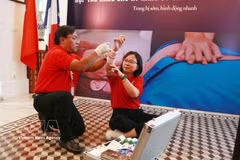
Staff from the Ho Chi Minh City First Aid Centre demonstrate first aid skills. (Photo: VNA)

Vietnam, France cooperate to build community first-aid network

The agreement focuses on establishing hundreds of first-aid stations across Long Chau’s pharmacy and vaccination network, standardising first-aid training for medical and pharmaceutical students, and expanding community health education activities nationwide.

In Hanoi, the temperature recorded in Lang Ha at 1 pm on May 26 reached 40 degrees Celsius. (Photo: VNA)

Proactive response needed to cope with extreme weather: Experts

Health experts warned that prolonged heat exposure could cause heatstroke, heat exhaustion and other serious health conditions. High-risk groups include the elderly, children, pregnant women, people working or exercising outdoors for long periods, and those suffering from chronic illnesses such as hypertension, chronic obstructive pulmonary disease, asthma and diabetes.

Ho Chi Minh City plans over 95 million USD for universal health screenings in 2026. (Illustrative photo: VNA)

Ho Chi Minh City earmarks over 95 million USD for universal health screenings in 2026

Ho Chi Minh City's free health examination programme, set to begin on May 25, is carried out at qualified healthcare facilities, mobile clinics at schools, factories and businesses, community-based screening sites arranged by local authorities, as well as through home visits to elderly residents, people living alone and those with limited mobility.

Healthcare workers are employed in an isolation and treatment area for patients infected with the Ebola virus in Entebbe, Uganda. (Photo: Xinhua/VNA)

Health Ministry calls for stronger preparedness against Ebola

Medical facilities were instructed to strengthen surveillance, especially for individuals who have travelled to or returned from outbreak-hit countries or areas within the previous 21 days. They were also asked to strictly enforce infection control measures, including protective procedures, screening, triage and isolation protocols for suspected or confirmed Ebola cases.