National Red Journey blood donation campaign 2026 launched

Addressing the opening ceremony, Associate Professor, Dr. Nguyen Ha Thanh, Director of the NIHBT and head of the campaign’s organising committee, said the Red Journey is a symbol of dedication, compassion and social responsibility, and the campaign carries the hopes of millions of voluntary blood donors and helps bring life-saving opportunities to patients in urgent need of blood transfusions.

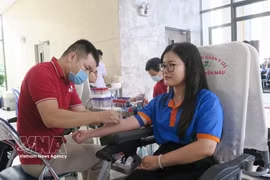
At the launch of the 14th national red journey blood donation campaign in Ho Chi Minh City on June 11. (Photo: VNA)

Ho Chi Minh City (VNA) – The 14th national red journey blood donation campaign was launched in Ho Chi Minh City on June 11, with organisers aiming to collect 120,000 units of blood nationwide this year.

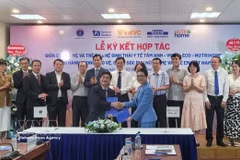
The programme is jointly organised by the National Institute of Hematology and Blood Transfusion (NIHBT), VTVCorp and the Ho Chi Minh City Steering Committee for Voluntary Blood Donation Mobilisation.

Addressing the opening ceremony, Associate Professor, Dr. Nguyen Ha Thanh, Director of the NIHBT and head of the campaign’s organising committee, said the Red Journey is a symbol of dedication, compassion and social responsibility.

He said the campaign carries the hopes of millions of voluntary blood donors and helps bring life-saving opportunities to patients in urgent need of blood transfusions.

This year’s campaign is being held in 32 provinces and cities across the country, including Hanoi, Hai Phong, Hue, Da Nang, Ho Chi Minh City, Can Tho, Nghe An, Thanh Hoa and Dak Lak. It targets the collection of 120,000 blood units, including 25,000 units from major donation events and 95,000 units from accompanying activities.
vnanet-potal-khai-mac-hanh-trinh-do-tinh-lang-son-nam-2025-8100723.jpg
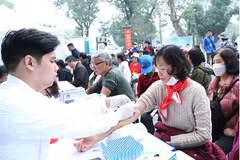
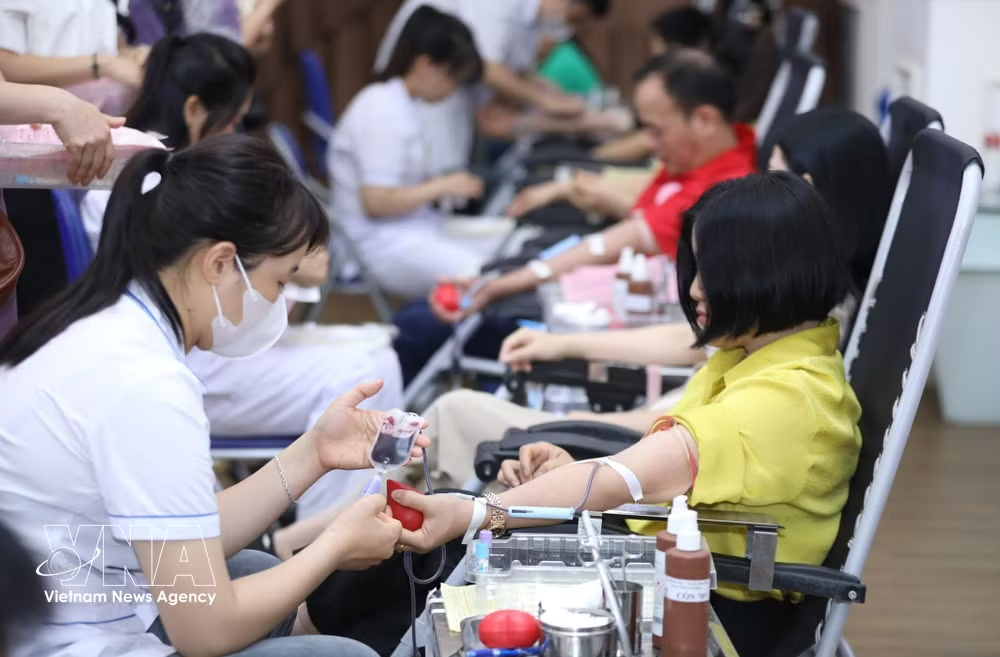
People donate blood at the launch of the Red Journey in Lang Son province. (Photo: VNA)

So far, the campaign has already been successfully organised in Lai Chau, Thai Nguyen and Dong Nai provinces, collecting nearly 3,000 units of blood.

Since its launch in 2013, Red Journey has become Vietnam’s largest and most effective blood donation campaign. Over the past 13 editions, it has organised 3,525 donation events nationwide and collected more than one million units of blood.

Beyond increasing blood supplies, the programme has helped strengthen coordination among localities, improve the efficiency of blood distribution nationwide and build a sustainable network of local volunteers.

On the opening day, the “Drops of Pink Blood from Ho Chi Minh City” blood donation festival was also held at multiple locations across the city, with an expected collection of around 1,300 blood units.

The city aims to receive more than 6,000 blood units through this year’s Red Journey campaign while promoting awareness of thalassemia, encouraging repeat donations and larger-volume donations of 350ml to 450ml. Digital transformation is also being applied through online blood donation registration platforms and the “Giot mau vang” (Golden Drop of Blood) mobile application.

On the occasion of World Blood Donor Day on June 14, organisers honoured outstanding individual blood donors and donor families who have made significant contributions to humanitarian and voluntary blood donation activities./.

VNA

See more

The number of foreign tourists coming to Ho Chi Minh City for travel combined with medical check-ups is increasing. (Photo: VNA)

Vietnam looks to unlock medical tourism potential with national strategy

The draft strategy aims to position Vietnam as a trusted healthcare destination in Southeast Asia by 2030 and eventually among Asia's leading medical tourism hubs. The plan marks a shift from viewing medical tourism as an untapped opportunity to making it a national development priority.

Delegates at the conference. (Photo: VNA)

Vietnam to produce first homegrown next-generation vaccines from 2028

Under the agreement, Sanofi will transfer technology to VNVC to manufacture selected high-demand vaccines for children and adults at VNVC Vaccine and Bioproduct Plant. The first next-generation vaccines produced in Vietnam are expected to roll off production lines in 2028.

Eric and Alysha joyfully welcome their baby through Mini IVF after more than 10 years of waiting. (Photo: Hong Ngoc Phuc Truong Minh General Hospital)

Vietnam - a destination for journeys to parenthood

An increasing number of international families are choosing Vietnam for infertility treatment, embarking on journeys to parenthood that transcend geographical distance and differences in nationality.

Prime Minister Le Minh Hung delivers remarks at the inauguration ceremony for Viet Duc University Hospital's second campus in Ninh Binh province. (Photo: VNA)

PM urges modern restructuring of healthcare network

The PM stressed that throughout the country’s development process, people have consistently been regarded as the centre, the driving force, the objective and the most important resource for national development. Sustainable and rapid development requires not only a healthy, knowledgeable and skilled population but also a modern, equitable, efficient, sustainable and accessible healthcare system.

Thu Duc General Hospital, with a capacity of 1,000 beds, was inaugurated and put into operation in April 2025 (Photo: VNA)

Ho Chi Minh City moves to expand robotic surgery to gateway hospitals

According to the municipal Department of Health, developing gateway hospitals is a key pillar of the city's strategy to establish a regional specialised healthcare system. The network is designed to permanently relieve overcrowding at major downtown hospitals while strengthening strong inter-regional emergency care and treatment network.

Doctors conduct health screenings for children in Tru Van Tho commune, Ho Chi Minh City. (Photo :VNA)

Ho Chi Minh City moves closer to universal health check-ups

Achieving universal health check-ups in 2026 will lay the foundation for a new healthcare model in which every resident has an electronic health record, receives regular screenings, benefits from lifelong health management and gains access to early intervention through primary healthcare services.

Illustrative photo: Internet

Dengue cases rise, outbreaks become more unpredictable

Vo Hai Son, Deputy Director of the ministry's Administration of Disease Prevention, said dengue fever is no longer following previous epidemiological trends. In 2025, infections remained elevated through November and December rather than declining at the end of the year as had traditionally been the case, indicating a shortening outbreak cycle.