Vietnam transfers fertility technology to France

French Consul General in Ho Chi Minh City Etienne Ranaivoson described the technology transfer as a vivid evidence of over-30-year health cooperation between the two countries.

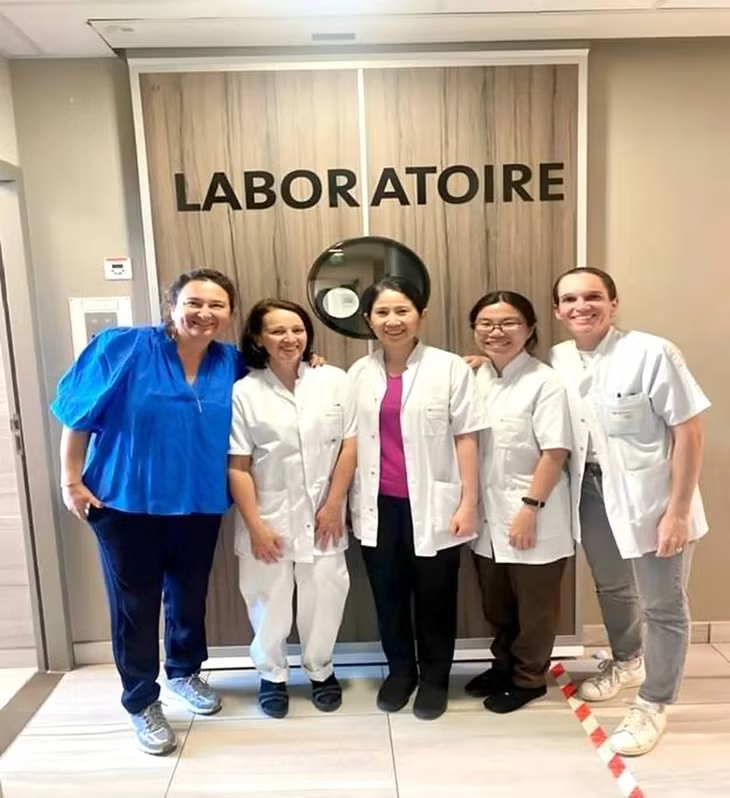
Key members of the OPKAPAMIV research project at Saint Joseph Hospital, France (Photo: tuoitre.vn)

Hanoi (VNA) – Nearly three decades after adopting in vitro fertilisation (IVF) from France, Vietnamese doctors have for the first time transferred an assisted reproductive technology back to the country that gave them the modern fertility treatment.

Biphasic IVM delivery

In early April 2026, Assoc. Prof. Vuong Thi Ngoc Lan, Vice Rector and head of the Department of Obstetrics and Gynaecology at the Ho Chi Minh City University of Medicine and Pharmacy, and Le Hoang Anh, Lab Director at the My Duc Hospital, travelled to Marseille to guide the rollout of a biphasic in vitro maturation (IVM) technique at Saint Joseph Hospital.

French doctors had visited Vietnam four years earlier to study the biphasic IVM model. Upon their return, they began clearing administrative hurdles, investing in equipment, and screening patients for the new technique, with Vietnamese experts slated to support the launch.

How French doctors turn to Vietnam

In autumn 2021, Dr Isabelle Koscinski joined the assisted reproduction unit at Saint Joseph Hospital. Her first months were spent mapping a system that had run smoothly for years.

Though IVM wasn’t new in France, Koscinski remained unconvinced by the efficacy and biological logic of conventional approaches. She saw room for improvement rather than a need to discard established methods.

A turning point came in July 2022 at the annual conference of the European Society of Human Reproduction and Embryology (ESHRE) in Milan, Italy, where Vietnamese fertility specialist Ho Manh Tuong presented the biphasic IVM protocol and its outcomes.

The presentation hooked her instantly, not only the clinical results, but the philosophy behind them: minimal hormonal intervention paired with optimised oocyte quality.

Back in France, Koscinski threw herself into the technique, reviewing every publication, picking apart the data, and studying its scientific foundations.

She then consulted Prof. Johan Smitz to map out the next steps. “I convinced the hospital’s management to fund my training so I could attend a biphasic IVM course in Vietnam in October 2022”, Koscinski said.

A four-year research project

While Koscinski absorbed the theory fast, bringing the technology to France became a four-year undertaking. The French team had to erect an extensive legal and regulatory framework before any clinical work could begin.

At the same time, a tri-country research alliance took shape for the OPKAPAMIV research project. Smitz’s Belgian group supplied scientific expertise and culture media. The Vietnamese team, comprising Vuong Thi Ngoc Lan and Le Hoang Anh, delivered technical support and training. Koscinski’s French unit handled patient recruitment, preparation, and oocyte cryopreservation.

Another obstacle involved the physical distance between the operating room and the embryology lab. Saint Joseph Hospital solved it by building a temperature-controlled workstation with a high-magnification microscope directly inside the operating theatre, enabling immediate handling of retrieved oocytes.

After four years of preparation, the project finally entered its clinical phase in April 2026. The first four oocyte retrieval procedures were performed on April 8 and 9 at the hospital, with the visiting Vietnamese doctors directly involved.

Koscinski confirmed that technical support from her Vietnamese colleagues was instrumental in getting the OPKAPAMIV research project off the ground.

French Consul General in Ho Chi Minh City Etienne Ranaivoson, for his part, described the technology transfer as a vivid evidence of over-30-year health cooperation between the two countries.

Vietnam’s supply of assisted reproductive technology to a French facility shows that the support has flipped from a one-way flow into a two-way exchange of know-how, he said./.
VNA

See more

At the launch of the 14th national red journey blood donation campaign in Ho Chi Minh City on June 11. (Photo: VNA)

National Red Journey blood donation campaign 2026 launched

Addressing the opening ceremony, Associate Professor, Dr. Nguyen Ha Thanh, Director of the NIHBT and head of the campaign’s organising committee, said the Red Journey is a symbol of dedication, compassion and social responsibility, and the campaign carries the hopes of millions of voluntary blood donors and helps bring life-saving opportunities to patients in urgent need of blood transfusions.

Da Nang will roll out a citywide health screening and periodic health check-up programme for all residents on July 1. (Illustrative photo: VNA)

Da Nang to launch citywide health screening programme on July 1

Director of the municipal Department of Health Tran Thanh Thuy said the city has developed a comprehensive plan for conducting free periodic health examinations and screening services throughout 2026, and prepared the necessary human resources, facilities and digital infrastructure to ensure effective implementation.

Students play football during a break atthe Hai Xuan Secondary School in Ninh Binh province . (Photo: VNA)

Vietnam targets annual health screening for all students by 2030

By 2030, all educational institutions are expected to have separate medical rooms equipped with essential medicines and healthcare equipment, adequate access to safe drinking water and sanitation facilities, and school meal services that comply with food safety regulations.

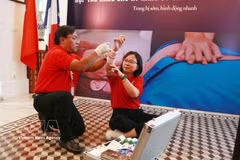
Staff from the Ho Chi Minh City First Aid Centre demonstrate first aid skills. (Photo: VNA)

Vietnam, France cooperate to build community first-aid network

The agreement focuses on establishing hundreds of first-aid stations across Long Chau’s pharmacy and vaccination network, standardising first-aid training for medical and pharmaceutical students, and expanding community health education activities nationwide.

In Hanoi, the temperature recorded in Lang Ha at 1 pm on May 26 reached 40 degrees Celsius. (Photo: VNA)

Proactive response needed to cope with extreme weather: Experts

Health experts warned that prolonged heat exposure could cause heatstroke, heat exhaustion and other serious health conditions. High-risk groups include the elderly, children, pregnant women, people working or exercising outdoors for long periods, and those suffering from chronic illnesses such as hypertension, chronic obstructive pulmonary disease, asthma and diabetes.

Ho Chi Minh City plans over 95 million USD for universal health screenings in 2026. (Illustrative photo: VNA)

Ho Chi Minh City earmarks over 95 million USD for universal health screenings in 2026

Ho Chi Minh City's free health examination programme, set to begin on May 25, is carried out at qualified healthcare facilities, mobile clinics at schools, factories and businesses, community-based screening sites arranged by local authorities, as well as through home visits to elderly residents, people living alone and those with limited mobility.

Healthcare workers are employed in an isolation and treatment area for patients infected with the Ebola virus in Entebbe, Uganda. (Photo: Xinhua/VNA)

Health Ministry calls for stronger preparedness against Ebola

Medical facilities were instructed to strengthen surveillance, especially for individuals who have travelled to or returned from outbreak-hit countries or areas within the previous 21 days. They were also asked to strictly enforce infection control measures, including protective procedures, screening, triage and isolation protocols for suspected or confirmed Ebola cases.

Party General Secretary and State President To Lam speaks at a working session Party Committee of the Ministry of Health on Vietnamese traditional medicine in Hanoi on May 20 (Photo: VNA)

Top leader calls for historic transformation of traditional medicine

Highlighting strategic orientations for the sector, Party General Secretary and State President To Lam requested that traditional medicine be incorporated into the country’s overall development strategy in the new era. He called for the building of a national traditional medicine ecosystem linked to the development of the health economy and national soft power.

Deputy Prime Minister Pham Thi Thanh Tra speaks at the programme “Organ and Tissue Donation Day May 20 – Giving is Forever”. (Photo: VNA)

Deputy PM calls for stronger organ donation movement to save more lives

Vietnam has gradually mastered some of the world’s most complex transplant techniques since the country’s first successful kidney transplant in 1992. As of 2025, Vietnam had conducted 10,878 organ transplants, with 34 licensed hospitals now capable of performing transplant procedures.

The meeting between the delegation from Military Hospital 175 and Mayor of Leipzig Burkhard Jung at Leipzig City Hall (Photo: VNA)

Healthcare cooperation shines in Vietnam – Germany ties

The partnership between Military Hospital 175 and medical institutions in Leipzig has been recognised as a highlight of Vietnam – Germany healthcare cooperation, as well as of the sister-city relationship between Ho Chi Minh City and Leipzig.