Quang Ngai makes strides in digital transformation

All administration agencies from provincial to commune levels are now connected to a dedicated data transmission network, while all villages gain access to mobile and internet services.

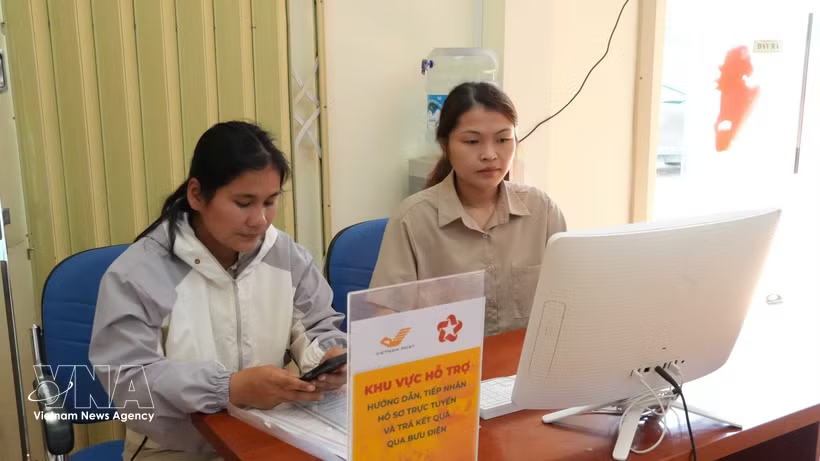
A member of the community-based digital technology team in Tu Mo Rong commune, Quang Ngai province, guides a resident in how to submit applications for administrative procedures online. (Photo: VNA)

Quang Ngai (VNA) – More than a year of implementing Politburo Resolution No. 57-NQ/TW on breakthroughs in science – technology development, innovation, and national digital transformation, the central province of Quang Ngai has reaped encouraging results, creating a solid stepping stone for digital administration, digital economy, and digital society development.

The provincial Department of Science and Technology reported that Quang Ngai has fulfilled or exceeded 12 of the 15 targets assigned by the Government, while the remaining three are expected to be completed by the end of this year. Of the 269 assigned tasks, 140 have been completed, 126 are progressing on schedule, and only three behind schedule. The progress has contributed to improvements in institutional frameworks, digital infrastructure, data management, human resources, and public service quality.

All administration agencies from provincial to commune levels are now connected to a dedicated data transmission network, while all villages gain access to mobile and internet services. Notably, 5G coverage has expanded to over 90% in urban centres and key economic zones, including the Dung Quat Economic Zone and the Vietnam – Singapore Industrial Park (VSIP Quang Ngai).

Digital administration development has accelerated through the deployment of shared digital platforms, data integration systems, record digitisation, and connections between specialised databases and the national residents database. All newly generated records are now processed electronically, while official documents exchanged among state agencies are digitally signed and transmitted.

The province has also connected 147,782 records with the National Public Service Portal. More than 85% of administrative dossiers are submitted online, and nearly 96% of online applications are processed on time.

The electronic issuance rate of administrative results has reached nearly 82%; more than 81% of records and administrative outcomes have been digitised. The reuse rate of digitised data exceeds 94%, equivalent to 139,643 dossiers.

Quang Ngai’s public service performance index has surpassed 92%, while citizen and business satisfaction has achieved the maximum score of 18 out of 18 points. The satisfaction with the handling of public feedback and recommendations stands at 100%, statistics show.

vnanet-quang-ngai1.jpg
Thanks to the guidance of members of the community-based digital technology team in Phuong Quy 2 village, Ngok Bay commune, Quang Ngai province, elderly citizens are now able to submit applications for administrative procedures online (Photo: VNA)

Across the province, 1,477 community-based digital technology teams with more than 12,198 members have been established in 96 communes, wards, and special zones to help residents access digital services.

Artificial intelligence (AI) application is also expanding. AI has been integrated into the provincial Public Service Portal while chatbots support citizens and businesses. The province has additionally developed an AI-powered legal consultation system and introduced AI-based voice recognition for the H’re and Co ethnic languages.

In the digital economy, more than 81% of enterprises now use electronic contracts, and about 250 local products are sold through e-commerce platforms. Cashless payments and QR-code transactions are also being expanded.

This year, Quang Ngai will focus on five priorities: building a comprehensive socio-economic database, developing green agriculture, applying AI to ethnic minority languages, creating a smart tourism ecosystem, and managing infrastructure through a digital mapping platform.

Despite the progress, challenges remain. Deputy Director of the provincial Department of Science and Technology Phan Van Hieu proposed the Government issue special mechanisms for information technology and digital transformation personnel at the commune level, give stronger support to community-based digital technology teams, and promote connectivity between national and local databases.

The province also hopes to receive support in financial resources, high-quality workforce training in AI, big data, semiconductors and cybersecurity, as well as the attraction of strategic technology investment projects to help develop a digital economy, build a digital society and strengthen its long-term competitiveness, he said./.

VNA

See more

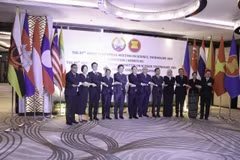
Delegates at the launch ceremony of the Vietnam National Multi-Project Wafer Coordination Centre (VNMPW/CC) on June 26. (Photo: VNA)

First national semiconductor chip prototyping support centre makes debut

Vietnam's semiconductor ecosystem now comprises around 60 chip design companies, some 7,000 chip design engineers and 166 universities offering semiconductor-related training programmes. Initial registrations from 12 organisations indicate demand for the prototyping of approximately 30,000 chips.

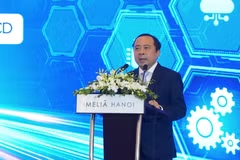
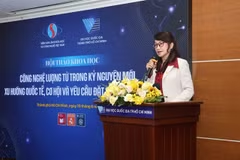
Minister of Science and Technology Vu Hai Quan speaks at the forum (Photo: nhandan.vn)

Vietnam redefines growth through strategic technologies: Forum

Vietnam should stop simply using technology and start truly mastering artificial intelligence (AI), semiconductors, clean energy and advanced materials; swap a resource-driven economy for one fired by innovation, knowledge and talent; and ditch cheap labour as its main calling card in favour of real technological competitiveness that lifts the country into higher-value global supply chains.

A product showcased at the AI Day 2026 (Photo: VNA)

Identifying right competitive advantages key to breaking through in AI era: Expert

Vietnam should develop a “borderless national intellectual network”, enabling Vietnamese professionals living abroad to contribute as visiting professors, strategic advisers, research leaders or co-directors of key laboratories. Such a model would help tap into global expertise without requiring specialists to return home permanently., according to Assoc. Prof., Dr Nguyen Thanh Phuong of the Department of Information Engineering, Computer Science and Mathematics (DISIM) at the University of L’Aquila in Italy.

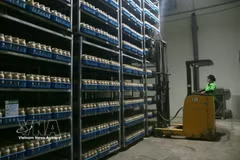
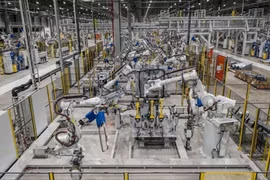
Robots handle cargo loading and unloading, helping reduce labour intensity and boost productivity (Photo: VNA)

Flexible policies key to unlocking Vietnam’s strategic technology ambitions: expert

According to Assoc. Prof. Dr. Tran Le Hung from Gustave Eiffel University (France), many countries have invested heavily in cutting-edge technologies but have failed to achieve expected results. The main constraints, he said, are often not capital or human resources, but regulatory bottlenecks, policy policies and implementation mechanisms.

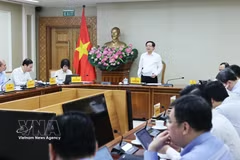
Deputy Prime Minister Ho Quoc Dung chairs the meeting in Hanoi on June 23. (Photo: VNA)

Investment should prioritise strategic technologies: Deputy PM

Under the draft project, research infrastructure development will align with Vietnam’s science, technology and innovation strategy, focusing on strategic technologies. The system will follow a unified three-tier model, prioritising the upgrading, integration and shared use of existing facilities, while ensuring operational efficiency, accountability, data security, intellectual property protection and national interests.

A speaker from the Internal Political Security Division under the Can Tho Department of Public Security delivers a cybersecurity awareness session for students at Can Tho University. (Photo: VNA)

Can Tho students gain tools to navigate misinformation in digital era

Recently, the Can Tho campus of the Saigon College of Technology held a seminar on information literacy in the digital age. The programme focused on practical skills such as searching for, filtering and evaluating online information, while also introducing students to regulations on cybersecurity, intellectual property rights, digital citizenship and the responsible use of generative AI.

Vietnamese delegates visit a booth at the Eurosatory 2026. (Photo: VNA)

Vietnamese tech firm showcases innovations at Eurosatory 2026

As the only Vietnamese tech firm exhibiting directly at the event, Gremsy's participation highlights the growing ability of domestic enterprises to integrate into global technology value chains and compete in high-tech international markets.

Engineers monitor and operate the power system at the central control room at the Northern Power Corporation (EVNNPC)’s Thanh Hoa Power Company in May 2025. (Photo: VNA)

Vietnam boosts financial investment to drive innovation

Resolution No. 57-NQ/TW of the Politburo on the development of science, technology, innovation and national digital transformation states that these areas are becoming not only prerequisites but also a historic opportunity for the country to achieve prosperity and strengthen national competitiveness in a new era of development.