Vietnam highlights science, innovation cooperation at ASEAN ministerial meeting in Laos

Vietnam called for enhanced cooperation and the establishment of common regional frameworks for emerging strategic technologies such as artificial intelligence (AI), big data, space technology and cybersecurity to create a secure digital business environment and improve ASEAN's overall competitiveness.

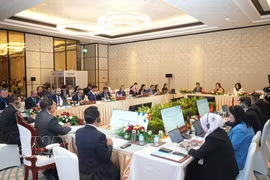
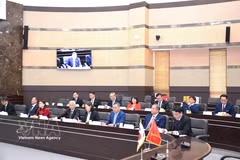
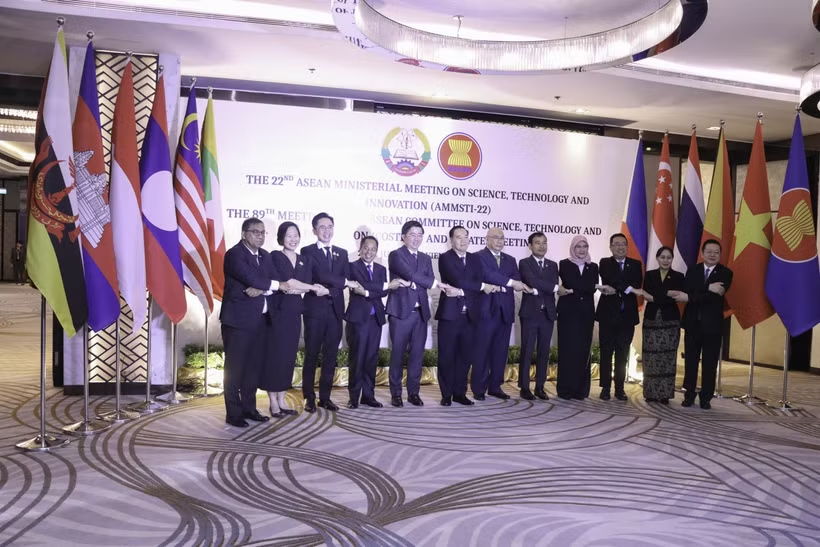
The 22nd ASEAN Ministerial Meeting on Science, Technology and Innovation (AMMSTI-22) is held in Vientiane, Laos, on June 26. (Photo: asean.org)

Vientiane (VNA) – Vietnam reaffirmed its commitment to advancing regional cooperation at the 22nd ASEAN Ministerial Meeting on Science, Technology and Innovation (AMMSTI-22) held in Vientiane, Laos, on June 26.

The meeting, themed "Advancing ASEAN Plan of Action on Science, Technology and Innovation (APASTI) for a Resilient, Sustainable and Competitive ASEAN," brought together ministers and officials from ASEAN member states and ASEAN Secretary-General Kao Kim Hourn to discuss how science, technology and innovation can strengthen the bloc's resilience, competitiveness and sustainable development.

The Vietnamese delegation, led by Deputy Minister of Science and Technology Bui Hoang Phuong, put forward a number of proposals aimed at deepening regional cooperation.

Addressing the meeting, Phuong expressed Vietnam's support for the ASEAN plan, describing science, technology, innovation and digital transformation as strategic drivers for sustainable development across the region.

Drawing on Vietnam's development experience, he proposed expanding joint research programmes in priority areas of common concern, including water security, climate-resilient high-tech agriculture and the green energy transition.

The Deputy Minister also stressed the need to develop a highly-skilled workforce by strengthening networks among leading ASEAN universities and research institutes and promoting expert exchanges to narrow technology gaps within the region.

Vietnam called for enhanced cooperation and the establishment of common regional frameworks for emerging strategic technologies such as artificial intelligence (AI), big data, space technology and cybersecurity to create a secure digital business environment and improve ASEAN's overall competitiveness.

A major outcome of the meeting was the endorsement of a significant restructuring of the ASEAN Committee on Science, Technology and Innovation (COSTI), reducing its sub-committee framework from nine to five specialised bodies to improve governance, enhance alignment with APASTI and accelerate the delivery of regional priorities.

The meeting also welcomed progress on two Priority Economic Deliverables for 2026: an ASEAN declaration on the advancement of cooperation in space science, technology and innovation, and a regional programme for AI applications in the health sector.

Delegates launched the ASEAN Science, Technology and Innovation Fund (ASTIF) Call for Proposals under the theme "ASEAN Grand Challenge: AI-Enabled Competitive and Resilient Region," aimed at harnessing artificial intelligence to address regional challenges, foster innovation, and improve people's wellbeing.

They also welcomed the operationalisation of the ASEAN–Republic of Korea High-Performance Computing Facility in Indonesia, the region's first shared supercomputing infrastructure, which is expected to support advanced research in AI, climate modelling, disaster forecasting, biotechnology and industrial innovation.

The meeting concluded with the adoption of a joint media statement reaffirming ASEAN's commitment to strengthening regional STI cooperation and partnerships with dialogue partners to build a more resilient, sustainable and competitive ASEAN. Malaysia will host the 23rd ASEAN Ministerial Meeting on Science, Technology and Innovation in June 2027./.

VNA

See more

Delegates at the launch ceremony of the Vietnam National Multi-Project Wafer Coordination Centre (VNMPW/CC) on June 26. (Photo: VNA)

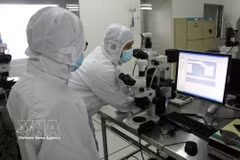
First national semiconductor chip prototyping support centre makes debut

Vietnam's semiconductor ecosystem now comprises around 60 chip design companies, some 7,000 chip design engineers and 166 universities offering semiconductor-related training programmes. Initial registrations from 12 organisations indicate demand for the prototyping of approximately 30,000 chips.

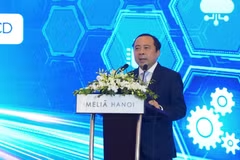
Minister of Science and Technology Vu Hai Quan speaks at the forum (Photo: nhandan.vn)

Vietnam redefines growth through strategic technologies: Forum

Vietnam should stop simply using technology and start truly mastering artificial intelligence (AI), semiconductors, clean energy and advanced materials; swap a resource-driven economy for one fired by innovation, knowledge and talent; and ditch cheap labour as its main calling card in favour of real technological competitiveness that lifts the country into higher-value global supply chains.

A product showcased at the AI Day 2026 (Photo: VNA)

Identifying right competitive advantages key to breaking through in AI era: Expert

Vietnam should develop a “borderless national intellectual network”, enabling Vietnamese professionals living abroad to contribute as visiting professors, strategic advisers, research leaders or co-directors of key laboratories. Such a model would help tap into global expertise without requiring specialists to return home permanently., according to Assoc. Prof., Dr Nguyen Thanh Phuong of the Department of Information Engineering, Computer Science and Mathematics (DISIM) at the University of L’Aquila in Italy.

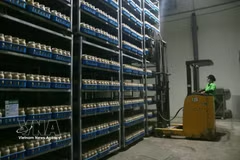
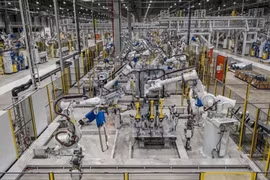
Robots handle cargo loading and unloading, helping reduce labour intensity and boost productivity (Photo: VNA)

Flexible policies key to unlocking Vietnam’s strategic technology ambitions: expert

According to Assoc. Prof. Dr. Tran Le Hung from Gustave Eiffel University (France), many countries have invested heavily in cutting-edge technologies but have failed to achieve expected results. The main constraints, he said, are often not capital or human resources, but regulatory bottlenecks, policy policies and implementation mechanisms.

Deputy Prime Minister Ho Quoc Dung chairs the meeting in Hanoi on June 23. (Photo: VNA)

Investment should prioritise strategic technologies: Deputy PM

Under the draft project, research infrastructure development will align with Vietnam’s science, technology and innovation strategy, focusing on strategic technologies. The system will follow a unified three-tier model, prioritising the upgrading, integration and shared use of existing facilities, while ensuring operational efficiency, accountability, data security, intellectual property protection and national interests.

A speaker from the Internal Political Security Division under the Can Tho Department of Public Security delivers a cybersecurity awareness session for students at Can Tho University. (Photo: VNA)

Can Tho students gain tools to navigate misinformation in digital era

Recently, the Can Tho campus of the Saigon College of Technology held a seminar on information literacy in the digital age. The programme focused on practical skills such as searching for, filtering and evaluating online information, while also introducing students to regulations on cybersecurity, intellectual property rights, digital citizenship and the responsible use of generative AI.

Vietnamese delegates visit a booth at the Eurosatory 2026. (Photo: VNA)

Vietnamese tech firm showcases innovations at Eurosatory 2026

As the only Vietnamese tech firm exhibiting directly at the event, Gremsy's participation highlights the growing ability of domestic enterprises to integrate into global technology value chains and compete in high-tech international markets.

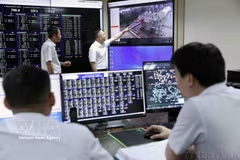
Engineers monitor and operate the power system at the central control room at the Northern Power Corporation (EVNNPC)’s Thanh Hoa Power Company in May 2025. (Photo: VNA)

Vietnam boosts financial investment to drive innovation

Resolution No. 57-NQ/TW of the Politburo on the development of science, technology, innovation and national digital transformation states that these areas are becoming not only prerequisites but also a historic opportunity for the country to achieve prosperity and strengthen national competitiveness in a new era of development.