Vietnam proposes hosting 14th ICAPP General Assembly in 2028

The ICAPP leadership and Standing Committee members welcomed Vietnam's proposal, calling it an important milestone that would strengthen ICAPP's role and promote cooperation among Asian political parties.

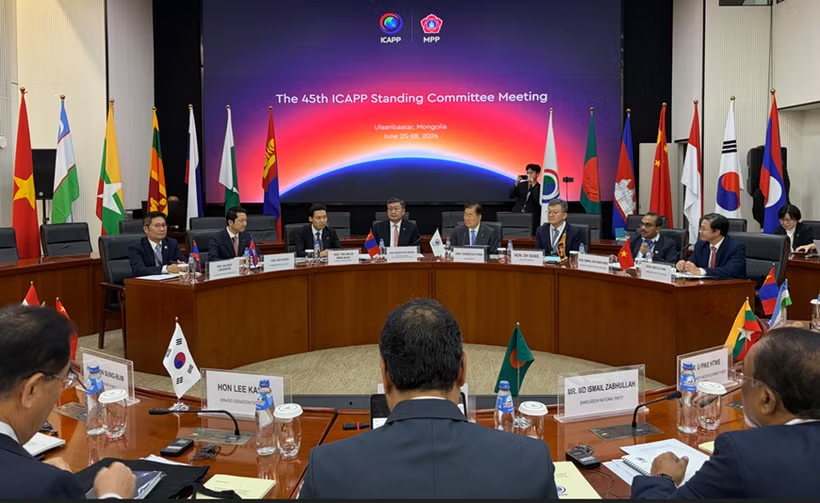
The 45th Meeting of the ICAPP Standing Committee is held in Ulaanbaatar, Mongolia, from June 24 to 28. (Photo: The Courtesy of the Ministry of Foreign Affairs)

Hanoi (VNA) – Vietnam has proposed hosting the 14th General Assembly of the International Conference of Asian Political Parties (ICAPP) in 2028 at the 45th Meeting of the ICAPP Standing Committee held in Ulaanbaatar, Mongolia, from June 24 to 28.

The meeting brought together representatives from 22 political parties serving on the committee from 17 Asian countries. The delegation of the Communist Party of Vietnam (CPV) was led by Ngo Le Van, member of the Standing Board of the Party Committee of the Ministry of Foreign Affairs and Deputy Minister of Foreign Affairs.

Addressing the meeting, Van underlined the importance of dialogue, trust building and cooperation for peace, stability and development amid profound changes in the international landscape.

He affirmed that the CPV attaches great importance to Party-to-Party diplomacy and to expanding ties with political parties across the region through multilateral mechanisms, stressing commitment to active and responsible participation in and contributions to ICAPP’s common activities.

The ICAPP leadership and Standing Committee members welcomed Vietnam's proposal, calling it an important milestone that would strengthen ICAPP's role and promote cooperation among Asian political parties. The proposal is expected to be officially announced and endorsed at the 13th ICAPP General Assembly later this year.

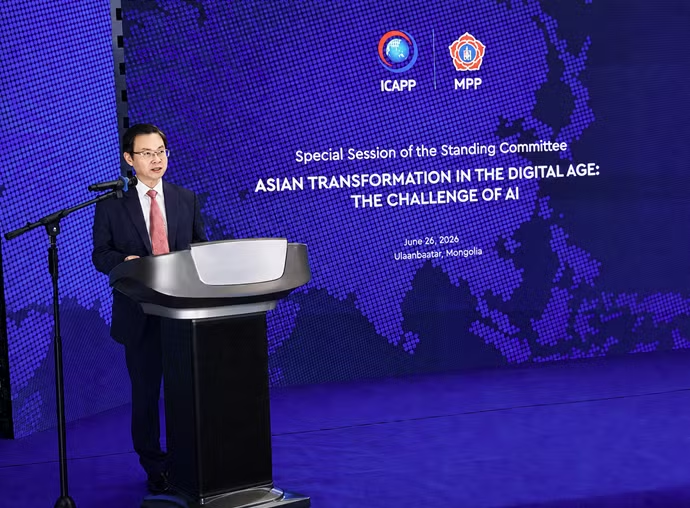
Speaking at a special session on Asia's transformation in the digital age, the Vietnamese official stressed that AI has become a key driver of economic growth, social progress, national competitiveness and global governance.

He noted that countries capable of harnessing AI effectively would gain new opportunities for development, while those left behind could face widening development gaps. He therefore emphasised that AI should be viewed not merely as a technological issue but as a strategic priority requiring effective governance, international cooperation, and the participation of political parties, governments, businesses, academia and citizens.
screenshot-2026-06-26-172034.png
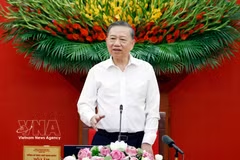
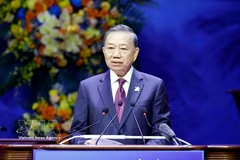
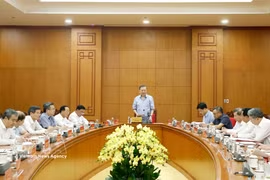
Ngo Le Van, member of the Standing Board of the Party Committee of the Ministry of Foreign Affairs and Deputy Minister of Foreign Affairs speaks at the session on Asia's transformation in the digital age. (Photo: The Courtesy of the Ministry of Foreign Affairs)

He also highlighted the Politburo Resolution No. 57-NQ/TW, which identifies science and technology, innovation and digital transformation as key drivers of national development in a new era, with AI playing a central role in promoting innovation and sustainable growth.

Vietnam proposed enhancing dialogue, building trust, expanding research cooperation, developing human resources, improving digital capacity, and supporting developing countries in participating more deeply in the global AI ecosystem.

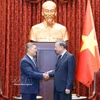
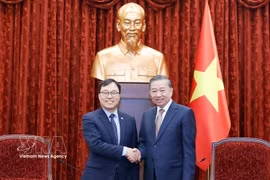
On this occasion, Van had a meeting with with General Secretary of the Mongolian People's Party (MPP) Sodbaatar Yangug.

They exchanged updates on each country’s development strategies and shared the view that the longstanding ties between the two parties provide a solid foundation for expanding bilateral relations, and that economic cooperation should serve as a key pillar.

During a meeting with ICAPP Standing Committee Chairman Chung Eui-yong, the Vietnamese official praised ICAPP’s growing stature and influence, while expressing hope for close coordination in preparations if Vietnam hosts the organisation’s 14th General Assembly in 2028.

Founded in Manila, the Philippines, in September 2000, ICAPP is the largest multilateral forum of political parties in Asia, promoting trust, understanding and cooperation in support of lasting peace and shared prosperity./.
VNA

See more

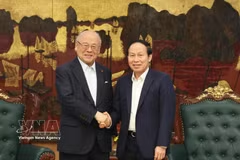
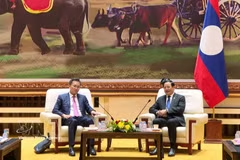
Deputy Prime Minister Le Tien Chau (R) receives Special Advisor to the Japan-Vietnam Parliamentary Friendship Alliance Takebe Tsutomu in Hanoi on June 26 (Photo: VNA)

Deputy PM receives special advisor to Japan-Vietnam parliamentary friendship alliance

Deputy Prime Minister Le Tien Chau highly valued Special Advisor to the Japan-Vietnam Parliamentary Friendship Alliance Takebe's more than three decades of contributions to promoting Vietnam-Japan friendship and cooperation, particularly in people-to-people exchanges, local-level cooperation, education and human resource development, with the Vietnam-Japan University (VJU) project standing out as a flagship initiative.

Illustrative photo (Photo: VNA)

Vietnam, UK strengthen parliamentary cooperation in science, innovation

The delegation paid a courtesy call on Deputy Speaker of the House of Commons Judith Cummins at the UK Parliament, during which the two sides welcomed the development of the two countries' relations, and agreed to strengthen cooperation between the Vietnamese NA and the UK Parliament.

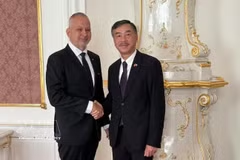
Vietnamese Ambassador to the Czech Republic Duong Hoai Nam (R) and Chairperson of the Czech Republic – Vietnam Interparliamentary Friendship Group Tomas Helebrant, at the Czech Chamber of Deputies headquarters on June 25, 2026. (Photo: VNA)

Vietnam, Czech Republic strengthen legislative cooperation

Nam expressed his appreciation for the support and efforts of the Interparliamentary Friendship Group and Helebrant personally in strengthening cooperation between the two legislative bodies, helping to serve as a bridge of friendship and deepen the Vietnam–Czech Republic Strategic Partnership.

☀️ Morning digest on June 26

☀️ Morning digest on June 26

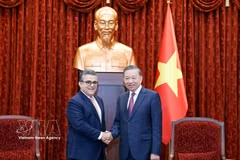
Party General Secretary and State President To Lam's receptions for the outgoing Palestinian and Korean ambassadors, the 13th National Congress of the Ho Chi Minh Communist Youth Union wrapping up, and a press conference on the Festival for Peace 2026 are among news highlights on June 25 evening.

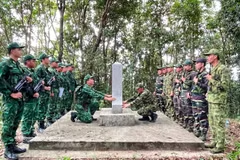
The bilateral patrol contributes to maintaining stability in the border area and strengthening the special solidarity and comprehensive cooperation between Vietnam and Laos. (Photo: VNA)

Vietnam, Laos conduct joint border patrol

The activity not only helped enhance the effectiveness of border management and sovereignty protection but also strengthened coordination, mutual trust and the special friendship and solidarity between the border protection forces of Vietnam and Laos.

Vietnamese, Chinese border forces conduct joint patrol

Vietnamese, Chinese border forces conduct joint patrol

The joint patrol covered the area between border markers No. 1055 and No. 1059. It reflected the friendship, mutual understanding and trust between the two sides in coordinating border management and protection, while reaffirming their commitment to maintaining regular joint patrols, exchanges and consultation mechanisms.

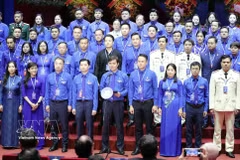
The 13th Central Committee, Standing Board and Secretariat of the Ho Chi Minh Communist Youth Union for the 2026–2031 term make their debut at the union's 13th national congress. (Photo: VNA)

13th National Congress of Ho Chi Minh Communist Youth Union concludes

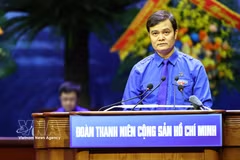
First Secretary of the HCYU Central Committee Bui Quang Huy affirmed that the congress has completed all scheduled items and fully and seriously incorporated the guidance of Party General Secretary and State President To Lam into its future programme of action, creating strong political momentum for the union’s activities and youth movements during the new term.

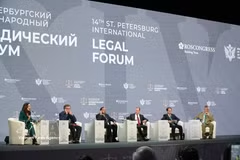
Panellists and keynote speakers at the plenary session of the 14th St. Petersburg International Legal Forum. (Photo: VNA)

Vietnam promotes legal cooperation and rule of law at global forum

Vietnam’s development and international integration have gone hand in hand with the improvement of its legal system, the incorporation of international commitments into domestic legislation, and legal reforms aimed at fostering development, openness and global integration. The country regards international law as an essential instrument for building fair, mutually beneficial relations among nations.