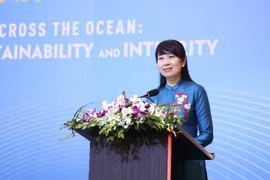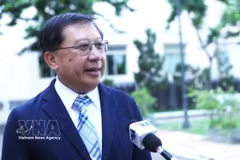
New York (VNA) – Prof. Carl Thayer from the Australian Defence Force Academy at the University of New South Wales has hailed the election of Assoc. Prof. Dr Nguyen Thi Lan Anh, Vietnam’s first international legal expert to sit on the International Tribunal for the Law of the Sea (ITLOS), as a landmark achievement for the country.
It was a vote of confidence in her ability and qualifications and underscored Vietnam’s deepening integration into international legal bodies, he said.
He noted that ITLOS, established in 1996, comprises 21 judges chosen to ensure geographic balance across Asia, Africa, Eastern Europe, Latin America and the Caribbean, and Western Europe and other states. Lan Anh secured the highest number of votes among Asian candidates. A total of 172 countries have so far signed on to the United Nations Convention on the Law of the Sea (UNCLOS).
According to Thayer, Lan Anh exemplifies Vietnam’s global integration journey. She was trained at the Diplomatic Academy of Vietnam (DAV) before earning a master’s in law at the University of Sheffield and a Ph.D. in law at the University of Bristol. He also spotlighted the DAV’s role in running and funding 17 international conferences on the East Sea.
As Director of the East Sea Institute, she plays a key role in Vietnam’s research, diplomatic outreach and international cooperation activities. Her election to ITLOS, Thayer said, reflects international acknowledgement of Vietnam’s contributions to promoting international law and upholding UNCLOS.
Thayer observed that Vietnam has traditionally joined and benefited from the international legal system. With a representative at ITLOS, the country will have more opportunities to shape international law. He stressed that UNCLOS is widely seen as the “constitution for the oceans”, meaning that each decision stretches far beyond the East Sea and applies to the entire world.
In his view, she will be able to sit on decisions involving oceans anywhere in the world. He added that ITLOS has been steadily widening its approach to new challenges, including climate change, ocean acidification and states’ responsibilities for protecting the marine environment.
Lan Anh’s term begins at a pivotal moment when ocean protection has become a growing global priority and competition over resources in the international seabed area is heating up. These issues, he said, demand new approaches and thinking./.