Can Tho universities gain international recognition in global rankings

As more universities from Can Tho gain international recognition, the city is reinforcing its role as a regional centre for education, science and technology, while contributing to the development of a highly skilled workforce and deeper international integration for the Mekong Delta.

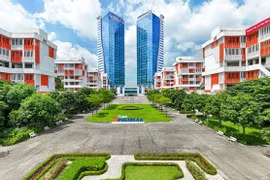
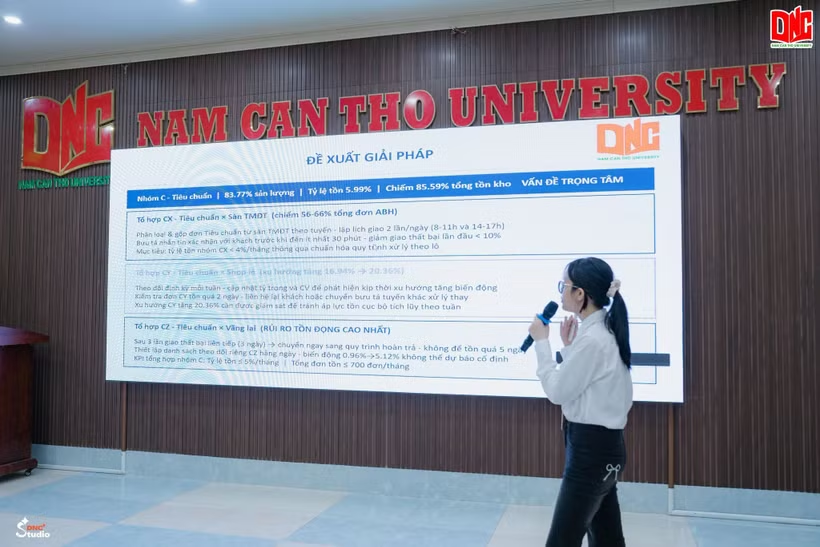
Illustrative photo (Photo: Facebook Nam Can Tho University)

Can Tho (VNA) – Three universities in the Mekong Delta city of Can Tho have earned places in prestigious international rankings this year, marking an important step forward for higher education in the region and highlighting its growing integration into the global academic community.

The latest achievement came on June 24 when Nam Can Tho University was listed for the first time in the Times Higher Education (THE) Impact Rankings 2026. The university was placed in the 801–1000 group globally among 1,603 higher education institutions from 116 countries and territories evaluated this year.

Nam Can Tho University was one of 17 Vietnamese universities included in the ranking, which assesses institutions based on their contributions to the United Nations’ 17 Sustainable Development Goals (SDGs).

The university recorded particularly strong results in several sustainability categories. It ranked in the global 101–200 group for clean water and sanitation, while in the 401–600 range for good health and well-being, gender equality, reduced inequalities, and sustainable cities and communities. In other areas including quality education, decent work and economic growth, and partnerships for the goals, the university was ranked in the 601–800 group worldwide.

The achievement adds to a series of recent successes for Nam Can Tho University. The institution currently holds a four-star rating under the QS Stars system and a five-star rating from UPM. Its hospital has also received international accreditation from the US-based Accreditation Commission for Health Care (AACI).

The university offers 49 undergraduate programmes, including 14 taught in English. It has also expanded into emerging fields such as artificial intelligence, semiconductor integrated circuit design, information security, biotechnology and high-speed railway engineering.

Meanwhile, 2026 has also been a milestone year for Can Tho University. For the first time, the institution was included in the QS World University Rankings 2026, placing in the 1,201–1,400 group globally.

The QS rankings are among the world's most respected university assessments, measuring institutions based on academic reputation, research quality, graduate employability, internationalisation and global partnerships.

Another notable success came from Can Tho University of Medicine and Pharmacy, which was ranked in the 191–200 group in Asia and placed 60th among 115 Southeast Asian institutions in the AppliedHE Rankings 2026.

Education experts said the appearance of three major universities from Can Tho in international rankings within a short period demonstrates the growing strength of higher education in the Mekong Delta. While global rankings in the past were largely dominated by institutions in Hanoi and Ho Chi Minh City, universities in Vietnam’s southernmost region are increasingly proving their competitiveness, education quality and international-standard research.

According to experts, the achievements reflect not only the efforts of individual institutions but also the positive results of higher education reforms, including greater autonomy, digital transformation, stronger research activities and expanded international cooperation.

As more universities from Can Tho gain international recognition, the city is reinforcing its role as a regional centre for education, science and technology, while contributing to the development of a highly skilled workforce and deeper international integration for the Mekong Delta./.
VNA

See more

An aerial view of Kinh Bac ward in Bac Ninh (Photo: VNA)

Politburo backs plan to turn Bac Ninh into centrally-run city

The conclusion sets out a vision for Bac Ninh as a model green, smart, modern, and affluent city that preserves the Kinh Bac region’s cultural identity, pushing economic expansion in parallel with environmental protection while leaning on sci-tech and innovation as core growth engines.

Hoan Kiem Lake, a cultural and historical symbol of the capital and also a key element of Hanoi’s distinctive urban landscape, is set to be preserved and enhanced as part of the city’s future development strategy. (Photo: VNA)

Hanoi’s Red River urban area development draws widespread attention

Located south of the Red River and extending from the historic inner city to newly developing areas in the south and the west, the central urban area along Red River’s right bank covers approximately 45,317 hectares and is projected to accommodate around 6.365 million residents by 2045 and 6.455 million by 2065.

Military personnel move the bomb to a designated disposal site. (Photo: VNA)

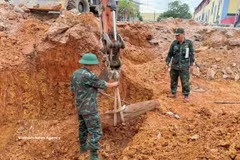
Wartime bomb safely detonated in Nghe An

The MK82 bomb, with its fuze still intact, was discovered on June 22 by workers excavating foundations for a primary school construction project. It was buried about 2.5 metres underground and measured 27.5cm in diameter and 1.55m in length.

The operation conducted by Vietnamese and Lao police forces, known as Case 135VL, results in the arrest of 16 suspects and the seizure of 50.7 tonnes of caffeine, a substance commonly used in illicit drug manufacturing. (Photo: vtv.vn)

Regional cooperation strengthened to combat cross-border drug crime

Vietnam, China, Laos and Myanmar face common challenges as drug syndicates increasingly exploit the Mekong River, cross-border transport networks, e-commerce platforms, international logistics services, cyberspace and cryptocurrencies to organise drug transactions and smuggling operations.

Efforts are stepped up to search for and recover remains of fallen soldiers at the Vi Xuyen battlefield. (Photo: qdnd.vn)

Campaign advances martyrs’ remains recovery in former Vi Xuyen battlefield

The martyrs’ remains recovery team under the Tuyen Quang provincial Military Command has strengthened its personnel, equipment and technical resources while coordinating with engineering units to clear unexploded ordnance and conduct recovery operations at key sites in Vi Xuyen, where fierce fighting took place during the northern border defence war.

The school's board of management receives a certificate of merit from the Vientiane Capital Association of Vietnamese People. (Photo: VNA)

Nguyen Du School reinforces Vietnamese language preservation in Laos

Nguyen Du Lao–Vietnamese Bilingual School in Vientiane occupies a particularly important position, contributing to Vietnamese-language education, cultural preservation and the development of a knowledgeable and skilled young generation, while helping strengthen the special ties between Vietnam and Laos.

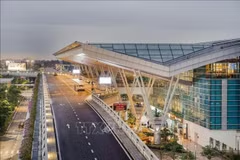
Da Nang International Airport (Illustrative photo: VNA)

Drone detection system trialed at Da Nang International Airport

Installed at the airport’s operations centre, the system is capable of automatically detecting, identifying and tracking unmanned flying devices operating within the airport area. During the trial period, authorities will assess the technology’s detection accuracy, operational range and target-tracking capabilities.

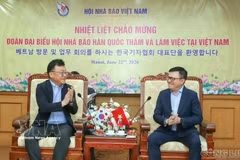
President of the Vietnam Journalists Association Le Quoc Minh (right) and President of the Journalists Association of Korea Park Jong-hyun at the meeting in Hanoi on June 22 (Photo: VNA)

Vietnam, RoK deepen press cooperation in digital age

The two sides agreed that with global media being rapidly reshaped by digital technology and artificial intelligence, more exchanges of information, management know-how and professional practice between journalism associations are critical for each country’s press development.

Assoc. Prof. Dr. Bui Xuan Bien, Chairman of the Board of Hanoi Financial and Banking University, speaks at the event (Photo: VNA)

Vietnam helps improve management capacity of Lao SOEs’ leaders

The programme features five thematic modules covering key issues in SOE management, including an overview of SOE governance, reform trends and sovereign wealth fund models, financial management and internal control, corporate culture development, and linkages between the private sector and SOEs.