Vietnam aims to train at least 35,000 railway workers by 2030

The Government has also outlined plans to train at least 70,000 additional railway workers during 2031–2035 while establishing specialised training and technology transfer centres by 2045.

Students of Ho Chi Minh City University of Transport study in the high-speed railway control and operation simulation room. (Photo: tuoitre.vn)

Hanoi (VNA) – Vietnam plans to train at least 35,000 railway workers in the 2025-2030 period as the country is accelerating the development of modern railway infrastructure, particularly high-speed rail projects.

The target includes around 1,000 postgraduates, 14,000 university graduates, 11,000 college-level graduates and 9,000 intermediate-level technicians.

Priority training areas include railway construction, signalling and communications systems, power supply, locomotives and rolling stock, and transport operations.

The Government has also outlined plans to train at least 70,000 additional railway workers during 2031–2035 while establishing specialised training and technology transfer centres by 2045.

One of the key challenges is the lengthy training period required for specialised engineers, which can range from 5 - 7 years, while major railway projects are expected to move forward in the near future.

To address this issue, the Government plans to allocate approximately 88 million USD for scholarships, training programmes and laboratory development. Universities are also stepping up preparations.

According to the Vietnam Railways Corporation (VNR), the planned Lao Cai–Hanoi–Hai Phong railway alone will require about 2,431 personnel for management, operation, maintenance and technical services across 13 job categories, including around 1,700 frontline workers.

Human resource needs are also evolving rapidly. Alongside traditional railway occupations such as train drivers and dispatchers, demand is rising for specialists in mechatronics, signalling and telecommunications systems, power supply networks, and rolling stock inspection and maintenance.

At a broader level, the North–South high-speed railway project, spanning more than 1,500 kilometres, is forecast to generate over 200,000 jobs. Opportunities will extend across project management, engineering consultancy, construction, equipment manufacturing and railway operations.
tau.png
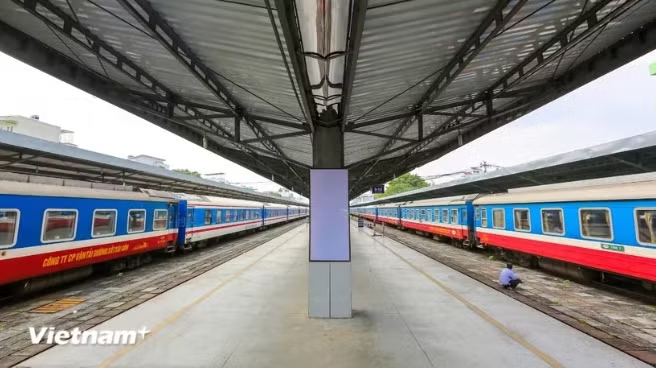
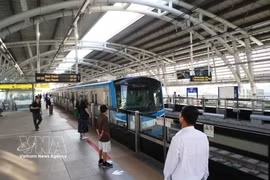
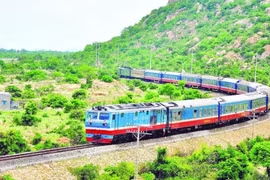
Illustrative photo (Photo: VNA)

The growing labour demand is already visible in related industries. Recently, SGC Investment and Construction JSC announced plans to recruit 25,000 workers across its system, highlighting how railway development is creating employment opportunities not only in transport but also in construction, mechanical engineering and technology sectors.

Industry experts noted that modern railway systems integrate a wide range of advanced technologies, including precision engineering, electronics, automation and artificial intelligence, making human resources a decisive factor in project success.

Associate Prof. and Dr Nguyen Van Hung, Rector of the University of Transport and Communications, stressed that Vietnam must develop a strong domestic workforce to reduce dependence on foreign contractors and experts.

Le Trung Thanh, Director of the Department of Science, Technology and Environment under the Ministry of Construction, described high-speed rail as the largest infrastructure project ever undertaken in Vietnam. He said skilled personnel are needed at every stage, from design and construction to equipment manufacturing, operations and standard management.

The University of Transport and Communications has introduced seven new academic programmes, developed a continuous training pathway from undergraduate to doctoral levels, and launched short-term courses for engineers already working on infrastructure projects.

Students are increasingly viewing the railway sector as a promising career path. Many believed that the expansion of modern and high-speed rail networks will offer long-term employment prospects while allowing them to contribute to the country's infrastructure development.

Experts said developing railway human resources is not only an immediate need but also a long-term strategic task. Building a skilled workforce alongside technological capacity and supportive policies will be essential for Vietnam to master railway technologies and support sustainable socio-economic growth in the decades ahead./.
VNA

See more

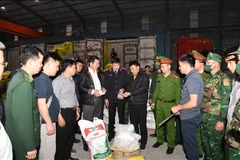
The operation conducted by Vietnamese and Lao police forces, known as Case 135VL, results in the arrest of 16 suspects and the seizure of 50.7 tonnes of caffeine, a substance commonly used in illicit drug manufacturing. (Photo: vtv.vn)

Regional cooperation strengthened to combat cross-border drug crime

Vietnam, China, Laos and Myanmar face common challenges as drug syndicates increasingly exploit the Mekong River, cross-border transport networks, e-commerce platforms, international logistics services, cyberspace and cryptocurrencies to organise drug transactions and smuggling operations.

Efforts are stepped up to search for and recover remains of fallen soldiers at the Vi Xuyen battlefield. (Photo: qdnd.vn)

Campaign advances martyrs’ remains recovery in former Vi Xuyen battlefield

The martyrs’ remains recovery team under the Tuyen Quang provincial Military Command has strengthened its personnel, equipment and technical resources while coordinating with engineering units to clear unexploded ordnance and conduct recovery operations at key sites in Vi Xuyen, where fierce fighting took place during the northern border defence war.

The school's board of management receives a certificate of merit from the Vientiane Capital Association of Vietnamese People. (Photo: VNA)

Nguyen Du School reinforces Vietnamese language preservation in Laos

Nguyen Du Lao–Vietnamese Bilingual School in Vientiane occupies a particularly important position, contributing to Vietnamese-language education, cultural preservation and the development of a knowledgeable and skilled young generation, while helping strengthen the special ties between Vietnam and Laos.

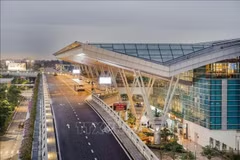
Da Nang International Airport (Illustrative photo: VNA)

Drone detection system trialed at Da Nang International Airport

Installed at the airport’s operations centre, the system is capable of automatically detecting, identifying and tracking unmanned flying devices operating within the airport area. During the trial period, authorities will assess the technology’s detection accuracy, operational range and target-tracking capabilities.

President of the Vietnam Journalists Association Le Quoc Minh (right) and President of the Journalists Association of Korea Park Jong-hyun at the meeting in Hanoi on June 22 (Photo: VNA)

Vietnam, RoK deepen press cooperation in digital age

The two sides agreed that with global media being rapidly reshaped by digital technology and artificial intelligence, more exchanges of information, management know-how and professional practice between journalism associations are critical for each country’s press development.

Assoc. Prof. Dr. Bui Xuan Bien, Chairman of the Board of Hanoi Financial and Banking University, speaks at the event (Photo: VNA)

Vietnam helps improve management capacity of Lao SOEs’ leaders

The programme features five thematic modules covering key issues in SOE management, including an overview of SOE governance, reform trends and sovereign wealth fund models, financial management and internal control, corporate culture development, and linkages between the private sector and SOEs.

The rapid technological development and the proliferation of new forms of IP infringement are creating significant challenges for adjudication. (Photo: VNA)

Strengthening legal mechanisms needed to enhance IP adjudication: Experts

As Vietnam advances judicial reform and deepens international integration, establishing specialised judicial mechanisms for intellectual property (IP) disputes and violations has become increasingly necessary. However, rapid technological development and the proliferation of new forms of IP infringement are creating significant challenges for adjudication.

Vietnam’s Hidden Spa-Water Hope wins top jury prize at Architizer A+Awards 2026

Vietnam’s Hidden Spa-Water Hope wins top jury prize at Architizer A+Awards 2026

Nestled among coastal sand dunes in Cam Ranh, the project was conceived with a strong commitment to respecting the natural landscape and harnessing water as its central element. Rather than creating a visually dominant structure, the design blends into the terrain, making use of sand layers, native vegetation and open spaces to strengthen the connection between people and nature.

Candidates listen to the exam rules. (Photo: VNA)

Nearly 1,000 candidates sit Vietnamese language proficiency test in Japan

According to organisers, the growing number of long-term learners shows that Vietnamese is increasingly becoming a practical foreign language for study, work and social interaction in Japan. Alongside the expanding Vietnamese community in the country, demand for Vietnamese language skills in daily life, workplaces and public services continues to increase.

National Assembly Chairman Tran Thanh Man (9th from right) poses for a photo with VNA leaders and authors whose works win awards at the 20th National Press Awards. (Photo: VNA)

VNA's message of appreciation on Vietnam's Revolutionary Press Day

The attention and encouragement from Party and State leaders, agencies, organisations, and the public serve as a tremendous source of motivation for VNA journalists and staff to continue fulfilling the mission of the national news agency – a strategic and trusted information centre of the Party and the State which remains committed to providing accurate, objective and comprehensive coverage of national developments, promoting positive values, inspiring patriotism, strengthening national self-reliance, and fostering aspirations for a prosperous and happy nation.