Vietnam targets full coverage of non-traditional security education in schools by 2030

All ministries, sectors, localities and armed force units are required to incorporate awareness-raising activities on non-traditional security into their annual work plans, while regular and thematic communication campaigns will be organised for different target groups and localities.

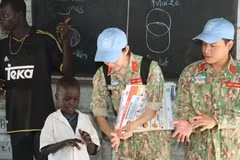
Illustrative image (Photo: baochinhphu.vn)

Hanoi (VNA) – All educational institutions nationwide are expected to implement communication and educational activities on the prevention of and response to non-traditional security threats under a project approved by Prime Minister Le Minh Hung on June 23.

​The project, titled “Communication on the prevention of and response to non-traditional security threats through 2030, with a vision to 2045”, aims to enhance awareness, responsibility and action among authorities, armed forces, businesses and people in preventing, detecting and responding to non-traditional security threats.

It also seeks to step up the country’s communication, forecasting, warning and response capacities, contributing to safeguarding national security, maintaining social order and supporting sustainable development.

​By 2030, all key leaders and managers at all levels are expected to be fully informed of the Party’s guidelines, the State's policies and laws, and the national strategy on preventing and responding to non-traditional security threats.

​All ministries, sectors, localities and armed force units are required to incorporate awareness-raising activities on non-traditional security into their annual work plans, while regular and thematic communication campaigns will be organised for different target groups and localities.

​The project sets a target that every province and centrally-run city will establish and maintain at least one pilot model for communication and capacity building in preventing and responding to non-traditional security threats by 2030.

​To improve communication capacity and crisis management, all ministries, sectors and localities are expected to establish focal points and coordination mechanisms for communication on non-traditional security issues.

​National and sector-specific communication campaigns will be organised annually in response to emerging risks and challenges. Efforts will also focus on improving the capacity to tackle fake news, misinformation and communication crises.

​Looking ahead to 2045, the project envisions a safe and highly adaptive society in which communication on non-traditional security becomes a routine activity supported by a modern communication ecosystem. Citizens will possess self-protection skills, while the political system and core forces will be capable of forecasting, issuing early warnings and responding effectively to non-traditional security threats.

​To achieve these goals, the project outlines eight groups of tasks and solutions, including strengthening the Party's leadership and the State's management; standardising communication content and developing a national messaging system; promoting digital transformation and digital communication; enhancing strategic communication, risk communication and crisis response; safeguarding ideological and information security in cyberspace; building a resilient society; improving human resource training, inter-sectoral coordination and international cooperation; and ensuring adequate resources for implementation.

​The project will be implemented nationwide, covering State agencies, organisations, armed forces, educational institutions, enterprises, media agencies and related organisations and individuals. Priority will be given to key areas, remote and border regions, islands, ethnic minority communities and groups vulnerable to non-traditional security threats.

​It will be carried out in two phases during 2026–2030, focusing on strengthening coordination mechanisms, databases and core forces, as well as on communication activities, training, pilot models, monitoring and evaluation, before expanding successful models and completing rapid-response and crisis-management mechanisms. Beyond 2030, the project will continue developing a modern, synchronised and multi-platform national communication system towards the 2045 vision./.


VNA

See more

The operation conducted by Vietnamese and Lao police forces, known as Case 135VL, results in the arrest of 16 suspects and the seizure of 50.7 tonnes of caffeine, a substance commonly used in illicit drug manufacturing. (Photo: vtv.vn)

Regional cooperation strengthened to combat cross-border drug crime

Vietnam, China, Laos and Myanmar face common challenges as drug syndicates increasingly exploit the Mekong River, cross-border transport networks, e-commerce platforms, international logistics services, cyberspace and cryptocurrencies to organise drug transactions and smuggling operations.

Efforts are stepped up to search for and recover remains of fallen soldiers at the Vi Xuyen battlefield. (Photo: qdnd.vn)

Campaign advances martyrs’ remains recovery in former Vi Xuyen battlefield

The martyrs’ remains recovery team under the Tuyen Quang provincial Military Command has strengthened its personnel, equipment and technical resources while coordinating with engineering units to clear unexploded ordnance and conduct recovery operations at key sites in Vi Xuyen, where fierce fighting took place during the northern border defence war.

The school's board of management receives a certificate of merit from the Vientiane Capital Association of Vietnamese People. (Photo: VNA)

Nguyen Du School reinforces Vietnamese language preservation in Laos

Nguyen Du Lao–Vietnamese Bilingual School in Vientiane occupies a particularly important position, contributing to Vietnamese-language education, cultural preservation and the development of a knowledgeable and skilled young generation, while helping strengthen the special ties between Vietnam and Laos.

Da Nang International Airport (Illustrative photo: VNA)

Drone detection system trialed at Da Nang International Airport

Installed at the airport’s operations centre, the system is capable of automatically detecting, identifying and tracking unmanned flying devices operating within the airport area. During the trial period, authorities will assess the technology’s detection accuracy, operational range and target-tracking capabilities.

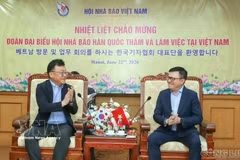
President of the Vietnam Journalists Association Le Quoc Minh (right) and President of the Journalists Association of Korea Park Jong-hyun at the meeting in Hanoi on June 22 (Photo: VNA)

Vietnam, RoK deepen press cooperation in digital age

The two sides agreed that with global media being rapidly reshaped by digital technology and artificial intelligence, more exchanges of information, management know-how and professional practice between journalism associations are critical for each country’s press development.

Assoc. Prof. Dr. Bui Xuan Bien, Chairman of the Board of Hanoi Financial and Banking University, speaks at the event (Photo: VNA)

Vietnam helps improve management capacity of Lao SOEs’ leaders

The programme features five thematic modules covering key issues in SOE management, including an overview of SOE governance, reform trends and sovereign wealth fund models, financial management and internal control, corporate culture development, and linkages between the private sector and SOEs.

The rapid technological development and the proliferation of new forms of IP infringement are creating significant challenges for adjudication. (Photo: VNA)

Strengthening legal mechanisms needed to enhance IP adjudication: Experts

As Vietnam advances judicial reform and deepens international integration, establishing specialised judicial mechanisms for intellectual property (IP) disputes and violations has become increasingly necessary. However, rapid technological development and the proliferation of new forms of IP infringement are creating significant challenges for adjudication.

Vietnam’s Hidden Spa-Water Hope wins top jury prize at Architizer A+Awards 2026

Vietnam’s Hidden Spa-Water Hope wins top jury prize at Architizer A+Awards 2026

Nestled among coastal sand dunes in Cam Ranh, the project was conceived with a strong commitment to respecting the natural landscape and harnessing water as its central element. Rather than creating a visually dominant structure, the design blends into the terrain, making use of sand layers, native vegetation and open spaces to strengthen the connection between people and nature.

Candidates listen to the exam rules. (Photo: VNA)

Nearly 1,000 candidates sit Vietnamese language proficiency test in Japan

According to organisers, the growing number of long-term learners shows that Vietnamese is increasingly becoming a practical foreign language for study, work and social interaction in Japan. Alongside the expanding Vietnamese community in the country, demand for Vietnamese language skills in daily life, workplaces and public services continues to increase.

National Assembly Chairman Tran Thanh Man (9th from right) poses for a photo with VNA leaders and authors whose works win awards at the 20th National Press Awards. (Photo: VNA)

VNA's message of appreciation on Vietnam's Revolutionary Press Day

The attention and encouragement from Party and State leaders, agencies, organisations, and the public serve as a tremendous source of motivation for VNA journalists and staff to continue fulfilling the mission of the national news agency – a strategic and trusted information centre of the Party and the State which remains committed to providing accurate, objective and comprehensive coverage of national developments, promoting positive values, inspiring patriotism, strengthening national self-reliance, and fostering aspirations for a prosperous and happy nation.