Strengthening legal mechanisms needed to enhance IP adjudication: Experts

As Vietnam advances judicial reform and deepens international integration, establishing specialised judicial mechanisms for intellectual property (IP) disputes and violations has become increasingly necessary. However, rapid technological development and the proliferation of new forms of IP infringement are creating significant challenges for adjudication.

The rapid technological development and the proliferation of new forms of IP infringement are creating significant challenges for adjudication. (Photo: VNA)

Hanoi (VNA) - As Vietnam advances judicial reform and deepens international integration, establishing specialised judicial mechanisms for intellectual property (IP) disputes and violations has become increasingly necessary. However, rapid technological development and the proliferation of new forms of IP infringement are creating significant challenges for adjudication.

Specialised IP courts improve enforcement effectiveness

Since July 1, 2025, specialised intellectual property courts have officially operated within the Regional People’s Court No. 2 of Hanoi and the Regional People’s Court No. 1 of Ho Chi Minh City. According to Chief Judge Hoang Ngoc Thanh of the Regional People’s Court No. 2 of Hanoi, the move reflects the judiciary’s commitment to judicial reforms, improving the quality of adjudication in line with directions from the Supreme People’s Court, while responding to the requirements of the digital economy and Vietnam’s international economic integration commitments.

Thanh said the specialised model helps shorten case-processing time, improve the quality of judgments, enhance consistency and predictability in the application of law, and better protect the legitimate creative and property rights of organisations and individuals. It also strengthens the confidence of domestic and foreign businesses and investors in Vietnam’s IP protection system.

Since its establishment, Hanoi's specialised court has accepted 27 civil and commercial cases involving intellectual property rights, primarily concerning copyright and related rights. Five cases have been resolved, while the remainders are undergoing legal proceedings.

Despite these developments, the number of criminal prosecutions and civil disputes currently brought before the courts still falls far short of the actual scale of IP violations occurring in Vietnam. During a nationwide enforcement campaign launched under the Prime Minister’s Official dispatch No. 38, market surveillance authorities handled 1,520 IP-related violations, up 370.6% year-on-year and accounting for more than 40% of all violations detected. In the digital sphere, more than 9,130 infringing products were removed and over 2,000 online storefronts were blocked for suspected sales of counterfeit, substandard or IP-infringing goods.

Challenges of handling violations in digital environment

Judge Hoang Nghia Hai, who regularly adjudicates IP cases at the Hanoi specialised court, noted that the nature of IP disputes and infringements has changed significantly with the rapid development of digital technology. While violations once occurred mainly in physical markets, most now take place online, where they spread faster, operate on a larger scale and employ increasingly sophisticated methods.

The targets of infringement have also evolved beyond traditional goods, trademarks and industrial designs to include customer data, software, digital copyrights, trade secrets and brand reputation.

Offenders frequently exploit advanced technologies, including anonymous accounts, overseas servers, virtual private networks (VPNs), artificial intelligence and intermediary systems to conceal identities and erase digital traces. Counterfeit and infringing operations are often fragmented into multiple stages and conducted through livestreams, social media platforms and delivery services to evade detection.

One of the greatest challenges facing courts is the collection, verification and assessment of electronic evidence. Unlike traditional forms of evidence, digital data can be altered, deleted or manipulated within a short period of time. In many cases, infringing content has already been removed from the internet by the time courts begin verification. Identifying the individuals behind websites, social media accounts or online business systems is also difficult because violators often use multiple layers of technical intermediaries to conceal their identities.

Thanh said many violations are committed through social media platforms, e-commerce marketplaces and intermediary systems hosted abroad, while the collection of electronic evidence also remains heavily dependent on cooperation from cross-border digital platforms, resulting in delays or incomplete information. Meanwhile, Vietnam still lacks sufficient specialised experts and institutions capable of conducting advanced digital forensics and assessments of highly technical violations.

Judges handling IP-related civil, commercial and administrative cases have called for stronger mechanisms to preserve evidence at an early stage, allowing courts to intervene promptly when there is a risk that evidence may be destroyed, altered or concealed.

Although Vietnamese law has recognised electronic evidence for many years, legal experts said further improvements are needed in regulations governing digital evidence, data collection and the responsibilities of intermediary platforms in providing information.

Deputy Chief Judge Dinh Thi Kieu My of the Hanoi court said procedures for collecting, preserving and evaluating electronic evidence should be standardised in line with international practices, particularly regarding data integrity, authenticity and chain-of-custody requirements.

Judge Nguyen Che Linh of the Can Tho People’s Court proposed standardising legal definitions and terminology related to electronic evidence and introducing clearer criteria for assessing the evidentiary value of electronic data messages. He also called for a dedicated legal and technical framework covering the collection, preservation and forensic examination of electronic evidence, including scenarios involving deleted data recovery, cloud computing platforms and social media.

Tang Duc Khuong from Vision & Associates suggested that Vietnam should consider developing a new intellectual property law capable of comprehensively addressing emerging challenges and ensuring a more coherent legal framework for the digital era./.

VNA
See more

Vietnam’s Hidden Spa-Water Hope wins top jury prize at Architizer A+Awards 2026

Vietnam’s Hidden Spa-Water Hope wins top jury prize at Architizer A+Awards 2026

Nestled among coastal sand dunes in Cam Ranh, the project was conceived with a strong commitment to respecting the natural landscape and harnessing water as its central element. Rather than creating a visually dominant structure, the design blends into the terrain, making use of sand layers, native vegetation and open spaces to strengthen the connection between people and nature.

Candidates listen to the exam rules. (Photo: VNA)

Nearly 1,000 candidates sit Vietnamese language proficiency test in Japan

According to organisers, the growing number of long-term learners shows that Vietnamese is increasingly becoming a practical foreign language for study, work and social interaction in Japan. Alongside the expanding Vietnamese community in the country, demand for Vietnamese language skills in daily life, workplaces and public services continues to increase.

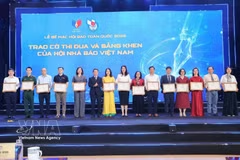
National Assembly Chairman Tran Thanh Man (9th from right) poses for a photo with VNA leaders and authors whose works win awards at the 20th National Press Awards. (Photo: VNA)

VNA's message of appreciation on Vietnam's Revolutionary Press Day

The attention and encouragement from Party and State leaders, agencies, organisations, and the public serve as a tremendous source of motivation for VNA journalists and staff to continue fulfilling the mission of the national news agency – a strategic and trusted information centre of the Party and the State which remains committed to providing accurate, objective and comprehensive coverage of national developments, promoting positive values, inspiring patriotism, strengthening national self-reliance, and fostering aspirations for a prosperous and happy nation.

The Vietnam Asian Schools Debating Championship 2026 (Vietnam ASDC) officially opens in Hanoi on June 21. (Photo: nhandan.vn)

Hanoi hosts Asian Schools Debating Championship 2026

Hosting the championship for the second consecutive year is significant not only for Vietnam's debating community but also for strengthening connections among debating communities across Asia, helping build a larger and stronger Asian debating community.

National Assembly Chairman Tran Thanh Man (6th from right) and Chairman of the Party Central Committee’s Commission for Information, Education and Mass Mobilisation Trinh Van Quyet (7th from right) present A prizes to award-winning authors and groups of authors at the 20th National Press Awards Ceremony. (Photo: VNA)

National Assembly Chairman calls on press to continue serving nation, people

Chairman Man highlighted the significant contributions of Vietnam’s revolutionary press throughout the country’s development process. He said the press has consistently been at the forefront of safeguarding the Party’s ideological foundation, combating false and hostile views, exposing corruption, wastefulness and negative phenomena, and at the same time, promoting positive role models and humanitarian values.

Hundreds of people join the protest at the Place de la Bastille in support of AO victims and those of chlordecone pesticide contamination. (Photo: VNA)

Calls for justice for Vietnamese AO victims gain renewed support in France

Lawyer Christophe Lèguevaques described the struggle for justice for AO victims as both necessary and legitimate. He noted encouraging signs in the Court of Cassation’s review of Nga’s case and expressed his admiration for her determination and perseverance in pursuing justice on behalf of victims.

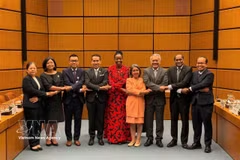
Ambassadors and Chargé d'affaires from eight ASEAN member countries and Monica Juma, Executive Director of the United Nations Office on Drugs and Crime (UNODC) pose for a group photo (Photo: VNA)

Vietnam values UNODC support for ASEAN

Vietnam highly values UNODC’s support for ASEAN and the region and calls on the organisation to continue prioritising capacity-building programmes, technical assistance, and the effective implementation of international legal instruments against transnational crime.

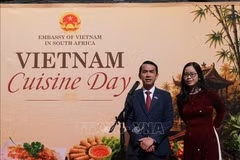
Vietnamese Ambassador to South Africa Hoang Sy Cuong delivers the opening remarks at the event. (Photo: VNA)

Vietnam Cuisine Day held in South Africa

The event introduced international guests to a broad spectrum of Vietnamese culinary traditions beyond well-known dishes such as pho and fried spring rolls, highlighting regional flavours from across the country.

The 10th anniversary ceremony of the Vietnamese language class in Belarus. (Photo: VNA)

Vietnamese language honoured, cultural values promoted in Belarus

Founded in Minsk in July 2016 with just 20 students aged between seven and 14, the class has grown steadily under the dedicated guidance of teacher Nguyen Phuong Dung. Over the past decade, it has provided second- and third-generation Vietnamese children born and raised in Belarus with a valuable opportunity to learn their mother tongue and stay connected to their cultural roots.

Politburo member, Secretary of the Party Central Committee and Chairman of its Commission for Information, Education and Mass Mobilisation Trinh Van Quyet (C) and other officials open the National Press Festival 2026 on June 19. (Photo: VNA)

National Press Festival 2026 opens in Hai Phong city

Trinh Van Quyet, Politburo member, Secretary of the Party Central Committee and Chairman of its Commission for Information, Education and Mass Mobilisation, called on journalists nationwide to stay close to reality, uphold the Party characteristic and people-centred orientation of the press, remain absolutely loyal to the Fatherland and the revolutionary cause, and continuously innovate and master new technologies.

The 32nd Beijing International Book Fair (BIBF) has attracted more than 1,700 exhibitors from 82 countries and territories (Photo: VNA)

Vietnam, China strengthen publishing cooperation at Beijing book fair

Chinese partners expressed strong interest in expanding cooperation with Vietnamese counterparts, including the Ethnic Culture Publishing House, particularly in copyright exchanges, reading culture promotion and introducing the cultural values of both countries to wider audiences.

Participants in the 2026 Vietnam–Japan Teenage Ambassadors programme pose for a group photo with delegates. (Photo: VNA)

Seeds of friendship strengthen Vietnam–Japan ties

Vietnamese Ambassador to Japan Pham Quang Hieu described the programme as a meaningful initiative that helps nurture lasting friendship between the younger generations of the two countries. He said people-to-people ties are the foundation of the Vietnam–Japan relationship, and that friendships and mutual understanding built by young people today will strengthen bilateral relations in the future.