Vietnam Family Day: Investing in families for sustainable development

Despite strong family bonds, many households in Vietnam now live in separate “worlds” shaped by technology and global integration. The rapid expansion of digital information has placed traditional family education under pressure, as children increasingly turn to online sources of knowledge rather than learning from parents and grandparents.

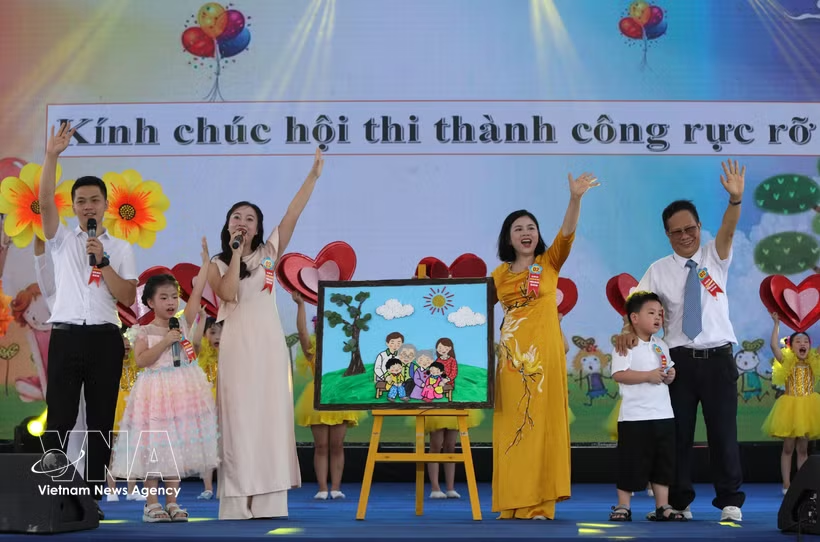
Teams compete in the “Talented Family” contest at the 2026 Bac Ninh Family Festival. (Photo: VNA)

Hanoi (VNA) - As Vietnam Family Day (June 28) approaches, experts have highlighted strong families as a cornerstone of human capital development and national prosperity, stressing that nurturing resilient households also strengthens community cohesion, social solidarity and sustainable development.

Family structures undergoing transformation

According to Dr. Tran Thi Hong, Deputy Director of the Institute for Human, Family and Gender Studies under the Vietnam Academy of Social Sciences, Vietnamese families are undergoing profound changes driven by socio-economic development, industrialisation, urbanisation, digital transformation and international integration.

Nuclear families are becoming increasingly common, household sizes continue to shrink, and the number of households consisting solely of elderly members or with migrant workers is rising. In 2024, the average household size stood at 3.6 people, down from 4.6 in 1999, significantly reshaping patterns of care and intergenerational connection.

Family functions have also evolved, with responsibilities related to education, caregiving and economic development increasingly shared with schools, markets and other social institutions.

At the same time, family values are balancing tradition and modernity. Traditional values such as filial piety, affection and responsibility remain important, while concepts such as individual autonomy, gender equality and shared family responsibilities are gaining greater prominence.

To realise the goal of building “prosperous, happy, progressive and civilised” Vietnamese families, Hong said the country should shift from a mindset of “addressing family problems” to one of “investing in family development”. This includes improving family-related policies, expanding family support services, enhancing parenting and elderly care skills, promoting gender equality and fostering a healthy cultural environment.

She also recommended placing family development at the heart of broader human development strategies, while promoting national, cultural and family value systems, as well as standards of Vietnamese identity. In addition, she proposed launching a comprehensive research programme on Vietnamese families for 2026–2030 to monitor family trends and build a national family database.
vnanet-potal-ngay-quoc-te-hanh-phuc-203-lan-toa-gia-tri-tot-dep-cua-hanh-phuc-gia-dinh-8649722.jpg
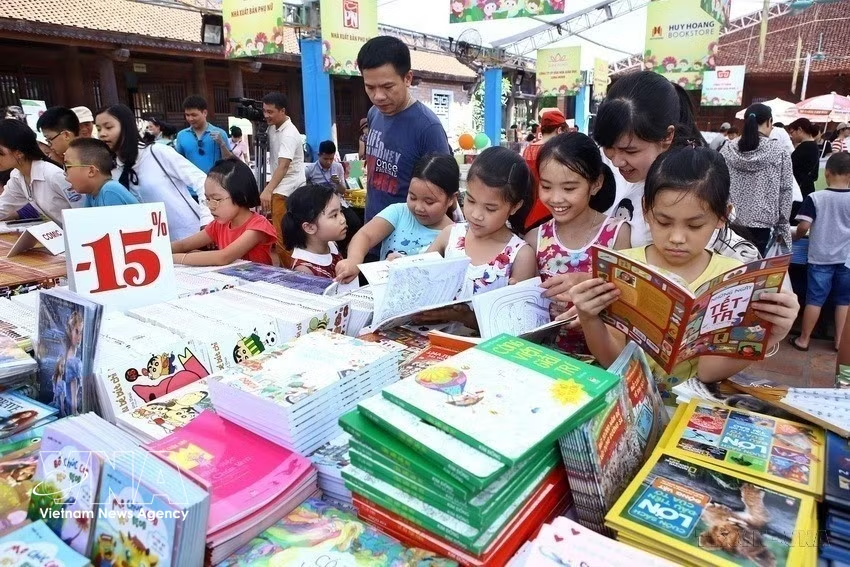
Children enthusiastically browse books with their families at the Children's Book Fair, selecting their favourite titles. (Photo: VNA)

Viewing families as unique cultural asset

Dr. Nguyen Thu Hanh, Director of the Centre for Research and Development of Vietnam Cultural Industry (SDCI), said the greatest challenge facing families today is not changing family structures but the widening emotional and communication gap between family members.

Despite strong family bonds, many households now live in separate “worlds” shaped by technology and global integration. The rapid expansion of digital information has placed traditional family education under pressure, as children increasingly turn to online sources of knowledge rather than learning from parents and grandparents.

Hanh argued that families should be recognised as a unique cultural and social asset of the nation – the first environment in which people are nurtured and core values are preserved. Stories of family affection, memories, lifestyles and traditions can become valuable resources for distinctive cultural, tourism and educational products.

To help spread the message that “Happy families create a prosperous nation,” she proposed viewing families as creators of content in their own right. Every family possesses valuable “living heritage” that should be shared through suitable creative platforms and spaces.

Initiatives such as S-Happy Café and O-Cafe Time Talks, developed by SDCI, have created opportunities for different generations to produce podcasts, short videos and family storytelling projects that preserve memories and strengthen family ties.

According to Hanh, such initiatives not only help culture adapt to the digital age but also foster greater understanding, connection and cohesion among family members./.

VNA

See more

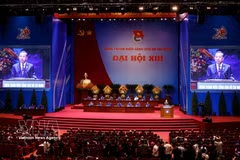
Party General Secretary and State President To Lam delivers a keynote address at the congress. (Photo: VNA)

Ho Chi Minh Communist Youth Union convenes 13th National Congress in Hanoi

In his opening speech, First Secretary of the HCYU Central Committee and Vice President of the VFF Central Committee Bui Quang Huy pointed to a sweeping transformation in mindset, content, and operational methods, steering the HCYU toward greater practicality, tighter alignment with real-world conditions, and a sharp youth-centred focus. Sci-tech, innovation, and digital transformation have become standout hallmarks, dramatically improving outreach, education, youth engagement, and the union’s expanding footprint in the digital space.

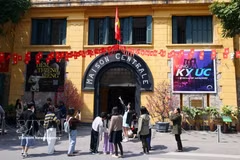
The Hoa Lo Prison historical site is a popular destination among visitors (Photo: VNA)

Vietnam emerges as tourism hotspot on global map

According to online travel platform Agoda, searches for accommodation in Vietnam by Chinese travellers surged 164% year-on-year in the first five months of 2026, the fastest growth among international source markets.

Illustrative photo (Photo: Facebook Nam Can Tho University)

Can Tho universities gain international recognition in global rankings

As more universities from Can Tho gain international recognition, the city is reinforcing its role as a regional centre for education, science and technology, while contributing to the development of a highly skilled workforce and deeper international integration for the Mekong Delta.

An aerial view of Kinh Bac ward in Bac Ninh (Photo: VNA)

Politburo backs plan to turn Bac Ninh into centrally-run city

The conclusion sets out a vision for Bac Ninh as a model green, smart, modern, and affluent city that preserves the Kinh Bac region’s cultural identity, pushing economic expansion in parallel with environmental protection while leaning on sci-tech and innovation as core growth engines.

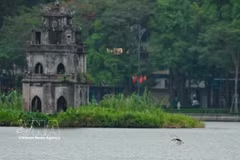
Hoan Kiem Lake, a cultural and historical symbol of the capital and also a key element of Hanoi’s distinctive urban landscape, is set to be preserved and enhanced as part of the city’s future development strategy. (Photo: VNA)

Hanoi’s Red River urban area development draws widespread attention

Located south of the Red River and extending from the historic inner city to newly developing areas in the south and the west, the central urban area along Red River’s right bank covers approximately 45,317 hectares and is projected to accommodate around 6.365 million residents by 2045 and 6.455 million by 2065.

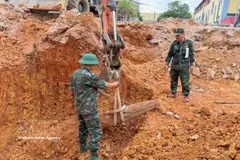
Military personnel move the bomb to a designated disposal site. (Photo: VNA)

Wartime bomb safely detonated in Nghe An

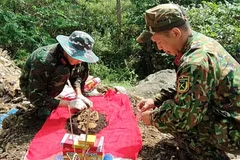
The MK82 bomb, with its fuze still intact, was discovered on June 22 by workers excavating foundations for a primary school construction project. It was buried about 2.5 metres underground and measured 27.5cm in diameter and 1.55m in length.

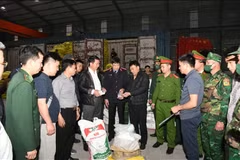
The operation conducted by Vietnamese and Lao police forces, known as Case 135VL, results in the arrest of 16 suspects and the seizure of 50.7 tonnes of caffeine, a substance commonly used in illicit drug manufacturing. (Photo: vtv.vn)

Regional cooperation strengthened to combat cross-border drug crime

Vietnam, China, Laos and Myanmar face common challenges as drug syndicates increasingly exploit the Mekong River, cross-border transport networks, e-commerce platforms, international logistics services, cyberspace and cryptocurrencies to organise drug transactions and smuggling operations.

Efforts are stepped up to search for and recover remains of fallen soldiers at the Vi Xuyen battlefield. (Photo: qdnd.vn)

Campaign advances martyrs’ remains recovery in former Vi Xuyen battlefield

The martyrs’ remains recovery team under the Tuyen Quang provincial Military Command has strengthened its personnel, equipment and technical resources while coordinating with engineering units to clear unexploded ordnance and conduct recovery operations at key sites in Vi Xuyen, where fierce fighting took place during the northern border defence war.

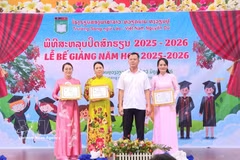
The school's board of management receives a certificate of merit from the Vientiane Capital Association of Vietnamese People. (Photo: VNA)

Nguyen Du School reinforces Vietnamese language preservation in Laos

Nguyen Du Lao–Vietnamese Bilingual School in Vientiane occupies a particularly important position, contributing to Vietnamese-language education, cultural preservation and the development of a knowledgeable and skilled young generation, while helping strengthen the special ties between Vietnam and Laos.

Da Nang International Airport (Illustrative photo: VNA)

Drone detection system trialed at Da Nang International Airport

Installed at the airport’s operations centre, the system is capable of automatically detecting, identifying and tracking unmanned flying devices operating within the airport area. During the trial period, authorities will assess the technology’s detection accuracy, operational range and target-tracking capabilities.