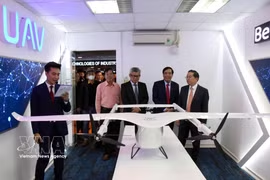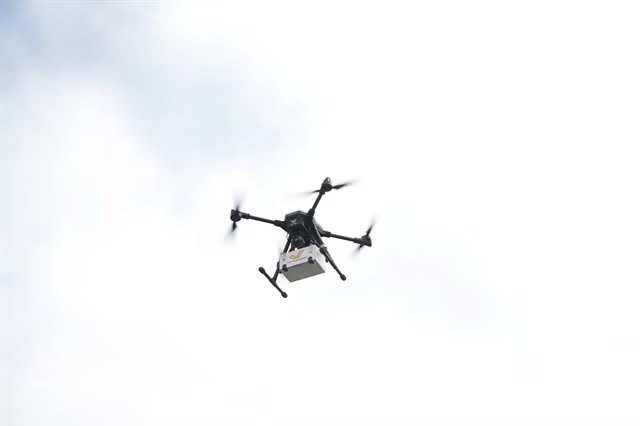
Hanoi (VNS/VNA) – The northwestern province of Dien Bien is set to carry out around 6,000 UAV flights under a newly-approved sandbox programme aimed at testing low-altitude economy applications.
The Dien Bien provincial People's Committee on June 23 authorised a controlled pilot programme for digital technology-based products and services using unmanned aerial vehicles (UAVs), targeting a flight safety rate of over 99% during the trial period.
The initiative is seen as a pioneering effort to unlock the potential of the low-altitude economy and help shape regulatory frameworks for the emerging sector.
The pilot programme will run until May 31 next year, focusing on four sectors: agriculture, logistics, healthcare and digital mapping.
Pilot activities include transporting agricultural products, farming inputs, medicines, medical supplies, laboratory samples and essential goods; supporting seeding, pesticide spraying, fertilisation, crop monitoring and pest detection; as well as conducting terrain surveys, digital mapping and the development of digital elevation models (DEM).
The province will also gradually establish a database to support flight management, flight monitoring, digital mapping and digital terrain modelling within the pilot areas.
The sandbox programme will be implemented in selected agricultural and healthcare zones across the province.
Vietnam Post is the lead organisation responsible for implementing and operating the pilot programme. FPT Corporation, together with other UAV manufacturers, is in charge of technical operations, providing technology solutions, UAV equipment, and flight control software systems.
Earlier, the Ministry of Science and Technology selected Dien Bien to implement the controlled pilot project for low-altitude economy development using UAV technology.
As reported by the Government News, Deputy Minister of Science and Technology Bui Hoang Phuong described the low-altitude economy as an emerging field with strong interdisciplinary characteristics and substantial development potential.
He said Dien Bien was chosen both for its unique geographical conditions and for its potential to provide a pilot model that could be replicated elsewhere in Vietnam.
Phuong noted that UAV technology had already been applied in many locations. Therefore, the project focuses not only on testing the technology itself but, more importantly, on developing practical application models and evaluating the effectiveness of integrating UAVs into economic activities, production and daily life./.
See more
Vietnam redefines growth through strategic technologies: Forum
Vietnam should stop simply using technology and start truly mastering artificial intelligence (AI), semiconductors, clean energy and advanced materials; swap a resource-driven economy for one fired by innovation, knowledge and talent; and ditch cheap labour as its main calling card in favour of real technological competitiveness that lifts the country into higher-value global supply chains.
Identifying right competitive advantages key to breaking through in AI era: Expert
Vietnam should develop a “borderless national intellectual network”, enabling Vietnamese professionals living abroad to contribute as visiting professors, strategic advisers, research leaders or co-directors of key laboratories. Such a model would help tap into global expertise without requiring specialists to return home permanently., according to Assoc. Prof., Dr Nguyen Thanh Phuong of the Department of Information Engineering, Computer Science and Mathematics (DISIM) at the University of L’Aquila in Italy.
Flexible policies key to unlocking Vietnam’s strategic technology ambitions: expert
According to Assoc. Prof. Dr. Tran Le Hung from Gustave Eiffel University (France), many countries have invested heavily in cutting-edge technologies but have failed to achieve expected results. The main constraints, he said, are often not capital or human resources, but regulatory bottlenecks, policy policies and implementation mechanisms.
Vietnam needs full-spectrum workforce for nuclear power development: insiders
Developing nuclear power therefore requires a comprehensive ecosystem in which every component is supported by highly skilled personnel.
Int’l cooperation boosts resources for science, technology, innovation
Strengthening international cooperation not only helps mobilise research resources but also enables Vietnamese scientists to integrate more deeply into global research networks, access advanced technologies and gradually enhance the country’s innovation capacity.
Vietnam advised to prioritise high-value tech links to strengthen global supply chain position
The expert said Vietnam should be particularly wary of what he described as the "technology protectionism trap" - investing heavily in developing products that serve only the domestic market but lack the competitiveness to succeed on the international markets.
Investment should prioritise strategic technologies: Deputy PM
Under the draft project, research infrastructure development will align with Vietnam’s science, technology and innovation strategy, focusing on strategic technologies. The system will follow a unified three-tier model, prioritising the upgrading, integration and shared use of existing facilities, while ensuring operational efficiency, accountability, data security, intellectual property protection and national interests.
Vietnam, RoK drive semiconductor, AI training collaboration
Vice President of Hoseo University Sung Eun-hyun said her school is turning itself into a specialised semiconductors and AI training hub while seeking to expand cooperation with Vietnamese universities and colleges.
Can Tho students gain tools to navigate misinformation in digital era
Recently, the Can Tho campus of the Saigon College of Technology held a seminar on information literacy in the digital age. The programme focused on practical skills such as searching for, filtering and evaluating online information, while also introducing students to regulations on cybersecurity, intellectual property rights, digital citizenship and the responsible use of generative AI.
Vietnam needs unified national network to master quantum technology: Experts
Experts urged that developing post-quantum cryptography and protecting national digital infrastructure must begin immediately.
Solutions needed to turn science, technology, innovation into key growth driver
Development efforts should properly recognise and leverage the role of science and technology in creating new economic models based on emerging resources.
Season two of AI game show launched to cultivate tech talent
This is the largest prize ever offered in a Vietnamese AI competition, reflecting the bank’s long-term commitment to advancing science and technology, innovation and digital transformation in line with Politburo Resolution No. 57.
Vietnam News Agency launches first digital-specialised information platform
The VNA not only has a responsibility to communicate and promote the spirit of innovation across society but must also take the lead in applying technology, modernising journalism practices and developing practical, high-value media products for the public.
Vietnam accelerates tourism digitalisation via AI, data ecosystems
Under this blueprint, tourism is designated as a high-priority sector to enhance the use of digital technology to improve management capabilities, service quality, and the visitor experience.
Vietnamese tech firm showcases innovations at Eurosatory 2026
As the only Vietnamese tech firm exhibiting directly at the event, Gremsy's participation highlights the growing ability of domestic enterprises to integrate into global technology value chains and compete in high-tech international markets.
Vietnam’s IPv6 rate hits 67.68%, ranks second in ASEAN
Vietnam now sits among the global front-runners in the shift to IPv6, outpacing many far larger economies, with 95 million broadband subscribers actively using IPv6 services.
Vietnam boosts financial investment to drive innovation
Resolution No. 57-NQ/TW of the Politburo on the development of science, technology, innovation and national digital transformation states that these areas are becoming not only prerequisites but also a historic opportunity for the country to achieve prosperity and strengthen national competitiveness in a new era of development.
Vietnam targets at least 10 large strategic technology firms by 2030
Deputy Prime Minister Ho Quoc Dung has signed a decision approving a plan to develop large domestic strategic technology enterprises in the 2026–2030 period, aimed at advancing digital infrastructure, digital human resources, digital data, strategic technologies and cybersecurity.
AI, social media redefines corporate communications
It has become part of Vietnam’s national digital transformation agenda under Politburo Resolution No. 57-NQ/TW dated December 22, 2024, which seeks to establish data, technology, innovation and digital governance as new pillars of economic competitiveness.
Valuing IP: Global standards and Vietnam’s realities
Vietnam’s legal framework already enables intangible asset valuation, and international methodologies can be applied. Yet IP valuation remains a knotty problem for regulators, valuation firms, universities, research institutes and businesses, all of whom are hunting for clearer roadmaps.