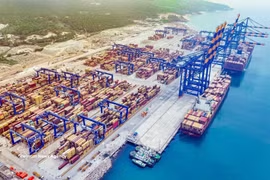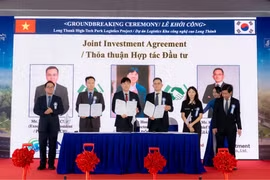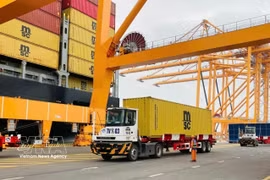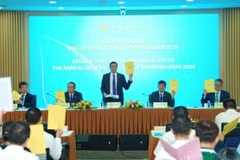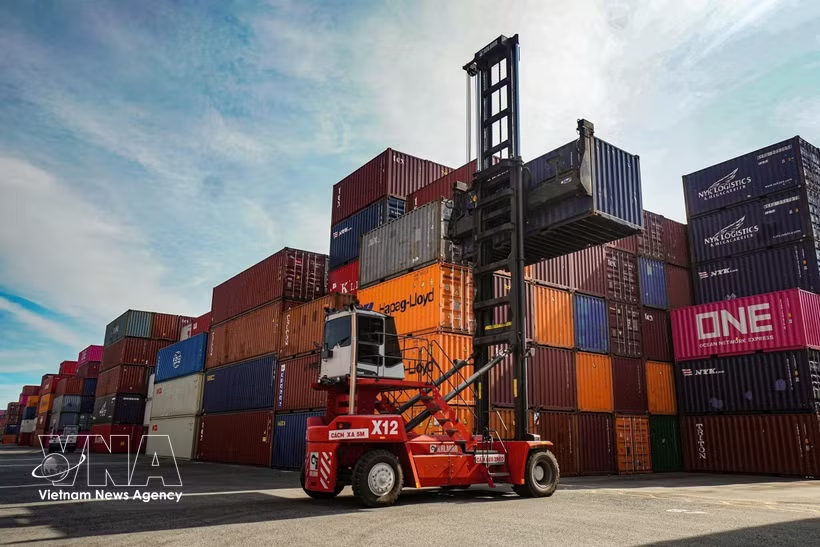
Hanoi (VNA) – As Vietnam moves to integrate more deeply into regional and global supply chains, the development of modern, green and smart logistics hubs is expected to become a new growth driver by reducing logistics costs, improving supply chain efficiency and enhancing the country's competitiveness, said insiders.
Vietnam's Logistics Services Development Strategy to 2035, with a vision to 2050, aims to build a sustainable, efficient and high-value-added logistics industry with stronger competitiveness. A central pillar of the strategy is forming large-scale and modern logistics hubs linked to seaports, cross-border railways, border gates and multimodal transport networks to optimise supply chains and lower logistics costs, thus increasing the competitiveness of Vietnamese goods.
Vital link in supply chains
With total import – export turnover exceeding 930 billion USD in 2025 and an extensive network of free trade agreements (FTAs), Vietnam holds an opportunity to evolve from a transit point for goods into a supply chain organiser.
Dr. Bui Ba Nghiem, a senior specialist from the Ministry of Industry and Trade (MoIT)'s Agency of Foreign Trade, said the strategy marks a new development phase in which logistics is no longer merely a supporting service but a strategic component of national competitiveness. If implemented comprehensively across institutional reforms, infrastructure investment, business competitiveness enhancement and the development of green, smart logistics hubs and free trade zones, Vietnam could become an important logistics link in ASEAN and integrate more deeply into global logistics networks.
However, logistics activities in Vietnam remain fragmented, said Bui Nguyen Anh Tuan, Deputy Director of the MoIT’s Agency for Domestic Market Surveillance and Development. He stressed the need to reorganise logistics services into a more integrated, professional and cost-efficient system.
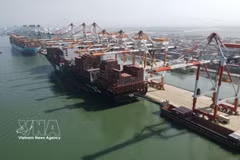
A breakthrough solution, he said, is developing regional and inter-regional logistics hubs connected to seaports, cross-border railways, border gates and multimodal transport infrastructure. Northern hubs could be centred in Hai Phong and Quang Ninh, leveraging deep-water ports and major international border crossings. Meanwhile, southern hubs could be developed around Ho Chi Minh City, linked with the Cai Mep – Thi Vai port complex, Long Thanh International Airport and the southeastern industrial region.
Tuan said rather than expanding logistics infrastructure indiscriminately, the MoIT plans to establish a tiered network comprising national, regional and local logistics centres, specialised logistics hubs and cargo consolidation points. Such an approach will avoid overlapping investment, improve efficiency and create logistics hubs capable of connecting Vietnam to regional and global supply chains.
At this stage, logistics hubs are evolving into strategic infrastructure for manufacturing and international trade, rather than being viewed merely as warehouses or cargo transshipment facilities, he noted.
Opportunities from green, smart logistics
Tuan noted that a network of modern, green, smart and interconnected logistics hubs will help significantly strengthen Vietnam's national competitiveness.
Lower logistics costs will reduce production, distribution and export expenses, an important factor as Vietnam pursues ambitious growth targets for 2026–2030. Faster and more efficient logistics will also improve product quality management, traceability and compliance with stringent export market standards.
Improved logistics infrastructure is expected to attract more investment to industry, retail, e-commerce and agricultural processing, while enhancing inter-regional connectivity by linking production zones, processing centres, consumer markets, border gates and seaports into an integrated network. Meanwhilee, green and smart logistics are expected to strengthen Vietnam's position in global supply chains.
Nguyen Le Hang, external affairs director at SLP Vietnam, said developing logistics hubs and green logistics represents an inevitable trend and offers Vietnamese companies significant opportunities.
By investing in modern and environmentally friendly logistics infrastructure and digital technologies, businesses can move beyond price competition to compete by service quality, delivery speed and compliance with international standards, she said.
They can also expand into fast-growing sectors such as e-commerce, cold storage and express delivery. Besides, green investment strategies are expected to improve access to financing by making firms more attractive to investors and financial institutions, Hang noted./.
See more
Ho Chi Minh City pushes green products to boost sustainable consumption
To support the transition, the city is introducing policies that ease the burden of upfront invesment costs for businesses and small traders.
Reference exchange rate rises 6 VND on June 29
With the current trading band of +/- 5%, the ceiling rate applicable for commercial banks during the day is 26,461 VND/USD, and the floor rate 23,941 VND/USD.
Vietnam Airlines targets profit despite soaring fuel costs
Despite the headwinds, the airline remains committed to achieving its 2026 business targets while strengthening its competitiveness, supporting economic growth and promoting trade, tourism and international connectivity.
National property identification system to be launched on July 1: MoC
Vietnam is scheduled to launch a national housing and real estate market information system on July 1, assigning each property a unique identification code to improve market transparency, enhance state management and curb speculation, according to the Ministry of Construction.
Finance ministry, OECD strengthen cooperation to enhance corporate governance capacity
Minister of Finance Ngo Van Tuan highlighted OECD’s technical support for the ministry in improving the tax system to enhance transparency in line with international standards, supporting capital market development, and strengthening corporate governance capacity across both private enterprises and state-owned enterprises.
Vietnam moves beyond production hub to higher-value link in global value chain: French expert
Speaking to French business and financial news channel BFM Business, Mickaël Driol, CEO of Mekong Partners, noted that amid global trade tensions and geopolitical uncertainty, multinational companies are increasingly diversifying their supply chains, with Vietnam emerging as a key beneficiary of this trend.
Ho Chi Minh City steps up investment attraction in next-generation industries
The Vietnamese southern economic hub’s programme attracted nearly 1,000 participants, with nine cooperation initiatives announced between municipal agencies and businesses and Chinese enterprises across sectors including artificial intelligence (AI), autonomous vehicles and smart mobility, high-tech healthcare, smart agriculture and aquaculture, smart urban centres, green materials, robotics and automation, innovation, digital transformation and innovation-driven finance.
Vietnam, Singapore eye stronger cooperation to build ASEAN Halal value chain
The Halal economy is opening up a new area of cooperation, further fostering the Comprehensive Strategic Partnership between the two countries, said Vietnamese Ambassador to Singapore Tran Phuoc Anh at a business seminar in Singapore on June 27.
Ho Chi Minh City targets global service hub status with high-value growth strategy
Ho Chi Minh City is positioning itself as a modern regional megacity and a value-added services hub by leveraging new development space created after the administrative merger. This a strategy seen as a core growth pillar to strengthen its role in global service supply chains.
Vietnam ready to launch domestic carbon exchange on June 29
The launch marks a major milestone in the development of Vietnam's carbon market, contributing to implementing the country's commitments to greenhouse gas emissions reduction, and accelerating the green transition and promoting low-carbon economic growth.
Tay Ninh courts investment from Germany’s industrial heartland
With a strategic location, improving transport infrastructure, ample industrial land and fast-improving investment climate, Tay Ninh aims to become a magnet for German firms in hi-tech manufacturing, industrial equipment, automation, semiconductors and digital transformation.
Vietnam defines coffee value, brand, culture in Singapore
Vietnamese coffee companies can go global by proactively building brand value and showcasing the unique character, quality and added value of their products, said Vietnamese Ambassador to Singapore Tran Phuoc Anh.
Hanoi sets out new investment blueprint with century-long development vision
As of early June, Hanoi had attracted 74.6 billion USD in foreign direct investment (FDI) through more than 9,250 valid projects. FDI inflows in the first six months were projected at 3.2 billion USD, surpassing the annual target by 116%, while nearly 16,000 new businesses were established in the first five months, up 34.4% year-on-year.
Flexible price management crucial to support economic growth: Deputy PM
Monetary policy should remain proactive and flexible, with close coordination with fiscal policy, while carefully managing core inflation, money supply, credit growth, exchange rates, and interest rates to curb imported inflation and stabilise market expectations.
Vietnam encourages US firms to expand investment in high-tech sectors: Deputy PM
Regarding the semiconductor sector, Dung said Vietnam is promoting the development of a comprehensive ecosystem, gradually expanding its role in chip design, packaging, testing, materials production and equipment manufacturing, while focusing on high-quality human resources and attracting strategic investors.
Dak Lak adds new high-tech coffee processing project meeting Net Zero standards
Construction began on the Trung Nguyen Legend coffee plant, designed as a sustainable, ecological energy-efficient facility meeting Net Zero standards. The first phase carries an investment value of 989 billion VND (37.58 million USD), with a spray-drying capacity of 1,000kg per hour across an area of 4.9 hectares.
Private sector gains momentum after one year of Resolution 68 implementation
A report by the Ministry of Finance on the first year of implementing the resolution highlighted fresh momentum in diversifying capital sources and removing administrative bottlenecks.
Prime Minister orders faster ODA, concessional loan disbursement
Under Directive No. 27/CT-TTg dated June 25, 2026, the PM called for stronger management and higher-quality preparation, appraisal and approval of ODA- and concessional loan-funded projects, with the goal of fully disbursing the annual public investment plan assigned by the Government leader.
Vietnam, US sign MoU for real-time customs data exchange
Under the agreement, the two sides plan to share electronic cargo manifest data in real time, or as quickly as possible, to support risk management and detect violations, including trade fraud, counterfeit goods, smuggling, origin fraud and tax evasion.
Vietnam updates preparations for negotiations to join Information Technology Agreement expansion
WTO members including the US, the European Union, China, Japan, the United Kingdom, Canada, Australia, Singapore, Hong Kong (China), Chinese Taipei, Thailand and Switzerland welcomed Vietnam’s decision and commended the progress achieved since April. They described Vietnam as a key partner in global IT supply chains and pledged their support for the upcoming negotiations.