Private sector gains momentum after one year of Resolution 68 implementation

A report by the Ministry of Finance on the first year of implementing the resolution highlighted fresh momentum in diversifying capital sources and removing administrative bottlenecks.

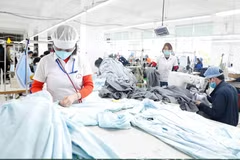
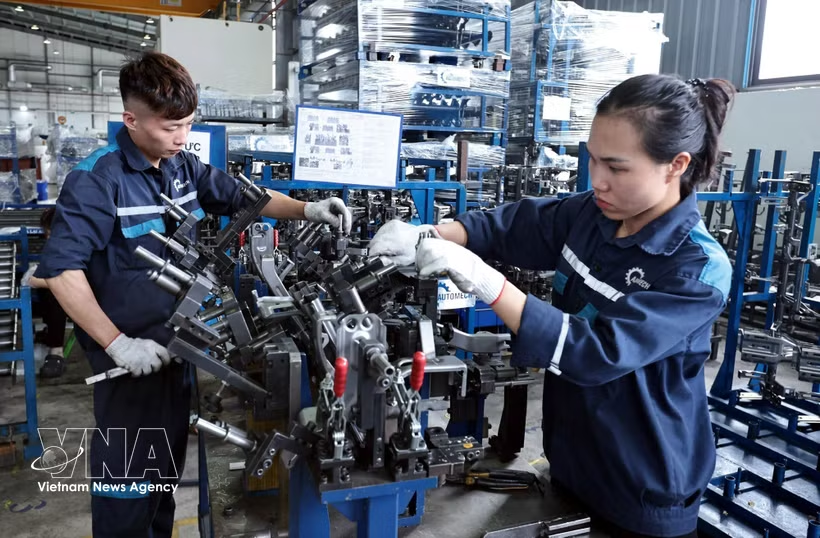
Automech Mechanical Equipment and Solutions JSC, located in Dinh Tram Industrial Park in Bac Ninh province, generates annual revenue of about 1 trillion VND (38 million USD) and provides jobs for more than 600 workers. (Photo: VNA)

Hanoi (VNA) – One year after Politburo Resolution No. 68-NQ/TW on private sector development came into force, Vietnam’s economic landscape has shown brighter prospects, marked by the strong rise of major private businesses and breakthrough institutional reforms.

Unlocking financial resources

A report by the Ministry of Finance on the first year of implementing the resolution highlighted fresh momentum in diversifying capital sources and removing administrative bottlenecks. However, experts say greater efforts are needed to ensure policies reach micro- and small-sized enterprises and business households, which form a critical part of the economy.

To implement Resolution 68, the Government directed ministries and agencies to roll out measures aimed at improving access to credit and reforming financing mechanisms. One of the most notable achievements is a shift in the banking sector’s lending approach.

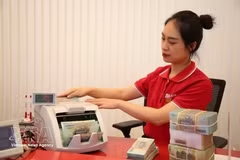
Following guidance from the State Bank of Vietnam, credit institutions have increasingly prioritised capital flows into the private sector, promoted value-chain financing, and expanded cash-flow-based lending. By the end of December 2025, outstanding loans to small- and medium-sized enterprises (SMEs) exceeded 3.65 quadrillion VND (138.7 billion USD), up 21.73% year-on-year.

Meanwhile, National Assembly Resolution No. 198/2025/QH15 has opened up major opportunities for green and sustainable projects. The introduction of a 2% annual interest-rate support package for enterprises and business households implementing circular economy projects and applying ESG (Environmental, Social and Governance) standards has helped not only reduce capital costs but also encourage the private sector to keep up with global trends. The Government is considering two guiding decrees to facilitate the disbursement of these resources through commercial banks and State financial funds.
vnanet-private-sector-2.jpg
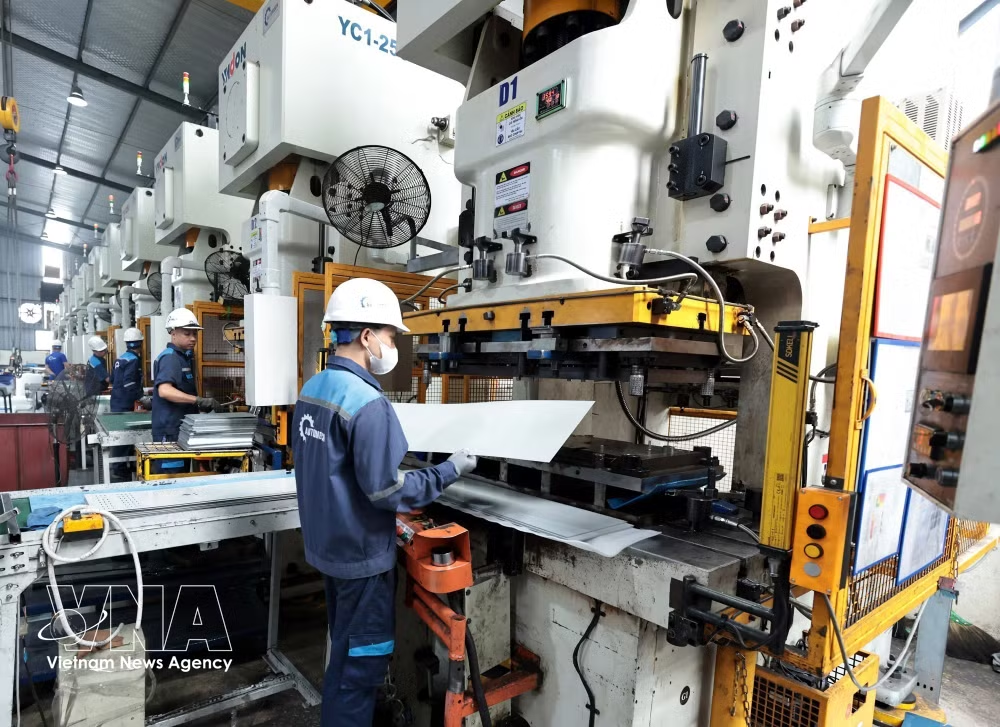
By the end of December 2025, outstanding loans to small- and medium-sized enterprises (SMEs) exceed 3.65 quadrillion VND (138.7 billion USD), up 21.73% year-on-year. (Photo: VNA)

Despite these efforts, challenges remain. Dr. Le Duy Binh, CEO of Economica Vietnam, said the positive impact of Resolution 68 has been concentrated mainly among large enterprises, while many micro- and small-sized firms have yet to benefit significantly.

The experience of DACE, an organic farm produce exporter, reflects this gap. Its director Tran Van Hieu noted the company was unable to fully grasp the 2% interest-rate support programme while borrowing interest rates remain above 10%, placing considerable pressure on manufacturers working directly with farmers.

Although some companies maintain healthy cash flows, possess internationally certified products and have stable export markets, it still faces difficulties in accessing credit.

Similar concerns persist across the production sector, where collateral requirements continue to limit financing opportunities.

Binh also pointed to the management mindset toward business households and micro-enterprises. Treating them as subjects of management rather than development partners has made some businesses opt to maintain small and fragment revenues or continue cash-based transactions, further expanding the informal economy and undermining efforts to improve transparency.

Improving adaptability, creating transparent environment

Despite lingering obstacles for SMEs, Vietnam has made significant progress in nurturing large-scale private groups. The adoption of Law No. 90/2025/QH15 and guiding decrees on public-private partnerships (PPP) has considerably broadened the development space for private enterprises.

In 2025, a total of 564 projects with combined investment of 5.2 quadrillion VND were launched or inaugurated, with private capital accounting for nearly 75% of the total. Programmes to develop 1,000 pioneering enterprises and support businesses to expand to international markets during 2026–2030 are expected to promote Vietnam’s integration into global value chains.

Ngo Sy Hoai, Vice Chairman and General Secretary of the Vietnam Timber and Forest Products Association (VIFOREST), acknowledged substantive institutional improvements, particularly the shift from pre-approval procedures to post-licensing inspection. Digitalisation and cross-sectoral data connection have shortened procedures related to land, environmental permits, fire prevention and tax refunds, reducing compliance costs for businesses.

However, he noted that the wood industry continues to face difficulties in export markets. Export turnover reached 7.02 billion USD in the first five months of 2026, up only 2.9% year-on-year, while exports of deep-processing products declined by 3.5%. Higher logistics and material costs, stricter technical standards and trade investigations in major markets, especially the US, have weighed on growth.

Deputy Minister of Finance Nguyen Duc Tam said the greatest barriers facing the private sector remain the access to fundamental resources such as capital, land, technology and skilled labour.

To address these bottlenecks, the ministry will focus on stepping up tax and fiscal reforms, improving the efficiency of State financial funds, and expanding access to land through transparent leasing mechanisms for unused public assets, he noted.

One year after Resolution 68 took effect, a new legal foundation and development mindset have taken shape. Experts believe that while supporting major corporations is important to enhancing national competitiveness, nurturing millions of micro- small-sized enterprises is key to building a resilient and sustainable economy as the private sector strives to become a leading force in Vietnam’s next stage of development./.

VNA

See more

Standing Deputy Prime Minister Pham Gia Tuc chairs a meeting with representatives of US business associations and companies operating in Vietnam on July 17, 2026. (Photo: baochinhphu.vn)

Standing Deputy PM meets with US business community

Chairing a meeting with representatives of US business associations and companies operating in Vietnam, Tuc praised the US business community for its substantive contributions to Vietnam's socio-economic development as well as the two countries’ relations.

Workers assembles electronic components on the production line at the Bao Sen Co., Ltd. in Bac Ninh province. (Photo: VNA)

Vietnam's economy needs to shift from quantity to quality: ADB experts

Shantanu Chakraborty, ADB Country Director for Vietnam, noted that while achieving strong growth in a single year is encouraging, maintaining both the pace and quality of growth over many years will be essential if Vietnam is to achieve its goal of becoming a high-income country by 2045.

The Long Son Petrochemical Complex, an investment project of Thailand's SCG Group, is located in Long Son commune, Ho Chi Minh City. (Photo: VNA)

Vietnam reshapes FDI strategy with focus on technology, innovation

Politburo Resolution No. 10-NQ/TW, issued on June 8, 2026, recognises the foreign-invested sector as an important component of the national economy, signalling a major shift in the country's investment attraction strategy. Rather than prioritising labour-intensive projects, Vietnam is now seeking high-quality investments capable of driving technological progress, innovation, sustainable development and stronger participation in global value chains.

International tourists love shopping for souvenirs at Hanoi's Old Quarter night market (Photo: VNA)

Hanoi aims to raise tourists' night-time spending to 30%

Hanoi will establish and operate flagship night-time economy zones supported by preferential policies, including heritage and cultural districts in Hoan Kiem, Cua Nam, Ba Dinh, Son Tay and Soc Son; modern entertainment hubs in Tay Ho-West Lake West, My Dinh and Dong Anh; creative economy zones linked to cultural industries such as theatres, cinemas and museums; and cultural tourism and resort destinations in suburban craft villages including Bat Trang, Ba Vi and Huong Son.

Vietnamese Ambassador to Laos Nguyen Minh Tam and Lao Deputy Minister of Industry and Commerce Phouthavanh Nanthavong visit the Vietnamese pavilion at VIETLAO EXPO 2026 (Photo: VNA)

VIETLAO EXPO 2026 helps boost Vietnam-Laos strategic cohesion

The Vietnam-Laos Trade Fair 2026 (VIETLAO EXPO 2026) opened on July 16 in Vientiane, serving as a key platform for businesses from both countries to showcase products, seek partnerships, transfer technologies and expand investment cooperation.

The Vietnam-EFTA FTA is one of the longest-negotiated trade agreements in Vietnam's history. (Illustrative Photo: VNA)

Vietnam-EFTA deal set to further boost bilateral trade growth

The Vietnam-EFTA FTA is one of the longest-negotiated trade agreements in Vietnam's history, reflecting its broad scope of commitments covering trade in goods and services, investment, intellectual property, government procurement, environmental protection, sustainable development, small and medium-sized enterprises (SMEs), and other areas of cooperation.

Passengers and visitors check in at Terminal 1 of Noi Bai International Airport. (Photo: VNA)

Hanoi-Ho Chi Minh City route among world’s busiest

According to IATA’s ranking of global air passenger markets, the US remained the world’s largest market in 2025, with 890.1 million passengers, up 1.6% from 2024. China, the world’s second-largest market, recorded stronger growth of 4.8%, reaching 776.1 million passengers. China is widely forecast to overtake the US and become the world’s largest air passenger market in the 2030s.

An overview of the working session between the Kazakh delegation and the Can Tho City People's Committee on July 16. (Photo: VNA)

Kazakhstan explores agricultural by-product recycling project in Can Tho city

The proposed project would use rice husks as its primary feedstock, with an estimated one million tonnes processed annually using advanced technology developed in Kazakhstan. At present, the top priority is to secure a stable supply of raw materials from rice-producing provinces across the Mekong Delta.

Consumers buy fruit at a supermarket in Vietnam. (Photo: VNA)

US highlights potential in Vietnam’s fruit market

The US was Vietnam's second-largest supplier of agricultural products, with export turnover reaching 4.7 billion USD in 2025, a remarkable increase from less than 3.5 billion USD in 2024, Fruitnet said, citing a new report by the US Department of Agriculture (USDA).

Vietnamese Ambassador to Thailand Pham Viet Hung (thitd, left) attends the opening ceremony of Grand Halal Bangkok 2026 (Photo: VNA)

Vietnamese firms seek global Halal opportunities at Bangkok exhibition

Ambassador Pham Viet Hung described Grand Halal Bangkok 2026 as an important opportunity for Vietnamese businesses to connect not only with Thailand's Halal industry but also with Halal food producers worldwide, while learning from experience of Thailand and international partners.

Marnufacturing garments for export at Hung Yen Jute and Garment Joint Stock Company. (Photo: VNA)

GDP expands 8.18%, with new growth drivers taking shape

According to the National Statistics Office under the Ministry of Finance, GDP expanded by 8.39% in the second quarter, up from 8.14% a year earlier. Growth for the first six months reached 8.18%, exceeding the 7.63% recorded in the same period of 2025. The performance reflected broad-based contributions from both the supply and demand sides of the economy.