Resolution 68 brings positive changes to private sector development

Resolution No. 68-NQ/TW on private sector development is expected to be implemented in a more consistent and effective manner, particularly at local level, so that businesses can feel sustainable improvements in the investment climate.

Vinpearl Nam Hoi An, invested in by a private enterprise, is expected to drive development in the eastern part of Da Nang city. (Photo: VNA)

Vientiane (VNA) – After one year of implementation, Resolution No. 68-NQ/TW on private sector development has generated positive, tangible and wide-ranging impacts on Vietnam’s business environment, according to Pham Thi Minh Huong, Vice President of the Business Association of Overseas Vietnamese (BAOOV).

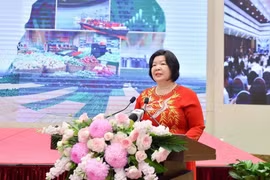
Speaking to the Vietnam News Agency’s correspondents in Vientiane, Huong, who is also a member of the Standing Board of the General Association of Vietnamese People in Laos, said the resolution has helped strengthen market confidence since its issuance in May 2025.

As an overseas Vietnamese entrepreneur in Laos who closely follows developments at home, she noted that the number of newly established businesses has increased significantly, reflecting a revived entrepreneurial spirit and stronger aspirations for wealth creation across society.
|
Timely tax reductions and exemptions for enterprises, individuals and household businesses have also produced positive effects, helping people and the business community gain greater confidence in development opportunities and the State’s support.

According to Huong, these policies have given fresh momentum to start-up activities, encouraged many household businesses to convert into formal enterprises, and promoted innovation more broadly.

She said recent efforts to streamline the administrative apparatus from central to local levels, especially the implementation of the two-tier local administration model from July 1, 2025, together with policies aimed at removing bottlenecks for production and business, have delivered practical results.

vnanet-private-economic-sector.jpg
Many private businesses are investing in the service and real estate sectors in Da Nang city. (Photo: VNA)

Measures including administrative reform, decentralisation, simplified business conditions, digital transformation and innovation promotion, capital market development and support for small and medium-sized enterprises have shortened processing times, reduced costs and made it easier for firms to access capital, land, human resources and technology.

These changes, she added, have been clearly recognised by both domestic businesses and overseas Vietnamese investors when working with agencies in Vietnam.

Huong said Vietnam is gradually turning the private sector from a supporting force into a leading driver of national economic growth.

She pointed to policies encouraging private enterprises to participate in major national infrastructure projects that were previously dominated by State-owned or foreign firms. Domestic private companies are now increasingly present in airports, seaports, railways and urban metro projects, opening broader development space and confirming the growing importance of the private sector.

From her perspective, the changes have not only domestic significance but also help enhance the standing, confidence and resilience of Vietnamese businesses in international markets.

She expressed her hope that Resolution 68 will continue to be implemented in a more consistent and effective manner, particularly at local level, so that businesses can feel sustainable improvements in the investment climate.

Looking ahead, Huong stressed the need for a stable, transparent and predictable institutional framework, along with stronger mechanisms enabling private enterprises to access capital, land, skilled labour and technology, especially in digital transformation, green economy and innovation.

She also called for more effective connectivity policies to help overseas Vietnamese deepen investment links, transfer knowledge and technology, and expand markets for domestic enterprises./.

VNA

See more

Illustrative image (Photo; VNA)

Top Vietnamese leader’s visit to Sri Lanka to tap trade potential

According to the Vietnamese Ministry of Industry and Trade (MoIT), Sri Lanka is Vietnam’s fourth-largest trade partner in South Asia after India, Bangladesh, and Pakistan. In recent years, Vietnam has been running a steady surplus, with exports exceeding imports.

A booth at VIETNAM MEDIPHARM 2026. (Photo courtesy of organisers)

Int'l medical, pharmaceutical expo opens in Hanoi

The exhibition, which runs until May 9 at the Hanoi International Centre for Exhibition, showcases advanced products and technologies across a range of fields, including pharmaceuticals, drug manufacturing machinery and equipment, medical devices, hospital and clinic services and dental equipment.

Vietnamese coffee products are promoted at Kaffee Campus 2026. (Photo: VNA)

Vietnam seeks stronger foothold in Germany’s premium coffee market

Industry representatives noted that Germany’s market is gradually shifting from Arabica towards high-quality Robusta as climate change affects supply. Although Vietnam remained Germany’s second-largest coffee supplier after Brazil with export turnover of 1.22 billion USD in 2025, its coffee is still largely associated with industrial processing.

Tuyen Do, Founder and Managing Partner of TVD Capital Partners, shares fundraising experience with Vietnamese enterprises. (Photo: VNA)

Vietnamese, US firms step up investment cooperation

Addressing the event, Vietnamese Ambassador to the US Nguyen Quoc Dung underscored that SelectUSA serves as a key platform enabling international investors to access the US business environment, while fostering stronger linkages between Vietnamese and US enterprises amid the deepening Comprehensive Strategic Partnership.

A corner of Hanoi city. (Photo: VNA)

Hanoi aims for over 10% growth in Q2

A Hanoi official called for the swift implementation of new mechanisms and policies, particularly the revised Capital Law, through detailed action plans, describing this as the key step to translate institutional advantages into tangible growth and help the capital achieve double-digit expansion for this year.

FPT possesses AI supercomputing infrastructure that ranks among the top 500 most powerful supercomputers in the world (Photo courtesy of FPT)

FPT signs multi-million dollar AI contract with leading global materials corporation

Under the agreement, FPT will deploy applications and services powered by its comprehensive AI platform, FleziPT, developed in-house to enhance operational efficiency for the client. The AI transformation is expected to help reduce costs by up to 40% within three years, while improving service reliability and accelerating the modernisation of core technology systems.

Staff at Hai Phong Railway Station assist passengers with ticket purchase procedures (Photo: VNA)

Vietnam railways accelerate digital shift, green transition

By 2030, Vietnam’s railway sector aims to achieve sustainable growth on existing lines while playing a greater role in supporting a green and circular economy. It also focuses on improving efficiency, reducing environmental impact, and upgrading service quality.

Vietnam is said to be facing a major opportunity not only to strengthen technical connectivity but also to take a leading role in building an integrated regional energy market, moving from a national to a regional scale. (Photo: VNA)

Vietnam – A strategic link in Pan-Asia Power Grid Initiative: ADB

In an interview with the Vietnam News Agency (VNA)'s reporter, Keiju Mitsuhashi, Director for Energy Sector for Southeast Asia and the Pacific at ADB, underscored this strategic position, describing Vietnam as a “truly important” part of the broader Pan-Asia Power Grid Initiative (PAGI).