AI reshaping new generation of workers

Adoption is moving faster than anyone predicted, turning AI into one of the most powerful forces reshaping labour markets worldwide, and Vietnam is squarely in its path. As AI technologies keep advancing, especially when woven together with automation systems and robotics, workers across a vast range of industries and occupations face mounting risks of being displaced.

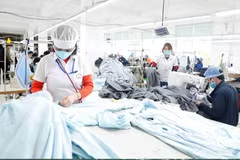
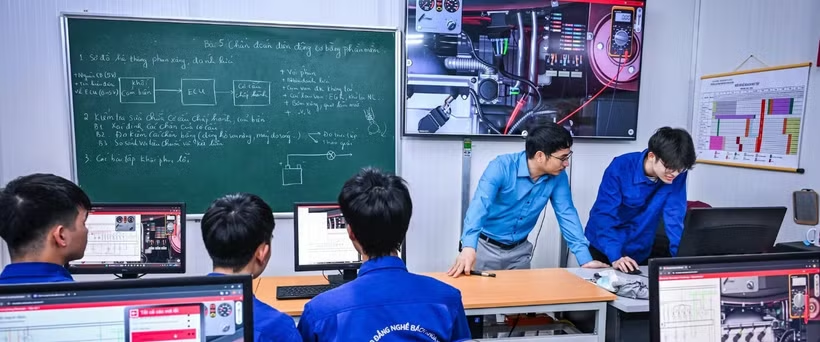
Hands-on training will create a sustainable talent pool for labour market restructuring (Photo: nhandan.vn)

Hanoi (VNA) - Vietnam’s labour market is hurtling toward a massive shake-up as artificial intelligence (AI) sweeps through every industry, fueled by an aging population and the fading power of cheap labour, igniting urgent need for reforms that can help workers pivot and prosper in the new economy.

AI’s sweeping toll on employment

Adoption is moving faster than anyone predicted, turning AI into one of the most powerful forces reshaping labour markets worldwide, and Vietnam is squarely in its path. As AI technologies keep advancing, especially when woven together with automation systems and robotics, workers across a vast range of industries and occupations face mounting risks of being displaced.

A mid-2025 report from Microsoft Vietnam found that the country is home to about one million information technology (IT) engineers, and as many as half of them may need to switch to entirely new roles because of AI. The report also revealed that 91% of corporate leaders are already considering hiring specifically for AI-focused positions.

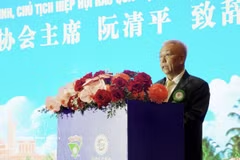
Nguyen Van Khoa, Chairman of the Vietnam Software and IT Services Association (VINASA), pointed out that some companies have slashed their workforce by as much as 70% after bringing in AI technologies.

Moreover, the breakneck advance of Generative AI (GenAI) is expected to land an even heavier blow on workers. A recent report titled “GenAI and jobs in Vietnam: Labour market exposure and policy considerations”, published by the International Labour Organisation (ILO) office in Vietnam, found that around 20.8% of all jobs, or roughly 11.5 million workers, could be affected. Instead of wiping out entire occupations, GenAI is set to dramatically reshape how tasks are done inside jobs, meaning a huge number of positions will need to be redesigned.

The trend is coming into sharp focus: as technology marches forward, traditional labour opportunities shrink. This shift threatens to create a class of “hidden unemployed” workers who remain on a payroll but earn far too little and see few chances to move up. Against this grim backdrop, Dr. Pham Xuan Khanh, Principal of the Hanoi High Technology College, issued a stark warning that Vietnam simply doesn’t have enough highly skilled professionals in emerging fields, while workers’ ability to jump between occupations is severely limited. Employees can no longer afford to sit still.

At a deeper level, AI is exposing a painful truth that Vietnam’s labour market can’t keep up with the rocketing demand for quality digital talent.

Adapt or get left behind?

Even though Vietnam produces a substantial number of IT graduates every year, a huge share still can’t meet what enterprises actually need, particularly in fast-emerging areas like AI, big data, and cybersecurity. The gap between education and market demand can never be fully closed, but shrinking it is essential to keeping future growth alive.
ai2.png
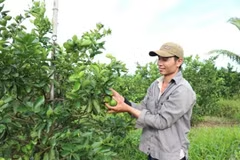
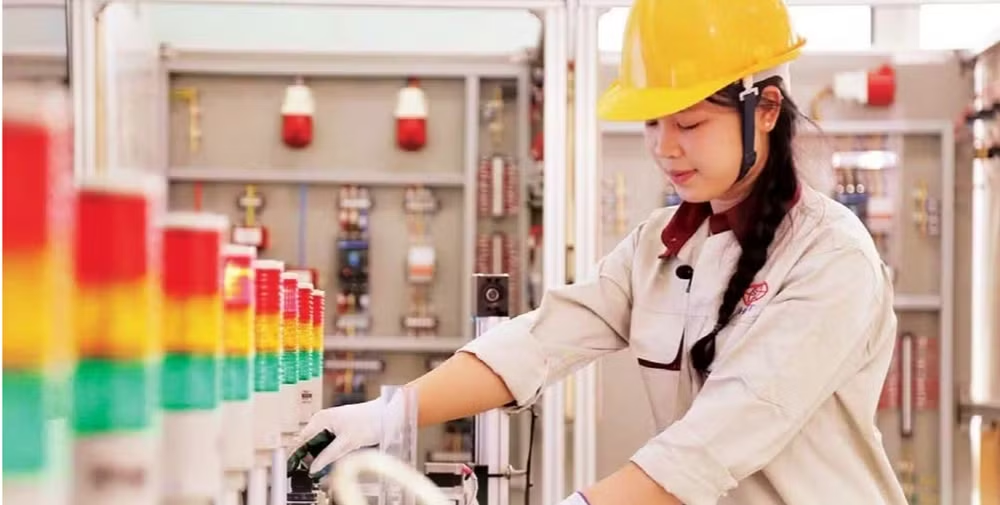
Workers themselves should sharpen their professional skills (Photo: nhandan.vn)

Dr. Vu Xuan Hung, a labour and employment expert, suggested Vietnam move aggressively to strengthen governance and AI competency frameworks for workers, push responsible AI use, reinforce labour market information systems, and pour investment into skills development, with a heavy focus on digital and soft skills.

At the same time, policies must put far more weight on gender equality to guarantee that women aren’t left behind as the technological wave rolls through, he insisted.

Tran Anh Tuan, Vice Chairman of the Ho Chi Minh City Vocational Education Association, stressed the urgent need for tighter state management of workforce development, far better coordination among career guidance, recruitment, and training activities, and a much closer match between practical training and what the labour market actually demands.

He made the case for rolling out incentives that push firms to invest in technology and vocational training, building stronger links between schools and real production floors, and establishing innovation hubs inside schools and hands-on training facilities within enterprises.

Vietnam, he went on, must design comprehensive support strategies for workers displaced by technological change, including reskilling and upskilling courses that keep human beings firmly at the centre of the workforce.

That kind of foundation, he added, will allow AI to become an engine of higher productivity, boost investor confidence, and sharpen Vietnam’s national competitiveness for years to come./.


VNA

See more

Can Tho yields about 3 million tonnes of rice each year (Photo: VNA)

Vietnam ships 5 million tonnes of rice abroad in first half

About 5 million tonnes of Vietnam's rice are expected to be shipped abroad in the first half, raking in an estimated 2.36 billion USD, up 5.7% annually in volume but down 3.3% in value, reported the Ministry of Agriculture and Environment.

Illustrative photo (Photo: VNA)

Hanoi to hold investment promotion event on June 29

At the event, Hanoi authorities plan to grant investment policy decisions and investment registration certificates to 20 exemplary projects in the fields of transportation infrastructure, industrial parks, urban development, social housing, environment, science and technology, and foreign investment attraction.

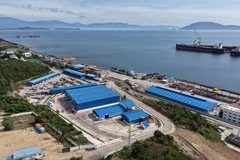
A corner of Van Phong Economic Zone in Khanh Hoa (Photo: VNA)

Khanh Hoa sets sail on smart, green logistics overhaul

Under a logistics development roadmap that stretches to 2030 with a vision to 2050, the province is racing to build a modern, green, and smart logistics ecosystem. Top priorities include rolling out logistics hubs linked to the Van Phong Economic Zone, Cam Ranh, and key transport gateways, while fast-tracking digital transformation and the use of cutting-edge technology across supply chain management.

A view of Xuan Loc traditional conical hat craft village in Thanh Hoa province (Photo: VNA)

New master plan aims to boost Vietnam’s collective economy through 2030

The programme seeks to strengthen the role of the collective economy and cooperatives in the national economy while expanding access to State support policies to encourage more people to join cooperatives and promote stronger links between cooperatives, businesses and other economic sectors.

Representatives of the Vietnam National Chemical Group (Vinachem) and the Chemical and Allied Industries' Association (CAIA) of South Africa sign a memorandum of understanding (MoU). Photo: Hong Minh/VNA Correspondent in South Africa (Photo: VNA)

Vietnam Chemicals Group steps up trade promotion in South Africa

A key event of the visit was a business networking forum held in Johannesburg on June 24, jointly organised by the Vietnamese Embassy in South Africa and Vinachem. The event attracted more than 20 leading South African companies and investors seeking business partnerships.

ASEAN ambassadors in Buenos Aires pose for a group photo with representatives of the Argentine Industrial Union (UIA). (Photo: VNA)

Vietnam highlights economic cooperation potential with Argentina

Vietnamese Ambassador Ngo Minh Nguyet highlights the strong momentum in Vietnam–Argentina economic ties. Vietnam is currently Argentina's sixth-largest trading partner, while Argentina ranks as Vietnam's third-largest trading partner in Latin America.

Grape farming in the southern areas of Khanh Hoa province. (Photo: VNA)

Green production zones to boost standing of Vietnamese farm products

The move follows the approval of the national project on low-emission crop production for 2025–2035, with a vision to 2050. The initiative is now being actively implemented across the country, with local authorities playing a key role in turning policy into action.

A mock-up of the Red River Landscape Boulevard project in Hanoi. Demand for capital for infrastructure projects is increasing sharply. (Photo: VNA)

SBV raises short-term capital lending cap to 40%

The new circular will help credit institutions have more room to provide capital to businesses and investment projects to support high economic growth in the next few years, while increasing flexibility in the SBV’s monetary policy management.

A farmer harvests seedless lemons in Vinh Long province. A national database covering all agricultural land, rather than only export-oriented production areas, is essential for meeting international standards and improving sector governance. (Photo: VNA)

Unified farm data system needed to meet EU deforestation rules

Fragmented data systems and limited information sharing among Government agencies, businesses and farmers remain major obstacles to compliance with the EUDR, which requires exporters of commodities such as coffee, rubber and cocoa to prove their products are not linked to deforestation, experts said at the conference.

Secretary of the Can Tho municipal Party Committee Le Quang Tung (R) and Indian Ambassador to Vietnam Tshering Wangchuk Sherpa (Photo: VNA)

Can Tho, India envisage common ground to develop closer partnerships

Secretary of the Can Tho Party Committee Le Quang Tung proposed expanding collaboration in education and training, particularly in artificial intelligence (AI), biotechnology, healthcare, and pharmaceuticals, during his meeting with Indian Ambassador to Vietnam Tshering Wangchuk Sherpa.

Vietravel Airlines takes delivery of a new Airbus A321 on June 24. (Photo: VNA)

Vietravel Airlines adds Airbus A321 to fleet

Vietravel Airlines currently operates routes linking major economic and tourism hubs across Vietnam while gradually expanding its international footprint. In addition to scheduled services from Hanoi and Ho Chi Minh City to Bangkok, it launched charter flights between Hanoi and Lanzhou in China’s Gansu province on June 20.