Unified farm data system needed to meet EU deforestation rules

Fragmented data systems and limited information sharing among Government agencies, businesses and farmers remain major obstacles to compliance with the EUDR, which requires exporters of commodities such as coffee, rubber and cocoa to prove their products are not linked to deforestation, experts said at the conference.

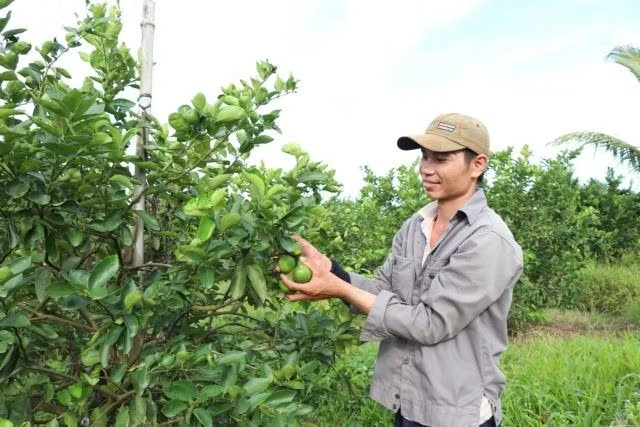
A farmer harvests seedless lemons in Vinh Long province. A national database covering all agricultural land, rather than only export-oriented production areas, is essential for meeting international standards and improving sector governance. (Photo: VNA)

Hanoi (VNS/VNA) - Vietnam needs to accelerate the development of a unified national database for farming areas to comply with the European Union's anti-deforestation regulation (EUDR) and support the digital transformation of agriculture, experts said at a conference on June 23.

Experts said at the conference held by Network for Agriculture and Forestry Policy Research that fragmented data systems and limited information sharing among Government agencies, businesses and farmers remain major obstacles to compliance with the EUDR, which requires exporters of commodities such as coffee, rubber and cocoa to prove their products are not linked to deforestation.

Ha Cong Tuan, Chairman of the Vietnam Association of Agricultural Economics and Rural Development, said a national database covering all agricultural land, rather than only export-oriented production areas, is essential for meeting international standards and improving sector governance.

Pham Dinh Lai, Director of the Dien Bien provincial Agriculture Sub-Department, said the expansion of coffee-growing areas has faced problems in collecting and managing cultivation data due to limited funding, technical capacity and challenges in gathering geospatial information, such as coordinates, land parcels and land-use status.

The province has adopted an approach that places communes at the centre of data collection efforts. This has shown promising results, with farmers becoming more engaged in data collection and gaining a better understanding of market requirements for traceability, Lai said.

He added that stronger participation from businesses would be needed, particularly in data sharing, farmer training and monitoring compliance with EUDR requirements.

To Xuan Phuc, an expert at Forest Trends, said the main challenge is the fragmentation of information across multiple stakeholders.

"A farm database is much more than a planting area code," he said.

He pointed out that a farm database is a management system containing information on land, crops, productivity, producers and geospatial data that can support policymaking, risk management and supply chain monitoring.

Vietnam possesses large amounts of agricultural data, but lacks mechanisms to integrate and update them, said Pham Tuan Anh, former director of Dak Nong province's Department of Agriculture and Rural Development.

He cited the durian sector as an example. While Vietnam has more than 40,000ha of durian cultivation, only about 13,000ha have been granted planting area codes, and roughly 20 per cent of those codes are no longer active. This demonstrates the need for continuous data update and management, he said.

As global markets increasingly require traceability and sustainability verification, experts warned that delays in building a reliable agricultural data system could weaken Vietnam's export position and increase compliance costs for producers and exporters.

Stressing the importance of a unified national database linked to digital maps and updated regularly, Tuan said data should be classified into three categories — green, yellow and red — corresponding to different levels of compliance and land-use risk.

Such a system would help authorities identify potential violations early and improve monitoring of agricultural production areas, he said.

Tuan also called for the development of a digital platform capable of integrating information from different ministries, local authorities and businesses while allowing authorised users to access and share data according to their responsibilities.

Experts said at the conference that building a comprehensive farming area database should be treated as a national priority rather than a purely technical task.

The Government should play a role by establishing standards and digital infrastructure while businesses would contribute data and support farmers in meeting market requirements, and farmers would provide and update information at the production level./.

VNA
See more

Vietnamese Ambassador to Brazil Bui Van Nghi speaks at the seminar. (Photo: VNA)

Vietnam, Brazil seek ways to promote trade, investment cooperation

Vietnamese Ambassador to Brazil Bui Van Nghi informed that two-way trade reached 4.22 billion USD in the first six months of 2026, up 16.8% year-on-year. Brazil's exports to Vietnam exceeded 2 billion USD, rising 16.6%, while its imports from Vietnam totalled about 2.11 billion USD, an increase of 17%.

Wave Alpha, Honda Vietnam’s best-selling manual motorcycle model each month. (Photo: Bnews/VNA)

Honda Vietnam posts strong car sales growth, leads motorcycle market

The company sold 172,299 motorcycles in June, up 4.7% from the same month last year, highlighting steady consumer demand even as the market gradually shifts towards greener transport options. For the first six months of 2026, motorcycle sales reached 515,743 units, up 0.6% year-on-year.

Rice harvest in Xuan Giang commune, Ninh Binh province. (Photo: VNA)

Plan issued to develop agricultural logistics system

A key target is that by 2030, all concentrated agricultural, forestry and fisheries production areas will have access to essential services, including product traceability, quarantine, testing, quality certification, processing and market development. The move reflects growing international demand for stricter food safety, quality and traceability standards, which have become increasingly important for agricultural exports.

Delegates at the signing ceremony (Photo: VNA)

Vietnam, RoK boost micro-business cooperation

Vietnam's young population, dynamic market, and big growth potential are a perfect fit for the strengths that Korean micro-businesses bring in K-brands, technology, and service expertise, said KFME President Song Chi Young.

Cars at a public parking lot in Hai Phong city. (Photo: VNA)

Vietnam's auto sales rise 15%, hybrid, imported vehicles continue to outperform

With auto loan interest rates remaining competitive, stable vehicle supply, and an increasingly diverse product range, Vietnam's automotive market is expected to maintain its growth momentum through the remainder of 2026. SUVs, MPVs, and hybrid vehicles are likely to remain the main drivers of overall market sales.

The MoU signing ceremony between Becamex VSIP Binh Dinh and PV Gas CNG in Gia Lai province on June 26, 2026 (Photo: nhandan.vn)

Gia Lai positions itself as magnet for sustainable investment

Vice Chairman of the provincial People's Committee Nguyen Huu Que said ESG is no longer a communications message or a cost burden, but an essential requirement for accessing global capital. Gia Lai has chosen ESG as a pillar for building new competitive advantages and achieving sustainable development.

Chairman of the Tay Ninh provincial People's Committee Le Van Han delivers remarks at the inauguration ceremony. (Photo: VNA)

Suntory PepsiCo inaugurates 300-million-USD plant in southern Tay Ninh province

Built on nearly 20 hectares at Huu Thanh Industrial Park, the facility is the company's largest and most advanced plant in Vietnam and the biggest production site in Suntory PepsiCo's Asian manufacturing network. The factory has a designed annual production capacity of over 1.24 billion litres and is equipped with highly automated production, filling and warehousing systems.

Ho Chi Minh City inaugurates a UAV postal route linking Can Gio commune and Vung Tau ward on February 12, 2026. (Photo: VNA)

Ho Chi Minh City promotes UAV applications to develop low-altitude economy

With its enlarged development space, Ho Chi Minh City now combines strengths in urban development, industry and services with high-tech agriculture, the marine economy, logistics and diverse ecological areas. These conditions provide an ideal testing ground for UAV applications in urban management, land administration, environmental monitoring, disaster prevention and response, agriculture, logistics and public services.