Green production zones to boost standing of Vietnamese farm products

The move follows the approval of the national project on low-emission crop production for 2025–2035, with a vision to 2050. The initiative is now being actively implemented across the country, with local authorities playing a key role in turning policy into action.

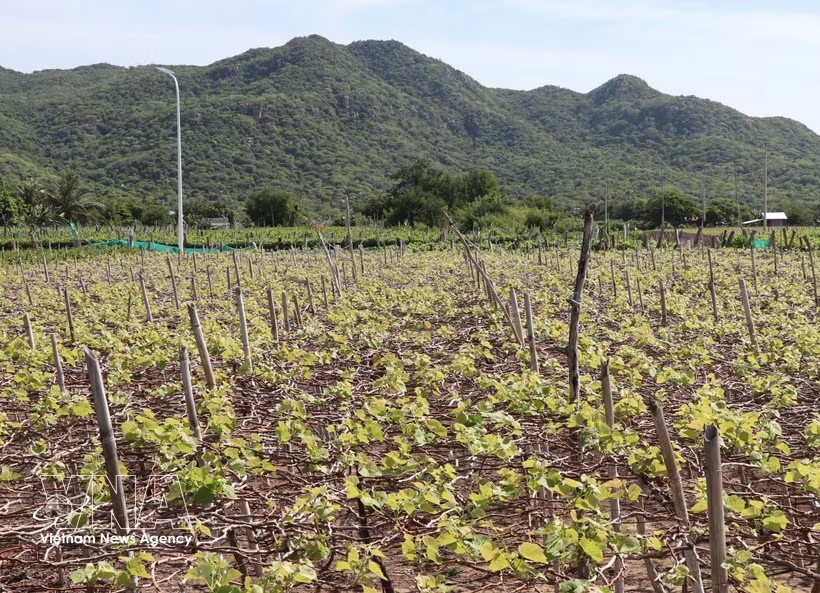
Grape farming in the southern areas of Khanh Hoa province. (Photo: VNA)

Hanoi (VNA) – Vietnam is stepping up efforts to build low-emission agricultural production zones and standardise greenhouse gas measurement systems as part of a long-term strategy to make the farming sector greener, more competitive, and better positioned in international markets.

The move follows the approval of the national project on low-emission crop production for 2025–2035, with a vision to 2050. The initiative is now being actively implemented across the country, with local authorities playing a key role in turning policy into action.

According to Nguyen Thi Thu Huong, Deputy Director of the Department of Crop Production and Plant Protection under the Ministry of Agriculture and Environment, 22 cities and provinces have already issued provincial action plans to carry out the project.

Several localities have launched pilot models. In the central province of Quang Tri, low-emission rice cultivation is being applied across more than 6,000 hectares in 13 communes. Hue city has introduced a 20-hectare rice farming model that combines advanced cultivation techniques, improved water management and better rice straw treatment to reduce emissions.

Many international organisations and businesses have also registered to participate in pilot programmes, while a measurement, reporting and verification (MRV) system is being developed to monitor emission reductions.
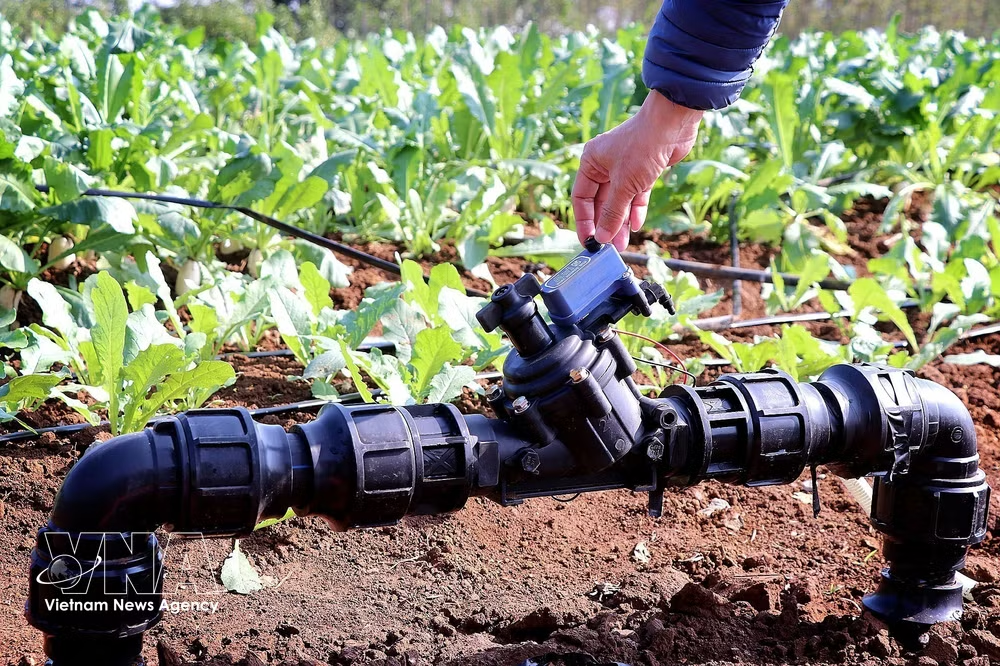
vnanet-potal-mo-hinh-san-xuat-rau-cu-qua-an-toan-theo-vietgap-tai-xa-da-bac-phu-tho-8517510.jpg
An automatic watering system is checked, adjusted, and maintained regularly to ensure safety. (Photo: VNA)

The crop production sector aims to establish low-emission farming zones tailored to key products and ecological regions by 2030. Priority will be given to rice, coffee, fruit and maize production.

For rice cultivation, the focus will be on expanding alternate wetting and drying (AWD) irrigation methods, improving rice straw management, reducing seed use, optimising fertiliser application and increasing mechanisation. These efforts will be linked to the national programme to develop one million hectares of high-quality, low-emission rice in the Mekong Delta.

In coffee-growing areas such as the Central Highlands and Son La province, authorities are promoting circular farming models, water-saving irrigation systems, organic fertilisers, by-product recycling and soil restoration. Pilot low-emission coffee zones will also be developed alongside traceability systems and sustainable export programmes.

For fruit crops, including durian, dragon fruit, pomelo, passion fruit and mango, the emphasis will be placed on irrigation management and agricultural waste treatment to meet increasingly strict green standards in export markets.

The ministry has also prioritised the development of a unified MRV framework from the central to local levels, starting with rice and coffee before expanding to other major crops.

Vietnam’s agricultural sector aims to reduce greenhouse gas emissions from crop production by at least 15% by 2035 compared with 2020 levels. It also plans to develop a national “Low Emission” label for crop products and pilot at least 15 farming models capable of generating carbon credits that meet international standards.

Deputy Minister of Agriculture and Environment Hoang Trung said the project’s ultimate goal is to build a sustainable and climate-resilient crop sector that lowers production costs, increases farmers’ incomes and enhances the reputation of Vietnamese agricultural products globally.

He stressed that the transition requires a shift from focusing on output volume to prioritising quality, efficiency, added value and environmental responsibility. While the ministry will provide policy guidance and technical support, local authorities will be responsible for organising implementation, mobilising resources and developing large-scale low-emission production models that can be replicated nationwide./.

VNA

See more

ASEAN ambassadors in Buenos Aires pose for a group photo with representatives of the Argentine Industrial Union (UIA). (Photo: VNA)

Vietnam highlights economic cooperation potential with Argentina

Vietnamese Ambassador Ngo Minh Nguyet highlights the strong momentum in Vietnam–Argentina economic ties. Vietnam is currently Argentina's sixth-largest trading partner, while Argentina ranks as Vietnam's third-largest trading partner in Latin America.

A mock-up of the Red River Landscape Boulevard project in Hanoi. Demand for capital for infrastructure projects is increasing sharply. (Photo: VNA)

SBV raises short-term capital lending cap to 40%

The new circular will help credit institutions have more room to provide capital to businesses and investment projects to support high economic growth in the next few years, while increasing flexibility in the SBV’s monetary policy management.

A farmer harvests seedless lemons in Vinh Long province. A national database covering all agricultural land, rather than only export-oriented production areas, is essential for meeting international standards and improving sector governance. (Photo: VNA)

Unified farm data system needed to meet EU deforestation rules

Fragmented data systems and limited information sharing among Government agencies, businesses and farmers remain major obstacles to compliance with the EUDR, which requires exporters of commodities such as coffee, rubber and cocoa to prove their products are not linked to deforestation, experts said at the conference.

Secretary of the Can Tho municipal Party Committee Le Quang Tung (R) and Indian Ambassador to Vietnam Tshering Wangchuk Sherpa (Photo: VNA)

Can Tho, India envisage common ground to develop closer partnerships

Secretary of the Can Tho Party Committee Le Quang Tung proposed expanding collaboration in education and training, particularly in artificial intelligence (AI), biotechnology, healthcare, and pharmaceuticals, during his meeting with Indian Ambassador to Vietnam Tshering Wangchuk Sherpa.

Vietravel Airlines takes delivery of a new Airbus A321 on June 24. (Photo: VNA)

Vietravel Airlines adds Airbus A321 to fleet

Vietravel Airlines currently operates routes linking major economic and tourism hubs across Vietnam while gradually expanding its international footprint. In addition to scheduled services from Hanoi and Ho Chi Minh City to Bangkok, it launched charter flights between Hanoi and Lanzhou in China’s Gansu province on June 20.

Trucks carry coal mined in Quang Ninh province. (Photo: VNA)

Quang Ninh adjusts GRDP growth targets for each quarter

To collect more than 100 trillion VND (3.7 billion USD) in state budget revenue this year, the provincial People’s Committee issued a decision mapping out detailed GRDP growth waypoints for each leg of the year: 12.58% in the second quarter, taking first-half growth to 11.07%; 15.48% in the third quarter, lifting nine-month growth to 12.56%; and 14.86% in the fourth quarter, yielding a full-year print of 13.21%.

At the construction site of the project to upgrade National Highway 28B connecting Da Lat city with Phan Thiet city. (Photo: VNA)

Vietnam’s public investment disbursement accelerating

Disbursement reached 227.2 trillion VND (8.73 billion USD) as of June 4, equal to 22.4% of the Prime Minister’s annual plan, the Ministry of Finance said. That was up from 198.4 trillion VND a week earlier, meaning more than 28.8 trillion VND was disbursed in the May 29–June 4 period alone, about 1.8 times the prior week’s pace.

Containers at Cat Lai Port in Ho Chi Minh City. (Photo: VNA)

Business confidence in Vietnam rebounds strongly: UOB

The study found that 85% of Vietnamese enterprises reported positive business sentiment, a sharp increase from 48% in 2025, when business confidence was weighed down by uncertainties surrounding US tariff policies and related trade developments.