Ho Chi Minh City (VNA) – The Politburo’s Resolution No. 10-NQ/TW, issued on June 8, 2026, on the development of the foreign-invested economic sector, has been widely viewed as a milestone in Vietnam’s approach to attracting foreign investment. For the first time, this sector is officially identified as an integral component of the national economy and a key driver of growth, innovation and international integration.
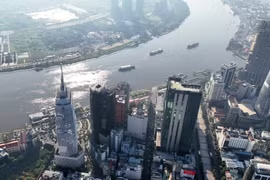
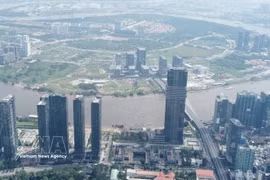
Against this backdrop, the Vietnam International Financial Centre (VIFC) is expected to play a pivotal role in attracting, connecting and channeling high-quality capital flows into the country.
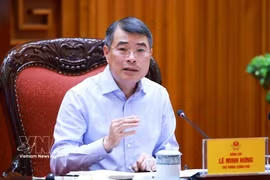
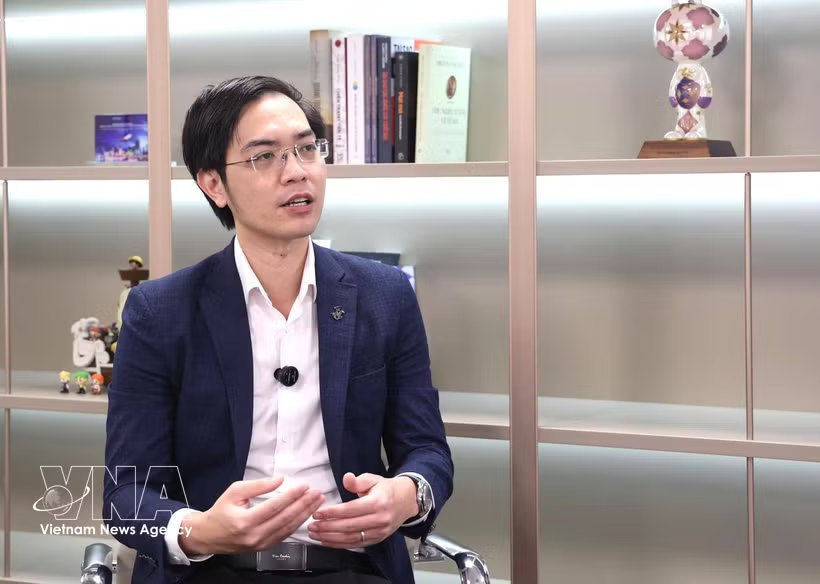
Associate Professor Dr. Nguyen Huu Huan, Vice Chairman of the Executive Agency of the VIFC in Ho Chi Minh City (VIFC-HCMC), assessed that Resolution 10 reflects a fundamental shift in development mindset, from prioritising the volume of foreign investment inflows to developing a strategic national investment ecosystem.
Huan noted that the resolution links foreign-invested enterprises with broader national development priorities, including capital markets, international financial centres, free trade zones, innovation, data infrastructure, logistics and the growth of domestic enterprises.
He explained that Vietnam is no longer positioning itself solely as a manufacturing destination but is increasingly seeking to attract higher value-added activities such as research and development (R&D), regional headquarters, advanced service industries and international financial operations. This approach, he said, would enable the country to integrate more deeply into global value chains and attract investment into innovation-driven and knowledge-intensive sectors.
In this context, the VIFC, particularly in Ho Chi Minh City, is expected to become a key platform for attracting next-generation foreign capital. Huan said the special mechanisms and institutional framework being developed for the centre will not only facilitate capital inflows but also support new models of capital mobilisation and allocation, generating greater value for the economy.
He also showed his belief that with these breakthrough mechanisms in place, Vietnam will not only attract greater volumes of high-quality capital but also gradually emerge as a regional hub for connecting and channeling global investment flows into Southeast Asia and the broader Asian region in the years ahead.
He noted that Vietnam currently has National Assembly Resolution No. 222/2025/QH15 on the VIFC, along with eight Government decrees providing implementation guidance. These are highly specific mechanisms that lay an important foundation for the VIFC to attract investment flows, particularly high-quality capital.
In practice, although Vietnam attracts a substantial volume of investment capital, especially in the manufacturing sector, many financial activities associated with these capital flows are still carried out in regional international financial centres such as Singapore, Hong Kong (China), and Dubai (the United Arab Emirates). As a result, the value added generated from financial services linked to investment flows into Vietnam has not been sufficiently retained domestically.
The establishment of the VIFC, therefore, will create opportunities for Vietnam to retain a larger share of these financial activities domestically. Services such as cross-border payments, insurance, capital management, fund management and asset management can increasingly be conducted within Vietnam, helping to deepen the domestic financial market and create additional economic value.
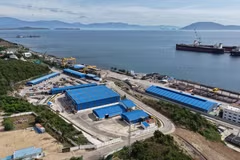
Regarding Vietnam’s readiness to develop the VIFC, Huan pointed to several advantages, including the country’s strong manufacturing base, abundant and increasingly skilled workforce, and strategic geographic location. He highlighted Vietnam’s expanding logistics network and major deep-water ports, such as Cai Mep–Thi Vai, as important assets supporting the country’s long-term financial centre ambitions.
At the same time, he acknowledged that Vietnam’s financial market remains relatively shallow and heavily reliant on the banking sector, which currently provides 70-80% of financing. To attract more international and high-quality capital, he stressed the need to further develop capital markets, expand financial products and improve overall market depth and competitiveness.
Huan said the VIFC has spent the past six months laying the groundwork for full operations. The centre has focused on four strategic pillars: aviation finance, maritime finance, a fintech hub and an international interbank system. Several major components have already been launched, including the Aviation Finance Centre in February, the Fintech Hub in April and the Maritime Finance Ecosystem in May.
He added that both domestic and international financial institutions have shown strong interest in participating in the VIFC. Once the operational framework is fully approved, these institutions will be able to commence activities immediately, helping to build a comprehensive financial ecosystem capable of attracting greater international capital flows into Ho Chi Minh City and Vietnam.
Huan emphasised that Ho Chi Minh City is poised to become an increasingly attractive destination for investors and global financial institutions. Beyond attracting capital, the VIFC is expected to serve as a magnet for innovation, technology and highly skilled talent, thereby creating new growth drivers and strengthening Vietnam’s position within global value chains./.
See more
Khanh Hoa sets sail on smart, green logistics overhaul
Under a logistics development roadmap that stretches to 2030 with a vision to 2050, the province is racing to build a modern, green, and smart logistics ecosystem. Top priorities include rolling out logistics hubs linked to the Van Phong Economic Zone, Cam Ranh, and key transport gateways, while fast-tracking digital transformation and the use of cutting-edge technology across supply chain management.
New master plan aims to boost Vietnam’s collective economy through 2030
The programme seeks to strengthen the role of the collective economy and cooperatives in the national economy while expanding access to State support policies to encourage more people to join cooperatives and promote stronger links between cooperatives, businesses and other economic sectors.
Vietnam Chemicals Group steps up trade promotion in South Africa
A key event of the visit was a business networking forum held in Johannesburg on June 24, jointly organised by the Vietnamese Embassy in South Africa and Vinachem. The event attracted more than 20 leading South African companies and investors seeking business partnerships.
AI reshaping new generation of workers
Adoption is moving faster than anyone predicted, turning AI into one of the most powerful forces reshaping labour markets worldwide, and Vietnam is squarely in its path. As AI technologies keep advancing, especially when woven together with automation systems and robotics, workers across a vast range of industries and occupations face mounting risks of being displaced.
Vietnam highlights economic cooperation potential with Argentina
Vietnamese Ambassador Ngo Minh Nguyet highlights the strong momentum in Vietnam–Argentina economic ties. Vietnam is currently Argentina's sixth-largest trading partner, while Argentina ranks as Vietnam's third-largest trading partner in Latin America.
Green production zones to boost standing of Vietnamese farm products
The move follows the approval of the national project on low-emission crop production for 2025–2035, with a vision to 2050. The initiative is now being actively implemented across the country, with local authorities playing a key role in turning policy into action.
Reference exchange rate going up on June 25
The State Bank of Vietnam set the daily reference exchange rate at 25,197 VND/USD on June 25, up 5 VND from the previous day.
SBV raises short-term capital lending cap to 40%
The new circular will help credit institutions have more room to provide capital to businesses and investment projects to support high economic growth in the next few years, while increasing flexibility in the SBV’s monetary policy management.
Vietnamese firms urged to focus on produce quality to strengthen foothold in China
Despite great opportunities, experts warned that China is no longer an “easy market” as it is shifting toward high-quality and high-standard products, with growing attention to food safety, origin and quality.
Unified farm data system needed to meet EU deforestation rules
Fragmented data systems and limited information sharing among Government agencies, businesses and farmers remain major obstacles to compliance with the EUDR, which requires exporters of commodities such as coffee, rubber and cocoa to prove their products are not linked to deforestation, experts said at the conference.
Can Tho, India envisage common ground to develop closer partnerships
Secretary of the Can Tho Party Committee Le Quang Tung proposed expanding collaboration in education and training, particularly in artificial intelligence (AI), biotechnology, healthcare, and pharmaceuticals, during his meeting with Indian Ambassador to Vietnam Tshering Wangchuk Sherpa.
Vietravel Airlines adds Airbus A321 to fleet
Vietravel Airlines currently operates routes linking major economic and tourism hubs across Vietnam while gradually expanding its international footprint. In addition to scheduled services from Hanoi and Ho Chi Minh City to Bangkok, it launched charter flights between Hanoi and Lanzhou in China’s Gansu province on June 20.
Rental housing emerges as strategic pillar of Hanoi’s social welfare policy
As Hanoi continues to advance social housing programmes, renovate ageing apartment complexes and promote transit-oriented urban development (TOD), expanding the rental housing stock is set to become a key pillar of its housing strategy.
Vietnam showcases products at Algiers International Fair 2026
The Vietnamese pavilion attracted hundreds of visitors on the opening day, with many expressing interest in the quality and diversity of Vietnamese products.
Dutch firm eyes 125-mln-USD waste-to-energy project in Tay Ninh
Dutch firm Harvest Waste B.V and the Tay Ninh Department of Industry and Trade to study investment in a waste-to-energy plant using European technology.
Reference exchange rate inches up 3 VND on June 24
With the current trading band of +/- 5%, the ceiling rate applicable for commercial banks during the day is 26,452 VND/USD, and the floor rate 23,932 VND/USD.
Vietnam’s electronics industry eyes deeper integration into global technology value chains
Multinational corporations are no longer simply relocating factories but are establishing supplier networks, technical capabilities and regional operations centres. As a result, Vietnam’s real opportunity lies not in attracting more factories, but in capturing higher value-added activities surrounding them.
Nationwide E10 rollout creates multi-million-dollar ethanol market
As E10 petrol, a blend of 90% conventional gasoline and 10% ethanol, is introduced nationwide, ethanol demand is expected to increase significantly.
Quang Ninh adjusts GRDP growth targets for each quarter
To collect more than 100 trillion VND (3.7 billion USD) in state budget revenue this year, the provincial People’s Committee issued a decision mapping out detailed GRDP growth waypoints for each leg of the year: 12.58% in the second quarter, taking first-half growth to 11.07%; 15.48% in the third quarter, lifting nine-month growth to 12.56%; and 14.86% in the fourth quarter, yielding a full-year print of 13.21%.
VinFast India partners with Shriram Finance to strengthen EV financing accessibility
Under the agreement, prospective customers of VinFast will benefit from SFL’s tailored financing solutions, including up to 100% on-road funding, attractive interest rates, and flexible repayment options across VinFast’s product portfolio, designed to simplify EV ownership and accelerate adoption.