Vietnam, Singapore eye stronger cooperation to build ASEAN Halal value chain

The Halal economy is opening up a new area of cooperation, further fostering the Comprehensive Strategic Partnership between the two countries, said Vietnamese Ambassador to Singapore Tran Phuoc Anh at a business seminar in Singapore on June 27.

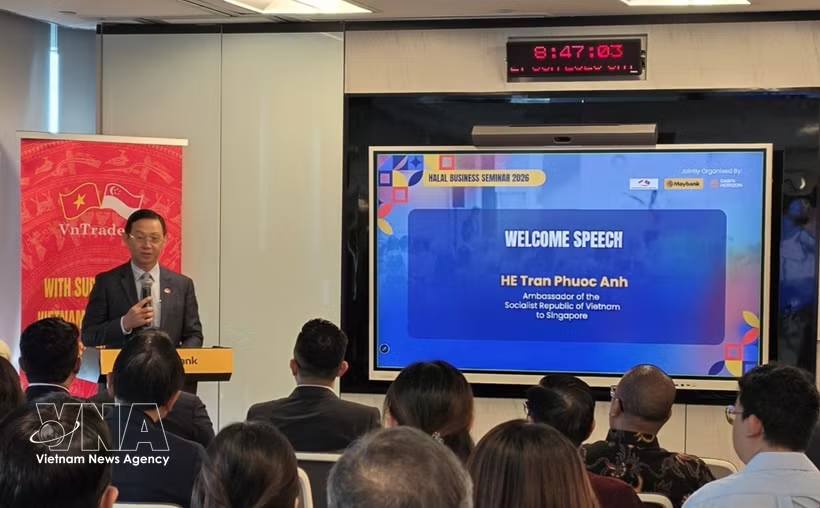
Vietnamese Ambassador to Singapore Tran Phuoc Anh speaks at the Halal Business Seminar 2026 in Singapore on June 27 (Photo: VNA)

Singapore (VNA) - Vietnam and Singapore have significant opportunities to jointly develop a regional Halal value chain by combining their complementary strengths to help ASEAN expand access to global markets as the multi-trillion-USD Halal economy continues to rapidly grow, speakers said at a business seminar in Singapore on June 27.

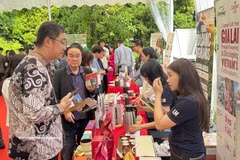
The Halal Business Seminar 2026 themed “Singapore – Vietnam and Beyond: Building the Regional Halal Value Chain ” was jointly organised by the Vietnam Trade Office in Singapore, Maybank and Dawn Horizon, bringing together policymakers, certification bodies, financial institutions and businesses from across Southeast Asia.

In his opening speech, Vietnamese Ambassador to Singapore Tran Phuoc Anh said the bilateral economic ties between the two countries have continued to grow stronger, with two-way trade reaching nearly 40 billion SGD (30.9 billion USD) in 2025, while Singapore remained the largest foreign investor in Vietnam.

The Halal economy is opening up a new area of cooperation, further fostering the Comprehensive Strategic Partnership between the two countries, he noted.

Serving nearly two billion Muslim consumers worldwide, the global Halal market is estimated to exceed 7 trillion USD annually, covering sectors ranging from food and beverages to pharmaceuticals, cosmetics, tourism, logistics, finance and digital services, the diplomat stressed adding that demand for certified Halal products is also rising steadily across Southeast Asia, the Middle East, Europe, Africa and North America.

According to the diplomat, Vietnam sees Halal industry as a strategic opportunity to diversify export markets and strengthen supply chain resilience. The Government has adopted a national strategy on enhancing international cooperation for developing Halal industry through 2030, while encouraging ministries, localities and businesses to improve certification capacity, upgrade production systems and expand international partnerships.

He noted that Vietnam’s strengths in agriculture, seafood, food processing and production complement Singapore’s advantages in finance, logistics, innovation and internationally recognised certification systems. Combining these capabilities, he said, will help establish a competitive regional Halal value chain linking ASEAN producers with global markets.

The ambassador also revealed that Vietnam will host the Halal Tourism Conference 2026, themed “Vietnam – A new destination for Muslim tourism,” in Khanh Hoa province on July 8-9 to promote the country's Halal tourism potential.

Tan Teck Lee, Country Head for Thailand, Malaysia and the Philippines at the Singapore Business Federation (SBF), said Vietnam is emerging as a key regional manufacturing hub and attracting increasing international investment. He noted said the SBF aims to strengthen business connectivity between the two countries and support the development of regional Halal value chains.

Tan identified differences in Halal certification systems across Southeast Asia as a major obstacle. Greater harmonisation or mutual recognition of certification standards, he said, will facilitate regulation, inspection and movement of goods, helping boost regional trade.

According to Tan, Vietnamese firms should invest more in innovation, and research and development (R&D) while leveraging Singapore’s role as a logistics, distribution and transshipment hub to reach wider international markets.

Sharing this view, Dewi Suratty, founder and CEO of Dawn Horizon, said Vietnam is well positioned to expand its Halal industry thanks to its government’s strong support and the country’s strengths in agricultural, seafood and food production.

With food security becoming an increasing priority from the Middle East to Southeast Asia, demand for high-quality raw materials is rising, creating new export opportunities for Vietnam’s Halal-certified products.

She said ASEAN could build a complementary Halal value chain in which raw materials are sourced from Vietnam, processed in Singapore and exported to major consumer markets. Such cooperation will allow each country to capitalise on its comparative advantages while enhancing ASEAN’s overall competitiveness in the global Halal market.

The delegates said the workshop not only opened up opportunities for business connectivity between Vietnam and Singapore, but also contributed to promoting ASEAN-wide cooperation in building a sustainable Halal value chain. With Vietnam’s production capacity, Singapore’s financial and logistics ecosystem, and the regional trend toward harmonised standards, ASEAN is expected to strengthen its position on the global Halal economic map./.

VNA
See more

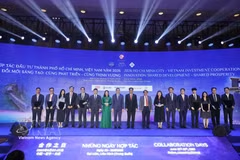
Delegates pose for a commemorative photograph following the cooperation announcement ceremony and the presentation of letters of intent for cooperation at the Ho Chi Minh City investment cooperation forum. (Photo: VNA)

Ho Chi Minh City steps up investment attraction in next-generation industries

The Vietnamese southern economic hub’s programme attracted nearly 1,000 participants, with nine cooperation initiatives announced between municipal agencies and businesses and Chinese enterprises across sectors including artificial intelligence (AI), autonomous vehicles and smart mobility, high-tech healthcare, smart agriculture and aquaculture, smart urban centres, green materials, robotics and automation, innovation, digital transformation and innovation-driven finance.

Vietnam's first domestic carbon exchange is expected to be launched on June 29. (Photo: VNA)

Vietnam ready to launch domestic carbon exchange on June 29

The launch marks a major milestone in the development of Vietnam's carbon market, contributing to implementing the country's commitments to greenhouse gas emissions reduction, and accelerating the green transition and promoting low-carbon economic growth.

Secretary of the Tay Ninh provincial Party Committee Nguyen Van Quyet speaks at the event (Photo: VNA)

Tay Ninh courts investment from Germany’s industrial heartland

With a strategic location, improving transport infrastructure, ample industrial land and fast-improving investment climate, Tay Ninh aims to become a magnet for German firms in hi-tech manufacturing, industrial equipment, automation, semiconductors and digital transformation.

A panoramic view of Hanoi’s political centre, stretching from Hoan Kiem Lake to the Red River (Photo: VNA)

Hanoi sets out new investment blueprint with century-long development vision

As of early June, Hanoi had attracted 74.6 billion USD in foreign direct investment (FDI) through more than 9,250 valid projects. FDI inflows in the first six months were projected at 3.2 billion USD, surpassing the annual target by 116%, while nearly 16,000 new businesses were established in the first five months, up 34.4% year-on-year.

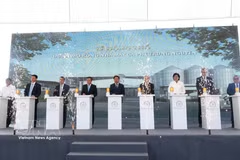
The ground-breaking and construction commencement ceremony for the Trung Nguyen Legend Group’s coffee factory system at the Tan An industrial cluster in Dak Lak province on June 25, 2026. (Photo: VNA)

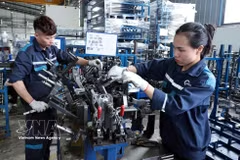
Dak Lak adds new high-tech coffee processing project meeting Net Zero standards

Construction began on the Trung Nguyen Legend coffee plant, designed as a sustainable, ecological energy-efficient facility meeting Net Zero standards. The first phase carries an investment value of 989 billion VND (37.58 million USD), with a spray-drying capacity of 1,000kg per hour across an area of 4.9 hectares.

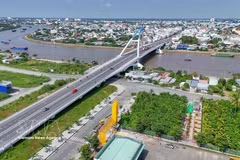
Tran Hoang Na Bridge spans the Can Tho River, linking Ninh Kieu and Cai Rang areas. (Photo: VNA)

Prime Minister orders faster ODA, concessional loan disbursement

Under Directive No. 27/CT-TTg dated June 25, 2026, the PM called for stronger management and higher-quality preparation, appraisal and approval of ODA- and concessional loan-funded projects, with the goal of fully disbursing the annual public investment plan assigned by the Government leader.

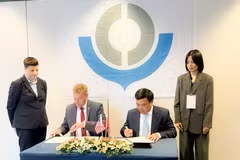
Director of the Vietnamese Department of Customs Nguyen Van Tho and US Customs Commissioner Rodney Scott sign the Memorandum of Cooperation. (Photo: VGP)

Vietnam, US sign MoU for real-time customs data exchange

Under the agreement, the two sides plan to share electronic cargo manifest data in real time, or as quickly as possible, to support risk management and detect violations, including trade fraud, counterfeit goods, smuggling, origin fraud and tax evasion.

A Petrolimex fuel station in Hung Yen province (Photo: VNA)

Ministry proposes extending fuel tax cuts

The MoF said the extension would help stabilise the domestic petroleum market, strengthen energy security and support macroeconomic stability amid continued volatility in global energy markets.

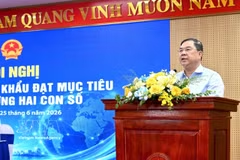
Permanent Deputy Prime Minister Pham Gia Tuc speaks at the conference on promoting exports to meet the double-digit growth target on June 25. (Photo: VNA)

Deputy PM outlines key solutions to boost exports

To support export expansion, Permanent Deputy PM Pham Gia Tuc asked the Ministry of Industry and Trade to work closely with ministries, sectors and localities to closely monitor market developments and regularly update production, business and trade data in order to make timely and effective policy responses.

A Vietnam Airlines aircraft (Photo: VNA)

Vietnam Airlines to add two more Airbus aircraft to fleet

Under the plan, the national flag carrier will take delivery of an Airbus A320 on June 26 under a three-year lease agreement. Another Airbus A321 is scheduled to join the airline's fleet in July to support peak summer travel demand.

Delegates at the meeting (Photo: VNA)

Can Tho seeks to expand industrial, trade cooperation with Chinese partners

In the first five months of 2026, Can Tho exported goods worth 12.7 million USD to China, mainly rice, seafood, agricultural products, processed farm produce and garments. Its imports from China reached 28.6 million USD, consisting primarily of veterinary medicines, fertilisers, chemicals and fabrics.