Ho Chi Minh City targets global service hub status with high-value growth strategy

Ho Chi Minh City is positioning itself as a modern regional megacity and a value-added services hub by leveraging new development space created after the administrative merger. This a strategy seen as a core growth pillar to strengthen its role in global service supply chains.

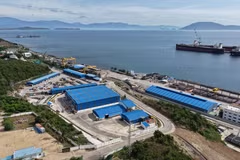
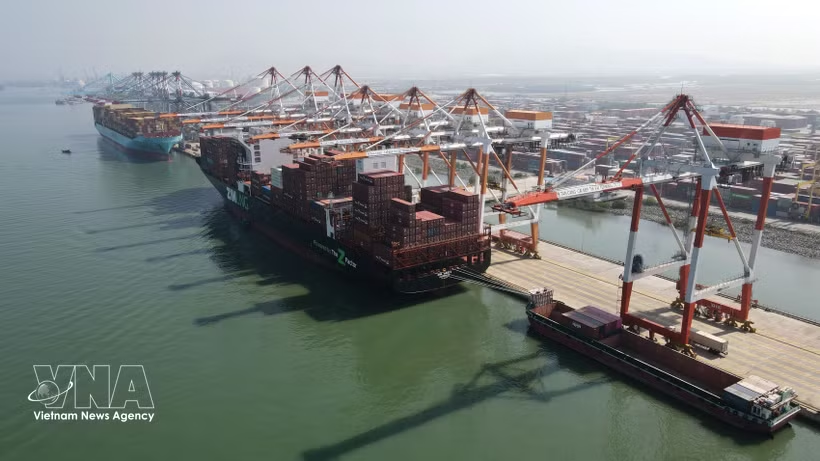
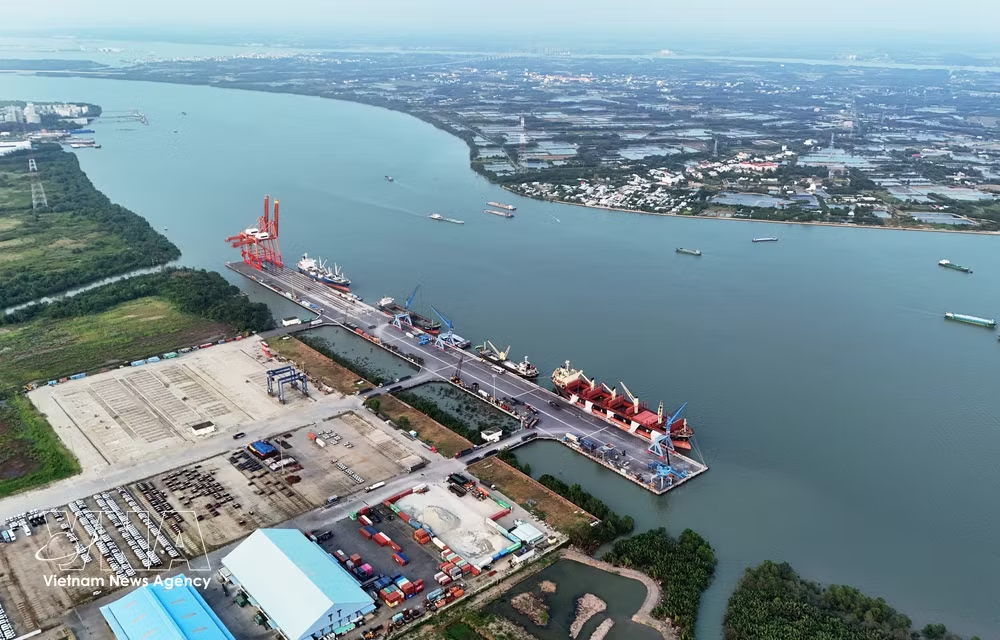
A view of the Cai Mep–Thi Vai deep-water port cluste in Ho Chi Minh City. (Photo: VNA)

Ho Chi Minh City (VNA) - Ho Chi Minh City is positioning itself as a modern regional megacity and a value-added services hub by leveraging new development space created after the administrative merger. This a strategy seen as a core growth pillar to strengthen its role in global service supply chains.

Tapping advantages for forming a regional service centre

Services remain the largest contributor to Ho Chi Minh City’s growth, accounting for around 51% of GRDP after the merger. With an area of more than 6,772 sq km, a population of about 14 million, and a GRDP of roughly 120 billion USD, comparable to many global megacities, it is well positioned to become a leading services hub.

According to Dr. Do Thien Anh Tuan from the Fulbright School of Public Policy and Management, rising population, income and living standards are creating a massive consumer market. The expanded city is expected to strengthen its role as a national distribution hub and trendsetter for consumption.

New development space also enhances advantages in logistics, maritime transport, international trade and tourism, he said. The city is home to 99 seaports, including the Cai Mep–Thi Vai deep-water port cluster, which is among the region’s leading ports capable of receiving the largest tonnage vessels. In 2025, the city’s port system handled more than 24 million TEUs of cargo, ranking eighth globally.

Dinh Xuan Khanh, Director of the Tan Cang Sai Gon Logistics Centre, said cargo throughput through the city’s port system is 14 million TEUs per year and could rise to 26–27 million TEUs by 2030 by adjusting international transshipment policies.
vnanet-hcm2.jpg
The Saigon–Hiep Phuoc port system, located along the Saigon–Nha Be river axis, supports inter-regional logistics connectivity, leverages deep-water port advantages, and helps shape a maritime–industrial–urban development space, creating momentum for Ho Chi Minh City's outward expansion toward the sea. (Photo: VNA)

Cruise tourism logistics is also emerging as a potential sector, with increasing international cruise ships docking in the Ba Ria–Vung Tau area.

In its development orientation, the newly-established international financial centre (IFC) and the seaport system are expected to serve as a core hub, linking with the city’s strategic service centres, including maritime logistics, information and communications, science, technology and innovation, tourism, healthcare, and education.

Insiders said that if these opportunities are harnessed, Ho Chi Minh City has strong potential to become a leading services hub in Southeast Asia in the coming decades.

Addressing structural bottlenecks

Despite strong potential, the city’s service sector still lags behind major regional hubs. According to Vu Doan Thai Long, Senior Project Manager at Roland Berger Vietnam, although the services share of GRDP rose from 40% in 2010 to 51% in 2025, overtaking industry, it remains significantly lower than Bangkok (88%), Singapore (71%) and Kuala Lumpur (70%).

According to Long, limited connectivity infrastructure, the continued dominance of traditional business models, the large proportion of small and medium-sized enterprises, and relatively low competitiveness all remain significant barriers to the development of high-quality services.

In addition, the shift toward high-value-added service industries remains slow. The service economy is still heavily dependent on trade, real estate, and media-related sectors, rather than finance, technology, innovation, or cross-border services, he added.

In logistics and maritime finance, most value-added services, such as trade finance, marine insurance, freight brokerage and risk management, are still controlled by international financial centres. Around 80–90% of financial transactions related to trade and logistics are processed in Singapore or Hong Kong (China), while Vietnam retains only about 4–5% of maritime transaction value.

To address these challenges, the city's development plan has mapped out a clear roadmap and phased targets to transform Ho Chi Minh City into a major national and regional services hub centred on high-end, modern, and high-value-added sectors.

To 2030, the city is focused on strengthening foundations, improving institutions and removing bottlenecks, aiming to build a complete service ecosystem and enhance competitiveness at the Asian level. By 2035–2040, it targets becoming a leading service hub in Asia, before reaching global-level status by 2045. Services are expected to contribute 70–75% of GRDP by 2040.

Key solutions include institutional reform, leveraging special mechanisms, and improving the investment environment.

Economist Le Ba Chi Nhan stressed the need for the city to accelerate the development of IFC in Thu Thiem, establish regulatory sandboxes for fintech and green finance, cross-border finance service, and introduce tax and visa incentives to attract international experts.

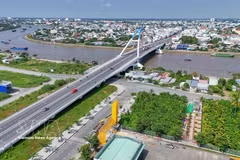
Major infrastructure projects, such as Thu Thiem 4 Bridge, Thu Thiem–Long Thanh railway, Ring Roads 3 and 4, and modern logistics systems linked to Can Gio port and Cai Mep–Thi Vai port cluster, are being promoted to reduce logistics costs below 15% of GDP.

Human resources development is also identified as decisive factor, with priority given to fintech, artificial intelligence, logistics, healthcare and education under international standards./.
VNA

See more

Vietnam's first domestic carbon exchange is expected to be launched on June 29. (Photo: VNA)

Vietnam ready to launch domestic carbon exchange on June 29

The launch marks a major milestone in the development of Vietnam's carbon market, contributing to implementing the country's commitments to greenhouse gas emissions reduction, and accelerating the green transition and promoting low-carbon economic growth.

Secretary of the Tay Ninh provincial Party Committee Nguyen Van Quyet speaks at the event (Photo: VNA)

Tay Ninh courts investment from Germany’s industrial heartland

With a strategic location, improving transport infrastructure, ample industrial land and fast-improving investment climate, Tay Ninh aims to become a magnet for German firms in hi-tech manufacturing, industrial equipment, automation, semiconductors and digital transformation.

A panoramic view of Hanoi’s political centre, stretching from Hoan Kiem Lake to the Red River (Photo: VNA)

Hanoi sets out new investment blueprint with century-long development vision

As of early June, Hanoi had attracted 74.6 billion USD in foreign direct investment (FDI) through more than 9,250 valid projects. FDI inflows in the first six months were projected at 3.2 billion USD, surpassing the annual target by 116%, while nearly 16,000 new businesses were established in the first five months, up 34.4% year-on-year.

The ground-breaking and construction commencement ceremony for the Trung Nguyen Legend Group’s coffee factory system at the Tan An industrial cluster in Dak Lak province on June 25, 2026. (Photo: VNA)

Dak Lak adds new high-tech coffee processing project meeting Net Zero standards

Construction began on the Trung Nguyen Legend coffee plant, designed as a sustainable, ecological energy-efficient facility meeting Net Zero standards. The first phase carries an investment value of 989 billion VND (37.58 million USD), with a spray-drying capacity of 1,000kg per hour across an area of 4.9 hectares.

Tran Hoang Na Bridge spans the Can Tho River, linking Ninh Kieu and Cai Rang areas. (Photo: VNA)

Prime Minister orders faster ODA, concessional loan disbursement

Under Directive No. 27/CT-TTg dated June 25, 2026, the PM called for stronger management and higher-quality preparation, appraisal and approval of ODA- and concessional loan-funded projects, with the goal of fully disbursing the annual public investment plan assigned by the Government leader.

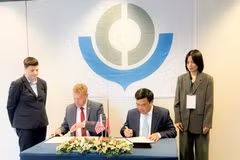
Director of the Vietnamese Department of Customs Nguyen Van Tho and US Customs Commissioner Rodney Scott sign the Memorandum of Cooperation. (Photo: VGP)

Vietnam, US sign MoU for real-time customs data exchange

Under the agreement, the two sides plan to share electronic cargo manifest data in real time, or as quickly as possible, to support risk management and detect violations, including trade fraud, counterfeit goods, smuggling, origin fraud and tax evasion.

A Petrolimex fuel station in Hung Yen province (Photo: VNA)

Ministry proposes extending fuel tax cuts

The MoF said the extension would help stabilise the domestic petroleum market, strengthen energy security and support macroeconomic stability amid continued volatility in global energy markets.

Permanent Deputy Prime Minister Pham Gia Tuc speaks at the conference on promoting exports to meet the double-digit growth target on June 25. (Photo: VNA)

Deputy PM outlines key solutions to boost exports

To support export expansion, Permanent Deputy PM Pham Gia Tuc asked the Ministry of Industry and Trade to work closely with ministries, sectors and localities to closely monitor market developments and regularly update production, business and trade data in order to make timely and effective policy responses.

A Vietnam Airlines aircraft (Photo: VNA)

Vietnam Airlines to add two more Airbus aircraft to fleet

Under the plan, the national flag carrier will take delivery of an Airbus A320 on June 26 under a three-year lease agreement. Another Airbus A321 is scheduled to join the airline's fleet in July to support peak summer travel demand.

Delegates at the meeting (Photo: VNA)

Can Tho seeks to expand industrial, trade cooperation with Chinese partners

In the first five months of 2026, Can Tho exported goods worth 12.7 million USD to China, mainly rice, seafood, agricultural products, processed farm produce and garments. Its imports from China reached 28.6 million USD, consisting primarily of veterinary medicines, fertilisers, chemicals and fabrics.

Can Tho yields about 3 million tonnes of rice each year (Photo: VNA)

Vietnam ships 5 million tonnes of rice abroad in first half

About 5 million tonnes of Vietnam's rice are expected to be shipped abroad in the first half, raking in an estimated 2.36 billion USD, up 5.7% annually in volume but down 3.3% in value, reported the Ministry of Agriculture and Environment.

Illustrative photo (Photo: VNA)

Hanoi to hold investment promotion event on June 29

At the event, Hanoi authorities plan to grant investment policy decisions and investment registration certificates to 20 exemplary projects in the fields of transportation infrastructure, industrial parks, urban development, social housing, environment, science and technology, and foreign investment attraction.

A corner of Van Phong Economic Zone in Khanh Hoa (Photo: VNA)

Khanh Hoa sets sail on smart, green logistics overhaul

Under a logistics development roadmap that stretches to 2030 with a vision to 2050, the province is racing to build a modern, green, and smart logistics ecosystem. Top priorities include rolling out logistics hubs linked to the Van Phong Economic Zone, Cam Ranh, and key transport gateways, while fast-tracking digital transformation and the use of cutting-edge technology across supply chain management.