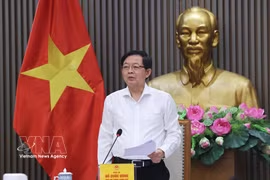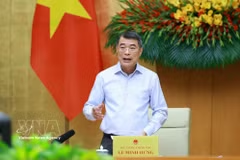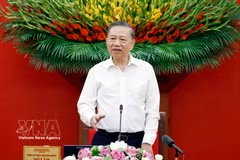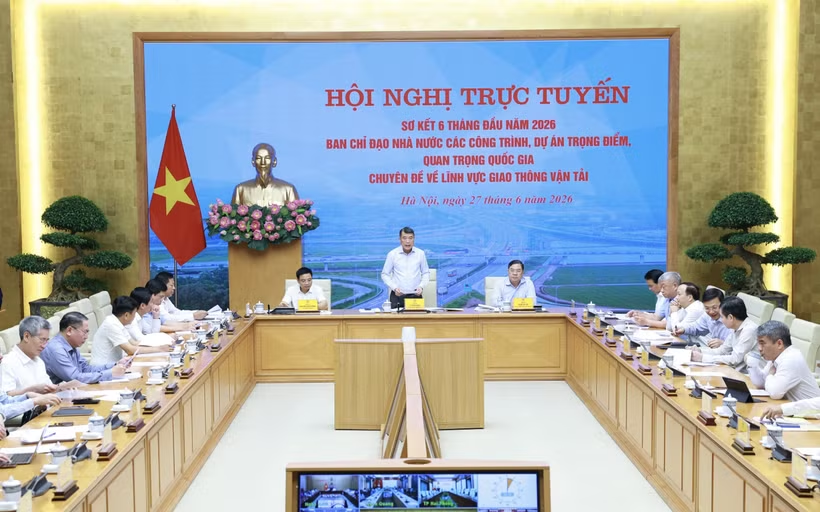
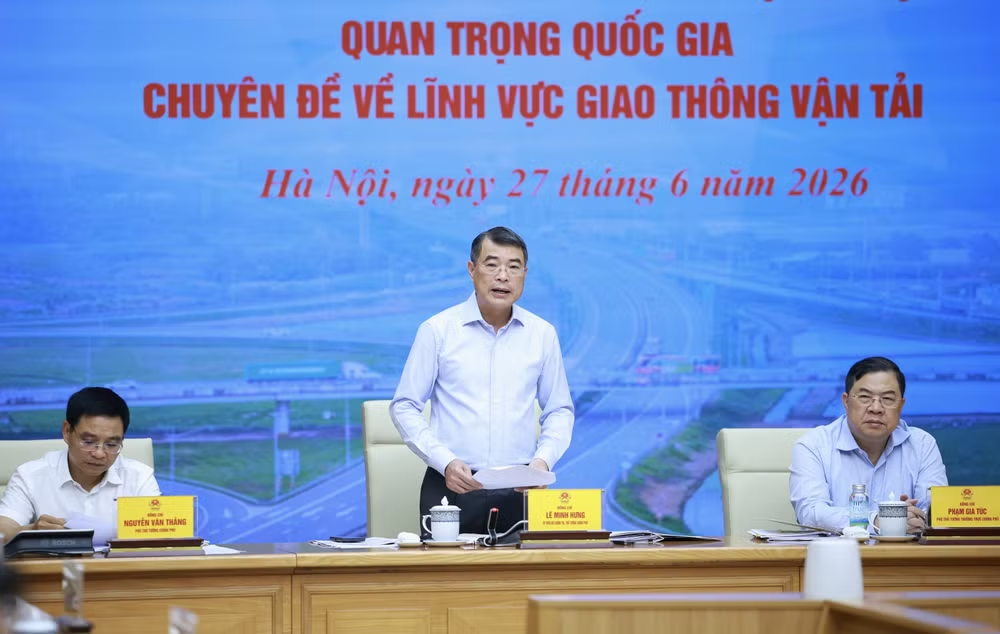
Hanoi (VNA) - Prime Minister Le Minh Hung on June 27 stressed the need to strictly adhere to implementation schedules for key national transport projects, saying that deadlines must not be extended unless there are objective reasons, as he chaired a meeting reviewing the implementation of major and imporant national transport projects in the first half of this year.
The meeting of the State Steering Committee for major and important national projects in the transport sector was held in a hybrid format, connecting the Government Office in Hanoi with the offices of the People’s Committees of 31 localities hosting the projects.
At the conference, the Ministry of Construction, relevant ministries, agencies, localities, and investors reported on the implementation of key tasks assigned by the Government and its leadership. They reviewed and assessed project progress and disbursement performance, particularly for projects scheduled for completion in 2026, major projects, and those facing delays or failing to meet requirements. They also identified shortcomings, bottlenecks, difficulties, and responsibilities of relevant stakeholders, especially in site clearance, material supply, and labour.
According to the reports, the Ministry of Construction and relevant agencies have completed and put into operation several important projects, including six sections of the Eastern North–South Expressway with a total length of 395 km, connecting the entire route from Lang Son to Ca Mau. The Bien Hoa–Vung Tau expressway has been completed, improving connectivity between Long Thanh International Airport and Vung Tau seaport. The Ca Mau, Phu Quoc, and Gia Binh airport projects are being implemented on schedule. Difficulties at the Long Thanh International Airport project are being gradually resolved, and several projects have achieved very high disbursement rates.
However, shortcomings remain. Many projects are facing shortages of construction materials, despite the fact that special mechanisms for licensing and exploiting common construction materials have been fully issued by the National Assembly and the Government. Construction progress at many projects remains slow, with low workload completion over the past six months. Regarding disbursement, some projects that have completed investment procedures and are under continuous construction still recorded very slow disbursement in the first half of the year, at below 20%, and in many cases below 10%.
Addressing the function, PM Hung emphasised that the 14th National Party Congress Resolution and Conclusion No. 18-KL/TW of the second plenum of the 14th Party Central Committee have demanded the development of a synchronised and modern infrastructure system, including transport infrastructure. To implement Conclusion No. 18, the Government issued Resolution No. 109/NQ-CP assigning specific tasks to ministries and localities, including many involving transport infrastructure development.
With a total of 38 transport sector projects under the State Steering Committee, with combined investment of about 5 quadrillion VND (190.1 billion USD), of which 220 trillion VND has been allocated for 2026, the Prime Minister stressed that these are substantial resources which, if effectively implemented, will strongly promote socio-economic development, contribute to double-digit growth targets, and reduce the incremental capital-output ratio (ICOR).
He praised the Ministry of Construction, other ministries, agencies, localities, investors, contractors, engineers, and workers for their efforts in overcoming difficulties and implementing transport infrastructure projects, making important contributions to infrastructure development and economic growth.
However, he also pointed out persistent issues, including delays in project preparation, approval of investment decisions, and investor selection. Some localities have been slow in site clearance with little progress compared to previous meetings, affecting construction schedules.
Project timelines are urgent, especially for projects required for completion in 2026, he said, noting that the workload for the coming period, particularly in the second half of the year, is very heavy, with key responsibility resting on investors, project management boards, local authorities, and contractors.
To ensure efficiency, the cabinet leader required ministries and localities to strictly follow the principle of proactive implementation within their mandates, avoiding unnecessary reporting to higher levels for issues under their authority, and not shifting or avoiding responsibilities.
He emphasised strict adherence to schedules set by the National Assembly and the Government, especially for tasks under Conclusion No. 18-KL/TW, and stated that delays or extensions will not be accepted unless there are justified objective reasons.
He also called for strict compliance with legal procedures and technical standards, ensuring quality, safety, and lifecycle standards of projects, while promoting science and technology, innovation, digital transformation, and green transition.
The PM further stressed cost control, requiring accurate calculation of project costs in line with norms and unit prices, and no corruption, waste, and loss of public assets. Inspection and supervision must be strengthened to promptly detect and address risks, he said.
He also emphasised the need for comprehensive assessment of economic, political, and socio-economic efficiency in infrastructure projects; mobilisation of the entire political system for compensation, resettlement, and livelihood support; and accelerating implementation so that disbursement in the third quarter of 2026 reaches over 50%.
The Government leader assigned tasks for July and the remaining months of the year, including accelerating investment preparation, feasibility study approval, and investor selection for delayed expressway projects, and completing procedures for those with feasibility study reports already approved to begin construction.
Local authorities must speed up site clearance, resettlement, and compensation work to ensure timely handover of clean land, he ordered.
The Ministry of Construction was tasked with guiding material pricing; while provinces with material mines must review planning, speed up licensing and extensions, and strengthen price control and publication of construction material prices.
The Ministry of Agriculture and Environment, in coordination with relevant agencies, must assess material reserves and allocate supplies to priority national projects. The Government Inspectorate, Ministry of Public Security, and Ministry of Agriculture and Environment will conduct inspections of construction material exploitation to address violations and, if necessary, revoke non-compliant licenses.
For airport projects, PM Hung stated that relevant ministries and the Airports Corporation of Vietnam (ACV) must ensure progress of Long Thanh International Airport, while Gia Binh International Airport must meet deadlines in service of APEC 2027.
For railway projects, including the North–South high-speed railway, Lao Cai-Hanoi-Hai Phong, Hanoi-Lang Son and Hai Phong-Mong Cai rail routes, and metro lines in Hanoi and Ho Chi Minh City, the Ministry of Construction must urgently select capable and experienced international consulting consortia for feasibility studies and appraisal procedures, he added.
The Prime Minister reiterated that ministries and local leaders must prioritise these projects as key tasks in the final months of the year./.