Smart tourism takes hold nationwide

Under the country’s 2026–2030 digital economy and digital society development programme, the sector has been identified as one of the priority ones for accelerating digital transformation to improve governance efficiency, service quality, and visitor experiences.

A 3D mapping light show projected onto Turtle Tower, combined with a water screen system. (Photo: VNA)

Hanoi (VNA) – Vietnam aims that by 2030, at least 70% of tourism establishments will use digital platforms in management and business operations.

Under the country’s 2026–2030 digital economy and digital society development programme, the sector has been identified as one of the priority ones for accelerating digital transformation to improve governance efficiency, service quality, and visitor experiences.

Currently, many localities across Vietnam are actively promoting digital transformation in tourism. Initial results show that such technologies are helping improve management efficiency and create new appeal for destinations.

Creating momentum for destinations

Home to the Trang An Scenic Landscape Complex – a UNESCO World Cultural and Natural Heritage Site, the northern province of Ninh Binh is considered one of Vietnam’s leading examples of tourism development linked to digital transformation.

According to Bui Van Manh, Director of the Ninh Binh Department of Tourism, the province’s expanded development space following administrative restructuring brings broader tourism resources and diversity, while also requiring stronger management, connectivity, and more effective use of cultural, historical, and natural assets.

Ninh Binh’s tourism sector has introduced five smart electronic kiosks at key tourist sites; 32 free public Wi-Fi locations for visitors; the “Ninhbinhtourisminfo” app on Android and iOS; QR-code digitisation of tourist information; and a tourist support hotline integrated with an automated chatbot.

To date, 100% of major tourist sites in the province have adopted QR-code e-ticketing and cashless payment systems, contributing to local tourism growth.

In the first six months of the year, Ninh Binh welcomed over 17.5 million visitors, up 23.19% year-on-year, with tourism revenue exceeding 17.835 trillion VND (677.88 million USD), an increase of 20.86%.

In Da Nang, alongside digital marketing campaigns, authorities have developed tourism support platforms and applications such as “Da Nang Tourism”, “Go! Da Nang”, “Da Nang Bus”, and the “Da Nang Fantasticity” chatbot. These tools help improve service quality and strengthen connections among visitors, businesses, and tourism authorities.

Meanwhile. according to Nguyen Tran Quang, Deputy Director of Hanoi’s Department of Tourism, in 2026 the city is focusing on building a shared tourism database, developing digital platforms for tourism businesses, applying virtual reality (VR) and artificial intelligence (AI) for destination promotion and visitor experiences, and creating Hanoi’s tourism promotion portal.

During the first half, the capital received an estimated 18.01 million visitors, up 15.7% compared with the same period in 2025.
vnanet-ho-chi-minh-square.jpg
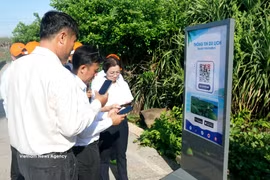
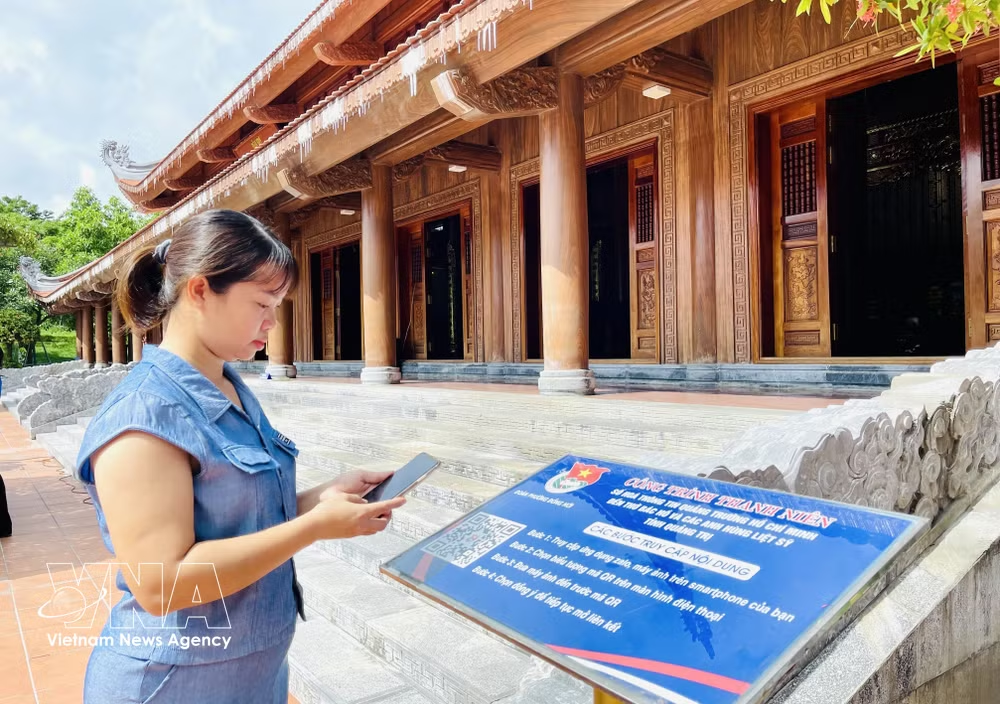
A visitor scans a QR code to access information at the square – memorial temple complex dedicated to President Ho Chi Minh and fallen heroes in Dong Hoi ward, Quang Tri province. (Photo: VNA)

Toward a smart tourism ecosystem

At the national level, Phan Thi Thai Ha, deputy director of the tourism information center under the Vietnam National Authority of Tourism, said several shared digital platforms have already been launched, including a Vietnam tourism database system, a tourism statistics database, the “Vietnam – Travel” tourism application, a tourism management and business platform, electronic ticketing and multimedia tour guide systems.

These platforms are strengthening connections among authorities, businesses, and tourists while creating large datasets to support governance, policymaking, and tourism product development.

According to Ha Van Sieu, Deputy Director General of the Vietnam National Authority of Tourism, smart tourism cannot develop independently but must be integrated with smart city infrastructure and other digital platforms to maximise development resources.

Recently, the Prime Minister approved the 2026–2030 digital economy and digital society development programme, under which the sector will prioritise applying digital technology for efficient management and operation across accommodation, travel services, food services, and destinations; improving visitor experiences; developing a national tourism data platform; and building a tourism workforce with digital management and business skills aligned with domestic and international standards, among many other tasks.

As science, technology, and digital transformation continue to expand, Vietnam’s tourism industry is expected to gain more opportunities for modern, professional, and sustainable development./.

VNA

See more

Delegates at the launch ceremony of the Vietnam National Multi-Project Wafer Coordination Centre (VNMPW/CC) on June 26. (Photo: VNA)

First national semiconductor chip prototyping support centre makes debut

Vietnam's semiconductor ecosystem now comprises around 60 chip design companies, some 7,000 chip design engineers and 166 universities offering semiconductor-related training programmes. Initial registrations from 12 organisations indicate demand for the prototyping of approximately 30,000 chips.

Minister of Science and Technology Vu Hai Quan speaks at the forum (Photo: nhandan.vn)

Vietnam redefines growth through strategic technologies: Forum

Vietnam should stop simply using technology and start truly mastering artificial intelligence (AI), semiconductors, clean energy and advanced materials; swap a resource-driven economy for one fired by innovation, knowledge and talent; and ditch cheap labour as its main calling card in favour of real technological competitiveness that lifts the country into higher-value global supply chains.

A product showcased at the AI Day 2026 (Photo: VNA)

Identifying right competitive advantages key to breaking through in AI era: Expert

Vietnam should develop a “borderless national intellectual network”, enabling Vietnamese professionals living abroad to contribute as visiting professors, strategic advisers, research leaders or co-directors of key laboratories. Such a model would help tap into global expertise without requiring specialists to return home permanently., according to Assoc. Prof., Dr Nguyen Thanh Phuong of the Department of Information Engineering, Computer Science and Mathematics (DISIM) at the University of L’Aquila in Italy.

Robots handle cargo loading and unloading, helping reduce labour intensity and boost productivity (Photo: VNA)

Flexible policies key to unlocking Vietnam’s strategic technology ambitions: expert

According to Assoc. Prof. Dr. Tran Le Hung from Gustave Eiffel University (France), many countries have invested heavily in cutting-edge technologies but have failed to achieve expected results. The main constraints, he said, are often not capital or human resources, but regulatory bottlenecks, policy policies and implementation mechanisms.

Deputy Prime Minister Ho Quoc Dung chairs the meeting in Hanoi on June 23. (Photo: VNA)

Investment should prioritise strategic technologies: Deputy PM

Under the draft project, research infrastructure development will align with Vietnam’s science, technology and innovation strategy, focusing on strategic technologies. The system will follow a unified three-tier model, prioritising the upgrading, integration and shared use of existing facilities, while ensuring operational efficiency, accountability, data security, intellectual property protection and national interests.

A speaker from the Internal Political Security Division under the Can Tho Department of Public Security delivers a cybersecurity awareness session for students at Can Tho University. (Photo: VNA)

Can Tho students gain tools to navigate misinformation in digital era

Recently, the Can Tho campus of the Saigon College of Technology held a seminar on information literacy in the digital age. The programme focused on practical skills such as searching for, filtering and evaluating online information, while also introducing students to regulations on cybersecurity, intellectual property rights, digital citizenship and the responsible use of generative AI.

Vietnamese delegates visit a booth at the Eurosatory 2026. (Photo: VNA)

Vietnamese tech firm showcases innovations at Eurosatory 2026

As the only Vietnamese tech firm exhibiting directly at the event, Gremsy's participation highlights the growing ability of domestic enterprises to integrate into global technology value chains and compete in high-tech international markets.