Vietnam urges stronger connectivity, resilience in ASEAN+3 cooperation

The Vietnamese minister underscored ASEAN+3's role as a strategic platform for deepening regional economic integration, strengthening resilience and helping build a peaceful and prosperous future for the region.

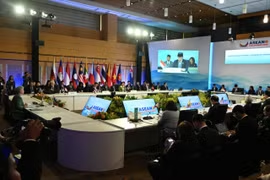
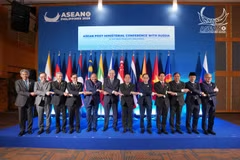
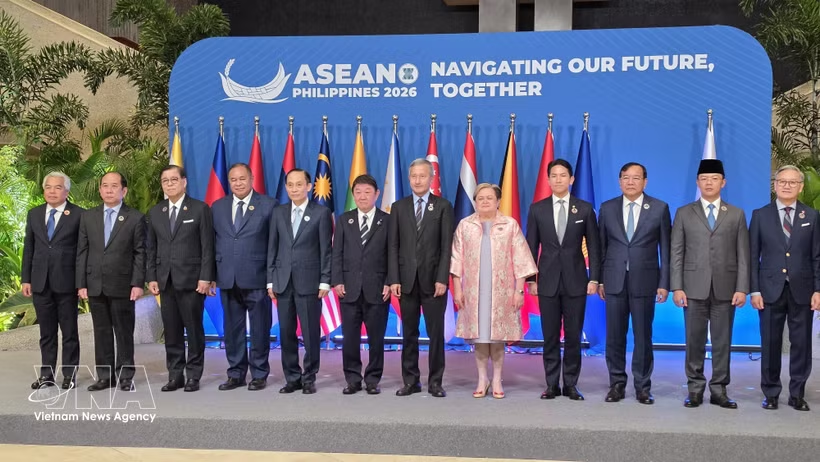
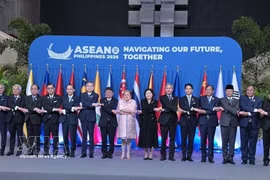
ASEAN+3 foreign ministers pose for a group photo ahead of the meeting. (Photo: VNA)

Manila (VNA) – Building on Vietnam's strong bilateral ties with Northeast Asian partners, Minister of Foreign Affairs Le Hoai Trung reaffirmed the country's commitment to further advancing ASEAN+3 cooperation, contributing to regional peace, stability and development while delivering tangible benefits to people across the region.

Trung made the remarks at the ASEAN+3 Foreign Ministers' Meeting on July 23 in Manila, the Philippines, held on the sidelines of the 59th ASEAN Foreign Ministers' Meeting (AMM-59) and related meetings. The meeting brought together the foreign ministers of ASEAN member states, China, Japan and the Republic of Korea (RoK).

The Vietnamese minister underscored ASEAN+3's role as a strategic platform for deepening regional economic integration, strengthening resilience and helping build a peaceful and prosperous future for the region.

To ensure ASEAN+3 remains responsive to shifts in the regional and global strategic landscape, he called on the countries to continue prioritising deeper economic integration and stronger regional connectivity through the effective implementation of trade agreements. He also proposed expanding cooperation in energy and food security, including exploring the feasibility of a regional energy cooperation arrangement to bolster the region's resilience and preparedness against external shocks.

Trung further urged China, Japan and the RoK to strengthen cooperation with and support for ASEAN in technology, innovation and digital transformation, while effectively implementing leaders' agreements on electric vehicles, clean energy and low-carbon development.
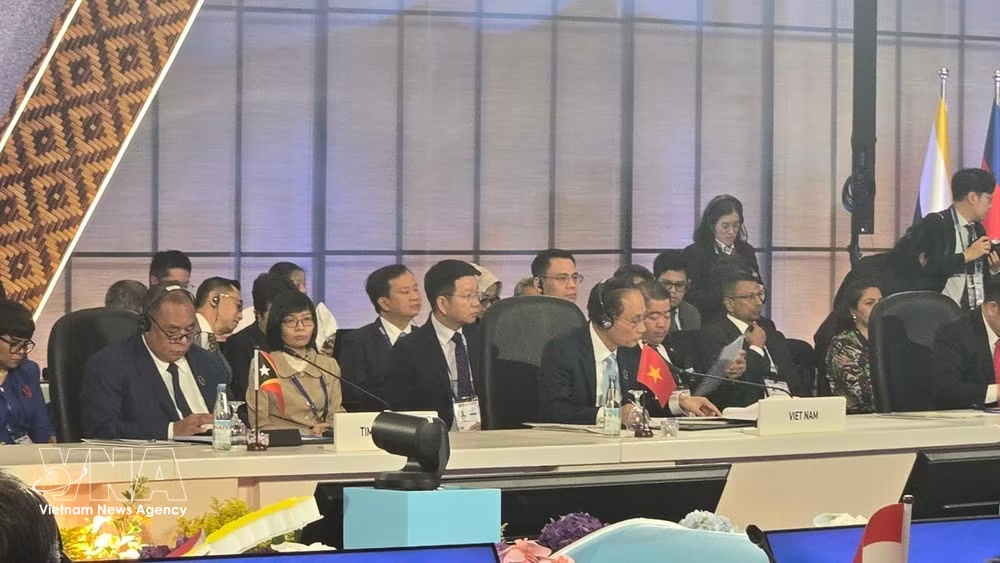
vnanet-potal-amm-59-bo-truong-ngoai-giao-le-hoai-trung-tham-du-hoi-nghi-asean3-8905910.jpg
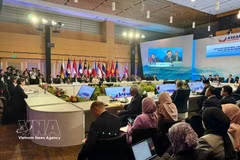
Minister of Foreign Affairs Le Hoai Trung (front, right) at the ASEAN+3 Foreign Ministers' Meeting in Manila, the Philippines, on July 23, 2026. (Photo: VNA)

At the meeting, the ministers noted that after nearly three decades of development, ASEAN+3 has firmly established itself as one of the region's most substantive and effective cooperation mechanisms. Through collaboration in trade, investment, finance, supply chain resilience, energy security and food security, the countries have successfully navigated a wide range of challenges, from financial crises, pandemics and natural disasters to mounting geopolitical and geoeconomic uncertainties.

China, Japan and the RoK reaffirmed their support for ASEAN centrality and pledged continued assistance for implementing the ASEAN Community Vision 2045 and strengthening the bloc's resilience to external challenges.Against the backdrop of increasing global and regional uncertainties, the ministers agreed that ASEAN+3 should further reinforce its role as a key driver of East Asian cooperation by prioritising economic integration and connectivity while enhancing regional resilience and collective capacity to respond to crises and external shocks.

Accordingly, the ministers stressed the need to accelerate implementation of the ASEAN+3 Work Plan 2023–2027, deepen economic and trade relations, strengthen linkages among regional free trade agreements and make better use of existing financial cooperation mechanisms. They also agreed to explore expanding the regional rice reserve to reinforce food security and examine the feasibility of establishing a regional petroleum reserve alongside enhanced cooperation on the green transition and renewable energy to strengthen energy security.

The countries also agreed to step up cooperation in digital transformation, technology and innovation by leveraging the technological strengths of Northeast Asian partners. Investment in education, human resource development, cultural exchanges and tourism will likewise remain a priority./.
VNA

See more

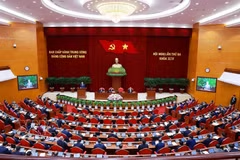
A view of the third plenum of the 14th Party Central Committee on July 23, 2026. (Photo: VNA)

Press release on fourth working day of 14th Party Central Committee's third plenum

The Party Central Committee on July 23 discussed a proposal to transfer responsibility for giving advice on mass mobilisation work from the Party Central Committee's Commission for Information, Education and Mass Mobilisation to the Party Committee of the Vietnam Fatherland Front and central mass organisations, as well as a proposal to rename the Commission for Information, Education and Mass Mobilisation as the Commission for Information and Education.

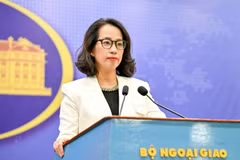
Spokeswoman of the Ministry of Foreign Affairs Pham Thu Hang (Photo: Ministry of Foreign Affairs)

Vietnam calls on parties concerned to fully implement DOC in East Sea

Responding to a reporter's question about recent clashes around Bai Co May (internationally known as Second Thomas Shoal) in the East Sea, Hang said Vietnam urged the parties concerned to act with restraint, respect the sovereign rights and jurisdiction of coastal states over their exclusive economic zones and continental shelves as established in accordance with the 1982 United Nations Convention on the Law of the Sea (UNCLOS), and fully and effectively implement the DOC.

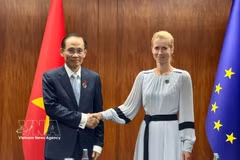
Vietnamese Minister of Foreign Affairs Le Hoai Trung (L) and Vice-President of the European Commission and the EU High Representative for Foreign Affairs and Security Policy Kaja Kallas (Photo: VNA)

AMM-59: Vietnam proposes substantive, sustainable ASEAN-EU ties

Looking ahead, Vietnam proposed the two sides prioritise stronger regional resilience by scaling up energy cooperation, pooling financial resources and cracking down on illegal, unreported and unregulated fishing, all aimed at building a resilient and sustainable blue economy.

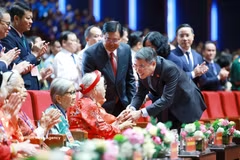
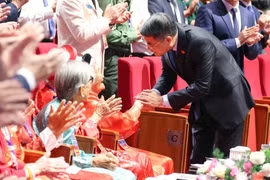
Prime Minister Le Minh Hung greets Heroic Vietnamese Mothers at the national conference honouring revolution contributors ahead of the 79th anniversary of War Invalids and Martyrs’ Day (July 27) in Hanoi on July 23. (Photo: VNA)

Caring for revolution contributors reflects Vietnam’s deep humanitarian value: PM

The PM urged all-level authorities, sectors, localities, and the public to fully implement relevant Party resolutions and directives as well as preferential policies for revolution contributors, push ahead with the 500-day campaign, expand gratitude movements, accelerate housing support for children of Agent Orange/dioxin victims and strengthen patriotic education.

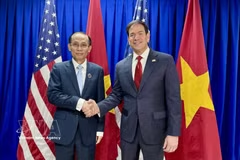
Minister of Foreign Affairs Le Hoai Trung (L) meets with US Secretary of State Marco Rubio in Manila on July 23. (Photo: VNA)

Vietnam, US pledge to deepen Comprehensive Strategic Partnership

At the meeting, Trung welcomed Rubio's participation and active contributions to the ASEAN meetings, saying they reflected the US' commitment to maintaining engagement in the region, supporting ASEAN centrality, and contributing to peace, stability and prosperity in Southeast Asia.

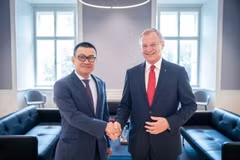
Ambassador Vu Le Thai Hoang meets with Governor of Upper Austria Thomas Stelzer on July 22. (Photo published by VNA)

Vietnam, Austria seek to promote strategic technology cooperation

Highlighting strengths of Linz city and Upper Austria in general in advanced technology, innovation and high-quality human resources training, Vietnamese Ambassaor to Austria Vu Le Thai Hoang proposed stronger links among businesses, research institutes and universities. He identified artificial intelligence (AI), semiconductors, robotics, automation, quantum computing and biotechnology as promising areas for cooperation.

Deputy Minister of Foreign Affairs Dang Hoang Giang (right) and UNRWA Acting Commissioner-General Christian Saunders (Photo published by VNA)

Vietnam reaffirms support for UNRWA, readiness to assist Gaza recovery efforts

During a meeting with the UNRWA official in Manila, the Philippines on July 22, Deputy Foreign Minister Dang Hoang Giang affirmed Vietnam’s consistent support for UNRWA’s role and operations, praising its efforts to maintain humanitarian, educational and healthcare assistance for Palestinians amid the complex situation.

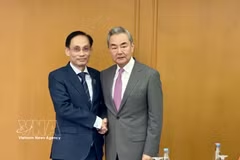
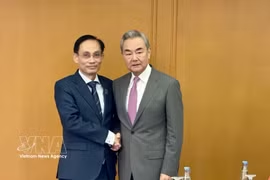
Le Hoai Trung, Politburo member of the Communist Party of Vietnam (CPV) Central Committee, Minister of Foreign Affairs (L), meets with Wang Yi, Politburo member, Director of the Office of the Commission for Foreign Affairs of the Communist Party of China (CPC) Central Committee and Minister of Foreign Affairs of China, in Manila, the Philippines, on July 22. (Photo: VNA)

Vietnam, China step up bilateral cooperation

The two ministers agreed to continue seriously and effectively implementing important common perceptions reached by the top leaders of the two Parties and countries; promote the strategic guiding role of high-level exchanges; and advance the building of the Vietnam-China Community with a shared future that carries strategic significance in an increasingly practical and profound manner in accordance with the “six major orientations”.

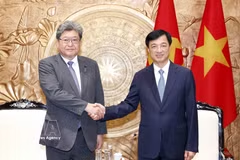
Nguyen Duy Ngoc, Politburo member, Chairman of the Communist Party of Vietnam (CPV) Central Committee's Organisation Commission and Chairman of the Vietnam-Japan Parliamentary Friendship Group (R) hosts a reception in Hanoi on July 22 for Executive Acting Secretary-General of Japan's Liberal Democratic Party (LDP) Hagiuda Koichi and his delegation. (Photo: VNA)

Vietnam, Japan seek to deepen cooperation between ruling parties and legislatures

The two sides expressed satisfaction with the robust development of the Vietnam-Japan Comprehensive Strategic Partnership across all fields, noting that Japanese Prime Minister Takaichi Sanae's official visit to Vietnam in May 2026 had created fresh momentum for strengthening ties between the two parties and the two countries.

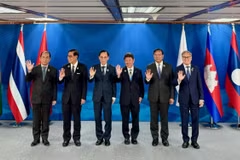
Foreign ministers of the Mekong countries and Japan reaffirm commitment to strengthening partnership through co-creation (Photo: Vietnamese Ministry of Foreign Affairs)

Mekong, Japanese foreign ministers reaffirm commitment to co-creating partnership

Mekong-Japan cooperation, together with ASEAN-led mechanisms, contributes to building a peaceful, stable, resilient and prosperous Asia-Pacific and Indo-Pacific region, they stressed, noting that amid growing uncertainties, emerging cooperation opportunities and challenges, the mechanism should continue to innovate and adapt to better meet the development demands of Mekong countries and Japan.

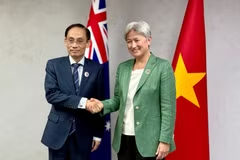
Vietnamese Minister of Foreign Affairs Le Hoai Trung (L) and his Australian counterpart Penny Wong in their meeting in Manila on July 22. (Photo: Courtesy of the Ministry of Foreign Affairs)

Vietnam, Australia agree to deepen cooperation in priority areas

The two ministers reaffirmed their support for ASEAN's common position and underscored the need to maintain peace, security, stability, safety, and freedom of navigation and overflight. They reiterated that disputes should be resolved through peaceful means in accordance with international law, particularly the 1982 United Nations Convention on the Law of the Sea (UNCLOS).

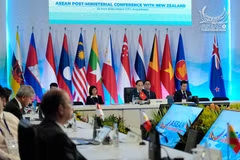
Delegates at the ASEAN Post-Ministerial Conference with Russia on July 22. (Photo: The Courtesy of the Foreign Affairs)

Vietnam calls for deeper, more practical ASEAN-Russia strategic partnership

Addressing the ASEAN-Russia Foreign Ministers' Meeting held on July 22 on the sidelines of the 59th ASEAN Foreign Ministers' Meeting (AMM-59) and related meetings in the Philippines, Trung described the ASEAN-Russia Commemorative Summit marking 35 years of dialogue relations held in Kazan, Russia, in June as an important milestone that reaffirmed the strategic value of ASEAN-Russia relations and injected fresh momentum into bilateral cooperation.

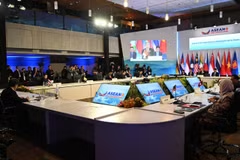
A view of the ASEAN-Japan Foreign Ministers’ Meeting in Manila, the Philippines, on July 22 (Photo: the Vietnamese Ministry of Foreign Affairs)

AMM-59: Vietnam proposes three priorities to advance ASEAN-Japan cooperation

Minister of Foreign Affairs Le Hoai Trung proposed promoting the co-creation of a secure digital economy by leveraging Japan’s strengths in technology and innovation to effectively implement the ASEAN-Japan Artificial Intelligence (AI) Innovation and Co-Creation Roadmap, the FOIP Digital Corridor and the Hanoi Convention against Cybercrime.