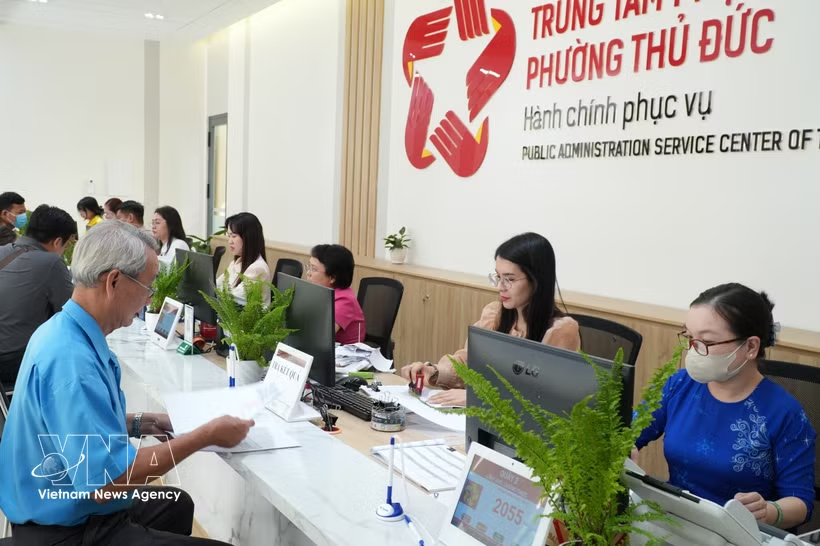
Hanoi (VNA) – Vietnam is facing a need to study the development of a national digital governance platform to unify public administration, strengthen data governance and improve the delivery of public services, as the country accelerates administrative reform and digital transformation.
According to the Ministry of Home Affairs' Department of Administrative Reform, Vietnam eliminated 697 administrative procedures and simplified another 673 in the first six months of 2026. It also abolished 1,754 business registration requirements, cutting processing time by 53% - equivalent to 51,247 out of 96,675 working days - and reducing compliance costs by 54.6% compared with 2024.
Online public service usage also continued to expand, with digital applications accounting for 37.9% of administrative dossiers processed by ministries and central agencies, and 93.57% at the local level.
The Ministry of Public Security reported that the VNeID electronic identification ecosystem is gradually evolving into a unified national digital identity platform, enabling citizens to access services more conveniently while providing businesses with a trusted authentication environment for developing digital services.
In taxation and finance, more than 505,000 businesses have adopted electronic invoices, generating over 7.3 billion e-invoices. State budget revenue from e-commerce reached 114.2 trillion VND (4.35 billion USD), up 9% year-on-year.
In banking, biometric authentication for 161.2 million customer transactions has reduced fraud cases by around 60%, generating estimated annual savings of 652 billion VND. Meanwhile, the verification of 115.8 million mobile phone subscriptions has helped prevent fraud-related losses estimated at 3 trillion VND each year.
Biometric verification has also been introduced at 19 airports, reducing passenger processing times to just three to five seconds and generating annual savings estimated at 126 billion VND.
The Ministry of Home Affairs also announced that it had completed the 2025 Satisfaction Index of Public Administration Services (SIPAS) and the 2025 Public Administration Reform Index (PAR Index).
The nationwide average SIPAS score reached 83.09%, while citizen satisfaction across the country's 34 provinces and cities ranged from 77.92% to 91.12%.
The average PAR Index reached 87.2% for ministries and ministerial-level agencies and 89.96% for provincial administrations - the highest level recorded to date.
Despite the progress, authorities acknowledged that significant challenges remain. Some software systems are still not interoperable or sufficiently stable, while information systems used to process administrative procedures at several ministries have experienced connectivity issues with local platforms, occasionally disrupting service delivery.
Some databases have yet to meet the required standards of being accurate, complete, clean and continuously updated. Delays in restructuring internal procedures and digitising administrative workflows have also slowed efforts to deliver public services regardless of administrative boundaries.
At the grassroots level, officials are often required to work across multiple digital systems and software platforms, reducing operational efficiency and increasing workloads.
Fragmented data management has also heightened cybersecurity risks. When population, digital identity, financial, land, health care, business and judicial data are stored across separate systems using different access controls, the risk of data breaches, identity fraud and abuse of public, banking, insurance and telecommunications services increases.
Authorities therefore argue that data must be managed through a unified, secure and transparent governance framework that enables comprehensive oversight of how information is accessed and used.
Against this backdrop, relevant agencies have been urged to study the development of a national digital governance platform.
Rather than replacing existing systems, the proposed platform will serve as a unified digital operating layer connecting all current government systems. Its greatest value would lie not only in streamlining administrative processes but also in creating a new governance model driven by data, monitored through performance indicators, evaluated on measurable outcomes and supported by real-time risk alerts.
The platform is expected to enable the Government to establish a unified digital management space linking central and local authorities, with every assigned task clearly identifying the responsible agency, implementation deadline, expected outputs, progress updates, delay warnings and accountability.
It will also allow leaders at all levels to monitor policy implementation, administrative services, socio-economic indicators, social welfare, healthcare, education and public security through a single integrated system instead of relying primarily on periodic reports.
For citizens and businesses, data already stored in national and sectoral databases could be authenticated and reused across services, reducing paperwork, saving time and costs, limiting the need for in-person transactions and improving service quality./.
See more
☀️ Morning digest on July 23
The following is a list of selected news summaries reported last night by the Vietnam News Agency.
Vietnam attends ASEAN foreign ministers’ meetings with partners
The Vietnamese delegation proposed making energy security and transition a pillar of ASEAN-Canada relations, and urged Canada to support the implementation of the ASEAN Power Grid and expand cooperation in renewable energy, hydrogen, energy storage and nuclear power for civilian purposes.
Vietnam, China step up bilateral cooperation
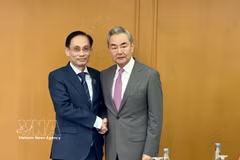
The two ministers agreed to continue seriously and effectively implementing important common perceptions reached by the top leaders of the two Parties and countries; promote the strategic guiding role of high-level exchanges; and advance the building of the Vietnam-China Community with a shared future that carries strategic significance in an increasingly practical and profound manner in accordance with the “six major orientations”.
Vietnam, Japan seek to deepen cooperation between ruling parties and legislatures
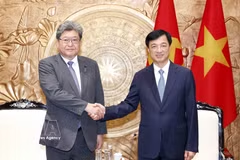
The two sides expressed satisfaction with the robust development of the Vietnam-Japan Comprehensive Strategic Partnership across all fields, noting that Japanese Prime Minister Takaichi Sanae's official visit to Vietnam in May 2026 had created fresh momentum for strengthening ties between the two parties and the two countries.
Mekong, Japanese foreign ministers reaffirm commitment to co-creating partnership
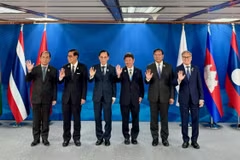
Mekong-Japan cooperation, together with ASEAN-led mechanisms, contributes to building a peaceful, stable, resilient and prosperous Asia-Pacific and Indo-Pacific region, they stressed, noting that amid growing uncertainties, emerging cooperation opportunities and challenges, the mechanism should continue to innovate and adapt to better meet the development demands of Mekong countries and Japan.
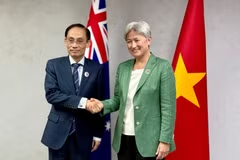
Vietnam, Australia agree to deepen cooperation in priority areas
The two ministers reaffirmed their support for ASEAN's common position and underscored the need to maintain peace, security, stability, safety, and freedom of navigation and overflight. They reiterated that disputes should be resolved through peaceful means in accordance with international law, particularly the 1982 United Nations Convention on the Law of the Sea (UNCLOS).
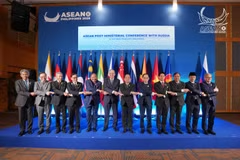
Vietnam calls for deeper, more practical ASEAN-Russia strategic partnership
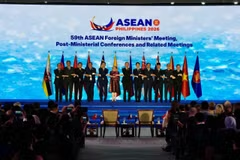
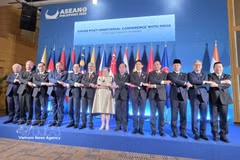
Addressing the ASEAN-Russia Foreign Ministers' Meeting held on July 22 on the sidelines of the 59th ASEAN Foreign Ministers' Meeting (AMM-59) and related meetings in the Philippines, Trung described the ASEAN-Russia Commemorative Summit marking 35 years of dialogue relations held in Kazan, Russia, in June as an important milestone that reaffirmed the strategic value of ASEAN-Russia relations and injected fresh momentum into bilateral cooperation.
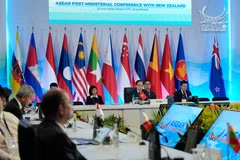
Vietnam co-chairs ASEAN-New Zealand Post-Ministerial Conference
Trung called on the Association of Southeast Asian Nations (ASEAN) and New Zealand to prioritise cooperation in ensuring people's essential needs, and building secure and resilient food and energy supply chains.
AMM-59: Vietnam proposes three priorities to advance ASEAN-Japan cooperation
Minister of Foreign Affairs Le Hoai Trung proposed promoting the co-creation of a secure digital economy by leveraging Japan’s strengths in technology and innovation to effectively implement the ASEAN-Japan Artificial Intelligence (AI) Innovation and Co-Creation Roadmap, the FOIP Digital Corridor and the Hanoi Convention against Cybercrime.
Top leader hails sacrifices, contributions of generations to national development
In a letter on the occasion of the 79th anniversary of War Invalids and Martyrs' Day (July 27, 1947–2026), the top leader said every piece of land in Vietnam is steeped in the sweat, blood, will and enduring aspirations of generations who devoted their youth, personal happiness, health and lives to the independence of the Fatherland, the freedom of the people, the noble ideals of the Party and the enduring future of the nation.
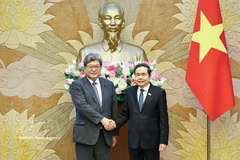
Top legislator receives Executive Acting Secretary General of Japan’s Liberal Democratic Party
NA Chairman Tran Thanh Man reaffirmed that Vietnam consistently regards Japan as one of its most important and long-term strategic partners and supports the leading role of the ruling LDP.
AMM-59: Vietnam proposes three priorities to advance ASEAN–China relations
In his remarks, Minister of Foreign Affairs Le Hoai Trung described ASEAN–China as one of ASEAN’s most dynamic and comprehensive partnerships, stressing the importance of effectively implementing the 2026–2030 Plan of Action to enhance the quality and strategic value of bilateral cooperation.
☕ Afternoon briefing on July 22
The following is a brief review of the day’s events as reported by the Vietnam News Agency.
Party Central Committee discusses marine economy, climate resilience
The 14th Party Central Committee on July 22 considered proposals on building a disciplined, safe, civilised, harmonious and development-oriented society, and developing a national security strategy, as well as discussed the establishment of Quang Ninh and Bac Ninh as centrally-governed cities.
Vietnam promotes ties with Canada, New Zealand at AMM-59
Vietnamese Minister of Foreign Affairs Le Hoai Trung met separately with his Canadian and New Zealand counterparts on the sidelines of the 59th ASEAN Foreign Ministers' Meeting (AMM-59) and related meetings in Manila, the Philippines, on July 22.
Vietnam proposes priorities to advance ASEAN–US relations
Vietnamese Minister of Foreign Affairs Le Hoai Trung proposed that ASEAN and the US promote trade and investment in an open, transparent and mutually beneficial manner, while expanding joint work in the digital economy, artificial intelligence (AI), semiconductors, science and technology, innovation, energy transition and regional energy connectivity.
Vietnam to play increasingly important role in ASEAN Community Vision 2045: Indonesian expert
As an active, proactive and responsible member of ASEAN, Vietnam has already proved it can forge consensus, spur cooperation and maintain balance amid an increasingly complex regional geopolitical landscape, according to an Indonesia-based expert.
Vietnam calls for stronger ASEAN–India maritime cooperation
Minister of Foreign Affairs Le Hoai Trung proposed exploring the establishment of an ASEAN–India maritime dialogue mechanism and asked India to continue supporting ASEAN's principled position on the East Sea issue.
📝 OP-ED: Sustainable national prosperity begins with people, cultural values
A nation's greatest wealth lies not only in economic achievements but also in the character of its people, the strength of its compassion and the vitality of its cultural identity. These enduring human values have sustained Vietnam throughout its long history and will continue to underpin its future development.
Vietnam considers Japan long-term partner
Vietnam and Japan agreed to work closely to realise the agreements reached during Prime Minister Takaichi’s visit to Vietnam in May, including bolstering economic connectivity and economic security, sci-tech collaboration, and pushing concrete joint projects in digital transformation, green transition, innovation, semiconductors, and artificial intelligence.