Vietnam urged to develop sovereign AI in digital era

Data has become a strategic asset and a key resource for socio-economic development, as well as a foundation of national competitiveness. As a result, effective data governance, utilisation and protection have become increasingly urgent for organisations and businesses.

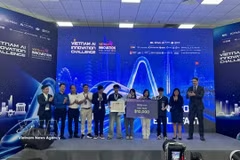
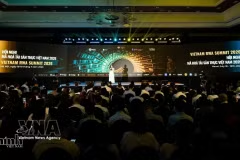
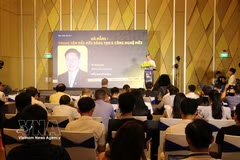
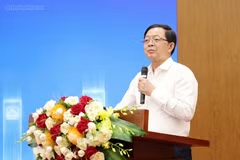
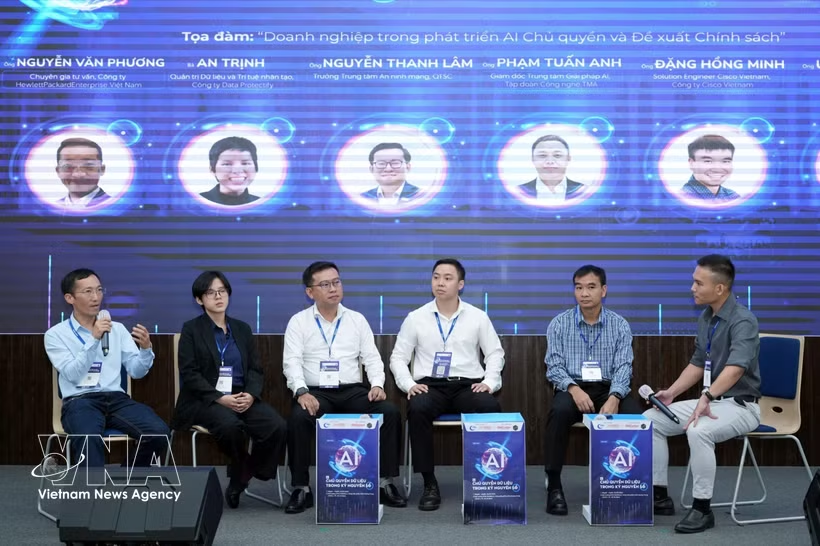
Speakers at the workshop held in Ho Chi Minh City on July 22 (Photo: VNA)

Ho Chi Minh City (VNA) – Artificial intelligence (AI) is no longer a technology of the future but a critical part of today's infrastructure, requiring Vietnam to gain greater control over data, computing infrastructure, technology and human resources to ensure sustainable AI development.

The issue was highlighted at a workshop on "AI and data sovereignty in the digital era", jointly held by the southern office of the Vietnam Internet Association (VIA) and Quang Trung Software City Development Company Limited (QTSC) in Ho Chi Minh City on July 22.

Pham Thi Kim Phuong, Deputy Director of QTSC, said AI can only generate meaningful value when powered by data. Data has become a strategic asset and a key resource for socio-economic development, as well as a foundation of national competitiveness. As a result, effective data governance, utilisation and protection have become increasingly urgent for organisations and businesses.

She noted that the concept of sovereign AI is attracting growing attention worldwide. Sovereign AI goes beyond owning AI technology to encompass the ability to control data, computing infrastructure and technology platforms, while developing human resources and innovation capabilities to serve national and business interests.

For Vietnam, experts said this is a critical period as policies and regulations governing data, information security, personal data protection and AI governance are gradually being strengthened, laying the groundwork for a safe and sustainable digital economy.

Nguyen Van Phuong from Hewlett Packard Enterprise Vietnam warned that sensitive data, including state secrets, financial information and medical records, could be vulnerable to unauthorised access when stored or processed on infrastructure beyond an organisation's control, increasing risks to data sovereignty and information security.

He described sovereign AI as a strategic imperative. While priorities may vary among organisations, common drivers include strengthening economic competitiveness, achieving technological autonomy, safeguarding national security, fostering innovation, and preserving cultural and linguistic identity.

Experts also noted a growing trend among businesses, particularly those handling critical or highly sensitive data, towards deploying AI on their own infrastructure rather than relying entirely on public cloud platforms.

Tran Thanh Lam, head of QTSC's Cybersecurity Centre, said AI sovereignty in cybersecurity does not begin simply with deploying AI, but with organisations' ability to manage its AI attack surface. Organisations should identify and map their AI assets, establish clear policies on AI use and data classification, conduct security exercises, and strengthen training and research on AI security.

Discussions at the workshop also examined the relationship between digital infrastructure, data and sovereign AI as businesses accelerate AI adoption.

Experts emphasised that data infrastructure, graphics processing units (GPUs), high-performance computing and large-scale AI deployment models are fundamental to building autonomous AI capabilities for both businesses and countries./.
VNA

See more

(Illustrative photo; VietnamPlus)

Expert calls for secure national digital archives system

Building a national electronic archives system is not merely a matter of investing in technological infrastructure. It must be designed in an integrated manner from the outset, encompassing system architecture, governance procedures, and data protection mechanisms, to ensure long-term security, integrity, and data sovereignty.

Dr. Vo Duc Thang, Assistant Professor at the National Taiwan University of Science and Technology and President of the Vietnam Innovative and Intellectual Network in Taiwan (China), speaks at a seminar on the semiconductor industry. (Photo: VNA)

Vietnam can deepen role in global semiconductor supply chain: Taiwan-based expert

Vietnam’s biggest takeaway from Taiwan isn’t just cutting-edge technology alone, but how to build an entire semiconductor ecosystem from the ground up, said Dr. Vo Duc Thang, Assistant Professor at the National Taiwan University of Science and Technology (Taiwan Tech) and President of the Vietnam Innovative and Intellectual Network in Taiwan (China) (VIN Taiwan) told the Vietnam News Agency.

The need to develop human resources for the atomic energy and nuclear power sectors is becoming increasingly urgent. (Illustrative photo from the Vietnam Government Portal)

Vietnam needs tens of thousands of nuclear power workers by 2035

According to the Agency for Radiation and Nuclear Safety under the Ministry of Science and Technology, human resources will be among the decisive factors determining whether the country can successfully implement its nuclear power programme on schedule.

Technologies for developing digital government infrastructure and cashless payment solutions are showcased at an exhibition. (Photo: VNA)

Vietnam approves national digital transformation strategy for 2026 - 2030

Vietnam aims to become a developed digital nation where digital transformation is implemented comprehensively across all sectors and serves as the country's principal development model. The strategy envisions a modern system of national governance powered by data and AI, strong domestic capabilities in strategic digital technologies, platforms and products, and firm protection of national digital sovereignty.

Vice Chairman of the Gia Lai provincial People’s Committee Lam Hai Giang speaks at the event. (Photo: VNA)

Int’l scientists gather at 2nd advanced school on topological quantum matters in Gia Lai

Jointly organised by the Rencontres du Vietnam (Meeting Vietnam) association and the International Centre for Interdisciplinary Science and Education (ICISE), the five-day event features lectures by leading professors and scientists in quantum physics and materials science, providing participants with a solid theoretical foundation. They are also updated on the latest research advances in quantum topological materials.

The survey found that mobile phones, particularly smartphones, have become an essential part of daily life in Vietnam. (Photo: VietnamPlus)

More than 80% of Vietnam's population uses smartphones

The 2025 household living standards survey showed that 87.3% of the population used mobile phones, up 2.5 percentage points from 84.8% in 2024. Of those, 80.3% used smartphones, while the proportion of people using feature phones fell to 8.5%.

An overview of the inaugural Vietnam RWA Summit 2026 in Hanoi on July 18 (Photo: VNA)

Vietnam seeks safe, regulated development of tokenised asset market

The two-day event, organised by the Vietnam Blockchain Association in partnership with the National Cybersecurity Association and the Vietnam National Real Estate Association, aims to foster policy dialogue, attract investment and position Vietnam as a regional hub for real-world asset (RWA) tokenisation during 2026-2030.

Scientists conduct experiments in the cleaning room at the Institute of Materials Science under the Vietnam Academy of Science and Technology. (Photo: VNA)

Vietnam pushes stronger basic research to drive innovation, self-reliance

Prof. Dr. Nguyen Van Minh, former rector of the Hanoi National University of Education, said basic research not only generates new knowledge but also fosters innovation and improves the quality of economic growth. Vietnam's growing research capacity has enhanced its regional and international standing while contributing to sustainable development, strategic autonomy, national defence and governance.

Deputy Prime Minister Ho Quoc Dung speaks at the forum on building a cooperation ecosystem for AI development in Hanoi on July 17, 2026. (Photo: chinhphu.vn)

Deputy PM outlines five strategic pillars for AI development

Deputy PM Ho Quoc Dung said the current priority is to change the mindset. AI should not be developed in isolation by individual agencies or organisations but through an interconnected ecosystem linking the State, universities and research institutes, and businesses.

A site for constructing Ninh Thuan 2 Nuclear Power Plant in Thai An village, Vinh Hai commune, Khanh Hoa province. (Photo: VNA)

Vietnam, IAEA expand cooperation in peaceful nuclear applications

Vietnam is implementing 19 cooperation projects with the IAEA in different areas, including agriculture, healthcare, nuclear safety and security, and physical and chemical sciences. The initiatives demonstrate how nuclear technologies can contribute to socio-economic development.

At the BCEC headquarters (Photo: VNA)

Vietnam, RoK deepen startup ecosystem connectivity

Both sides agreed that Vietnam-RoK startup cooperation must pivot from fact-finding tours, trade shows and short-term networking towards a hard-nosed partnership model that delivers concrete market access, business partner matchmaking, product validation, technology piloting and investor connectivity.

Chairman of the National Assembly Tran Thanh Man presents VinFuture awards 2025 to scientists. (Photo: VNA)

VinFuture's global science network delivers lasting value for Vietnam

Via conferences, expert dialogues, networking and inspirational talks, VinFuture has brought many of the world's leading scientists to Vietnam not just to share knowledge, but to co-design research, advise on talent pipelines, and build practical solutions for the country’s most urgent problems.

Plant breeding research at Tra Vinh University (Photo: VNA)

PM orders faster implementation of science, technology, digital transformation agenda

Under Directive No. 29/CT-TTg, the Prime Minister instructed ministers, heads of ministerial-level agencies and provincial and municipal leaders to treat science, technology, innovation and digital transformation as a top political priority, stressing that faster disbursement must go hand in hand with efficiency, transparency and the prevention of waste and corruption.