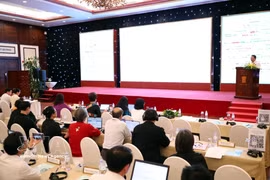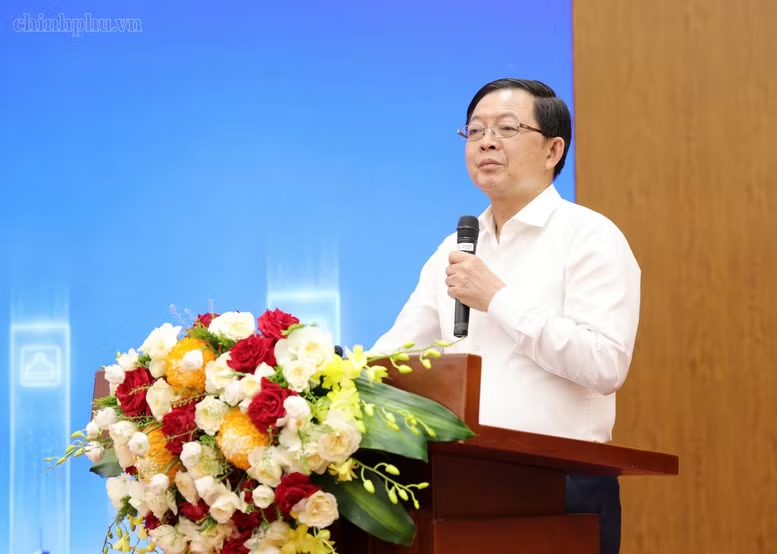
Hanoi (VNA) – Deputy Prime Minister Ho Quoc Dung has called for focus on five strategic pillars to advance artificial intelligence (AI) in the new development phase while attending a forum on building a cooperation ecosystem for AI development in Hanoi on July 17.
Speaking at the event, jointly organised by the Vietnam Institute for Green and Digital Transformation Development (IGD) and several universities and academies, Dung stressed that the Politburo’s Resolution No. 57-NQ/TW identifies science, technology, innovation, and digital transformation as key drivers of breakthrough socio-economic development.
According to the Deputy PM, the current priority is to change the mindset. AI should not be developed in isolation by individual agencies or organisations but through an interconnected ecosystem linking the State, universities and research institutes, and businesses.
In this ecosystem, the State plays a facilitating role by establishing institutional frameworks, setting strategic directions, and developing infrastructure; universities and research institutes serve as the core for training human resources, conducting research, and mastering core technologies; while businesses play the central role in investment, commissioning, resolving real-world problems, and commercialising AI products.
To accelerate AI development in the new phase, Dung outlined five strategic pillars. One of them is improving AI governance and regulatory mechanisms, creating a transparent legal framework that supports AI research, testing, and deployment while ensuring AI is developed safely, responsibly, and with people at its centre. It is also necessary to develop secure and reliable digital infrastructure and data platforms, and to accelerate the establishment of national data centres, building shared data platforms, and ensuring cybersecurity and national data sovereignty.
The Deputy PM also called for developing a high-quality AI workforce, with an emphasis not only on AI users but also on experts capable of mastering core technologies and developing Vietnamese AI models.
He underscored the importance of efficiently operating the innovation ecosystem based on close cooperation among the State, academia, and businesses, supported by clear coordination mechanisms and division of responsibilities. In addition, there is a need to expand international cooperation, proactively access new knowledge, attract top experts, and strengthen partnerships with leading technology companies.
The Deputy PM demanded that initiatives and recommendations put forward at the forum be swiftly translated into concrete policies, programmes, and projects to help promote Vietnam’s digital transformation and AI development.
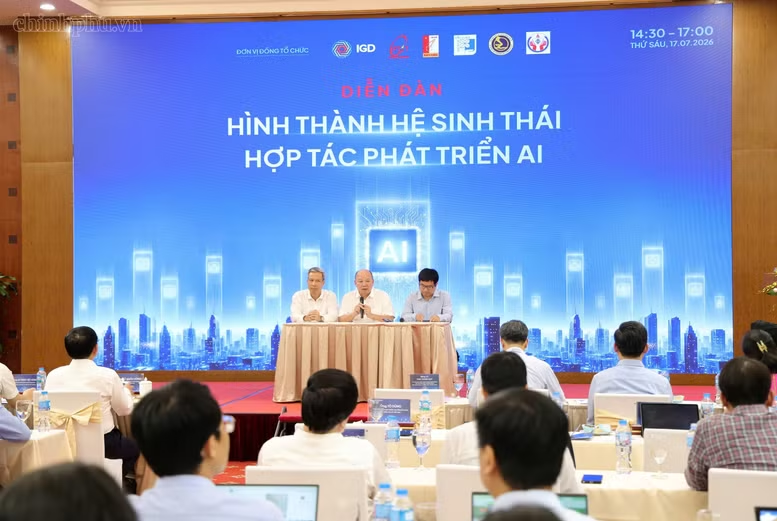
Addressing the forum, Assoc. Prof. Dr. Dang Hoai Bac, President of the Posts and Telecommunications Institute of Technology (PTIT), noted that in the current context, universities must go beyond their traditional role of education to become centres of interdisciplinary research, innovation, and technology transfer, thereby contributing to the development of national AI capabilities and strengthening the country's AI talent landscape at both the regional and global levels.
Bac also stressed that building such capabilities requires close collaboration among universities, research institutes, businesses, and other organisations to establish a comprehensive and well-coordinated AI development ecosystem.
To Dung, Chairman of IGD, said businesses, research institutes, and universities should strengthen cooperation in key tasks to help fine-tune institutional frameworks and select advanced national digital transformation strategies and models to enhance competitiveness amid rapid AI development, and build appropriate standards.
Participants also discussed strategies and platforms for AI and national digital transformation, solutions for developing the digital economy and digital society, and measures to train AI professionals capable of meeting the country's future development needs./.